2003 AIME II problem 4 (part 1) | Math for fun and glory | Khan Academy
TL;DR
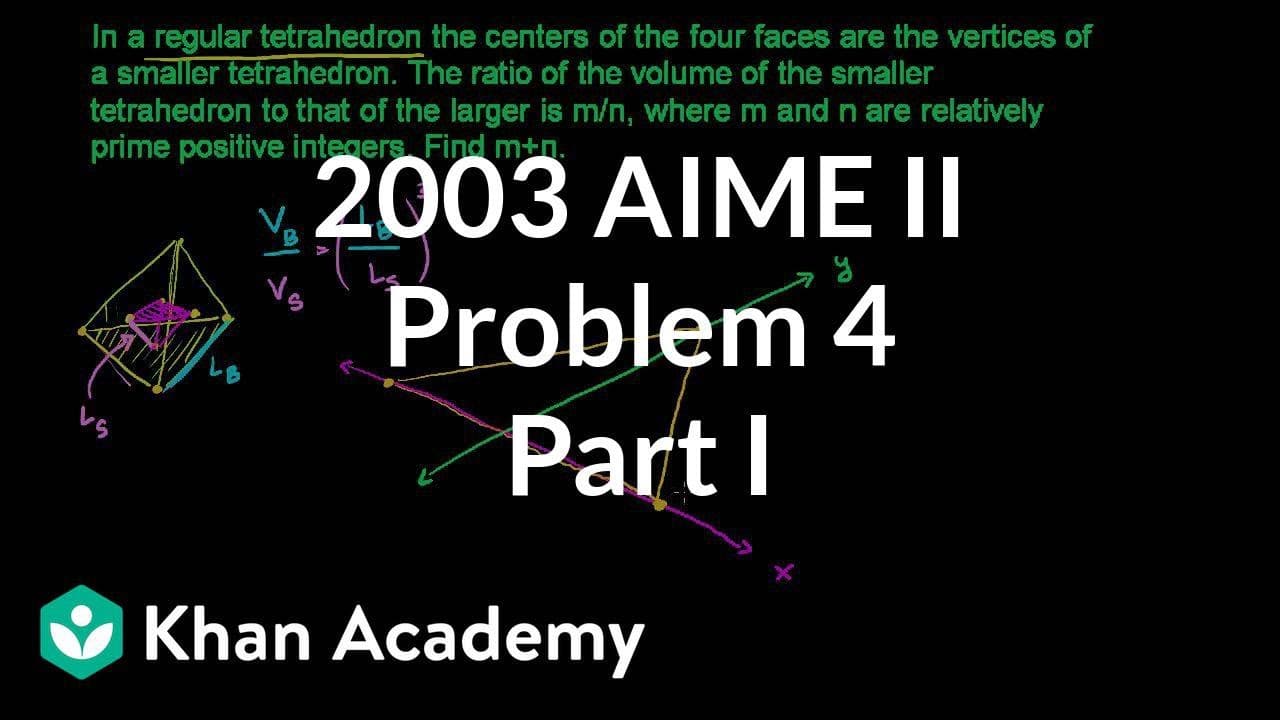
The video explains how to find the volume of a smaller tetrahedron within a larger regular tetrahedron, based on the centers of the faces.
Transcript
In a regular tetrahedron-- and that's just a four-sided polyhedron, and its regular, so all of the sides and all of the faces will be the same-- the centers of the four faces are the vertices of a smaller tetrahedron. The ratio of the volume of the smaller tetrahedron to that of the larger is m over n, where m and n are relatively prime positive in... Read More
Key Insights
- 🙃 A regular tetrahedron has four equal sides and faces, represented by equilateral triangles.
- 😀 The centers of the faces of a regular tetrahedron can form a smaller tetrahedron.
- 🛩️ The volume of the smaller tetrahedron can be found using the ratio of the sides of the larger and smaller tetrahedrons.
Install to Summarize YouTube Videos and Get Transcripts
Explore YouTube Video Summarizer or Get YouTube Transcript Extractor
Questions & Answers
Q: How can the volume of a smaller tetrahedron be determined based on the centers of the faces of a regular tetrahedron?
By connecting the centers of the faces, a smaller tetrahedron is formed. The ratio of one side of the larger tetrahedron to the corresponding side of the smaller tetrahedron can be used to calculate the volume using the cube of this ratio.
Q: How are the coordinates of the centers of the faces of the regular tetrahedron determined?
The coordinates of the centers are found by averaging the coordinates of the vertices of the base of the regular tetrahedron and the top point, which can be determined using the Pythagorean theorem.
Q: Are all the sides and dimensions of the larger and smaller tetrahedron in the same ratio?
Yes, since the regular tetrahedron is a symmetric shape, all its sides and dimensions have the same ratio, allowing for the determination of the volume using the ratio of one side.
Q: How does the cubic ratio of the sides of the tetrahedrons determine the ratio of their volumes?
When the cubes of the ratios of corresponding sides are taken, the resulting value represents the ratio of the volumes of the larger tetrahedron to the smaller tetrahedron.
Summary & Key Takeaways
-
A regular tetrahedron is a four-sided polyhedron with equal sides and faces.
-
The centers of the four faces of a regular tetrahedron form the vertices of a smaller tetrahedron.
-
The volume of the smaller tetrahedron can be found by cubing the ratio of one of the sides of the larger tetrahedron to the corresponding side of the smaller tetrahedron.
Read in Other Languages (beta)
Share This Summary 📚
Summarize YouTube Videos and Get Video Transcripts with 1-Click
Try YouTube Summary with ChatGPT & Claude or YouTube Transcript Generator
Explore More Summaries from Khan Academy 📚



Summarize YouTube Videos and Get Video Transcripts with 1-Click
Try YouTube Summary with ChatGPT & Claude or YouTube Transcript Generator