Products
Features
YouTube Video Summarizer
Summarize YouTube videos
Web & PDF Highlighter
Highlight web pages & PDFs
Chat with PDF
Ask any PDF questions with AI
Ask AI Clone
Chat with your highlights & memories
Audio Transcriber
Transcribe audio files to text
Glasp Reader
Read and highlight articles
Kindle Highlight Export
Export your Kindle highlights
Idea Hatch
Hatch ideas from your highlights
Integrations
Obsidian Plugin
Notion Integration
Pocket Integration
Instapaper Integration
Medium Integration
Readwise Integration
Snipd Integration
Hypothesis Integration
Apps & Extensions
Chrome Extension
Safari Extension
Edge Add-ons
Firefox Add-ons
iOS App
Android App
Discover
Discover
Ideas
Discover new ideas and insights
Articles
Curated articles and insights
Books
Book recommendations by great minds
Posts
Essays and notes from readers
Quotes
Inspiring quotes collection
Videos
Curated videos and summaries
Explore Glasp
Glasp Newsletter
Weekly insights and updates
Glasp Talk
Interview series with great minds
Glasp Blog
Latest news and articles
Glasp Use Cases
Learn how others use Glasp
Build & Support
Glasp API
Access Glasp's API for developers
MCP Connector
Connect Glasp to Claude & ChatGPT
Community
Glasp Reddit Community
Students
Student discount and benefits
FAQs
Frequently Asked Questions
AboutPricing
DashboardLog inSign up

Confidence interval for a mean with paired data | AP Statistics | Khan Academy
December 20, 2017
by
Khan Academy
YouTube video player
Confidence interval for a mean with paired data | AP Statistics | Khan Academy

TL;DR

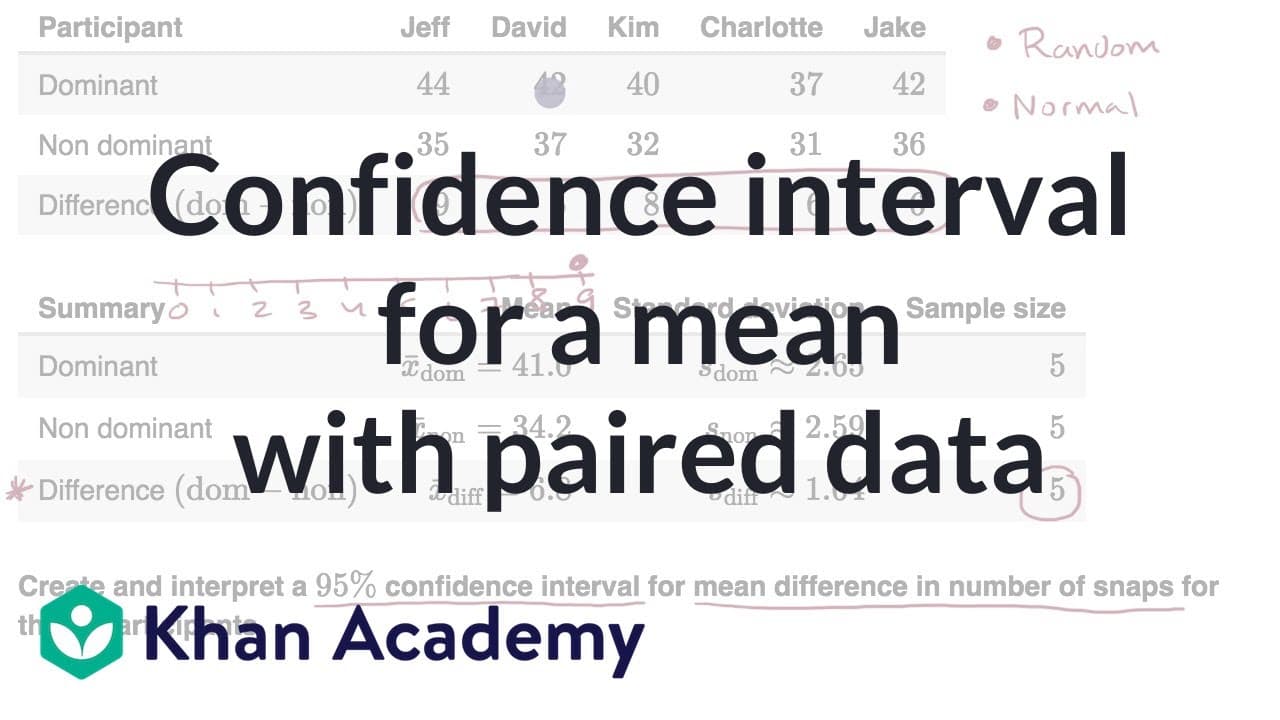
Participants snapped their fingers with their dominant and non-dominant hand, and the mean difference in snaps was found to be 6.8.

Transcript

  • [Instructor] A group of friends wondered how much faster they could snap their fingers on one hand versus the other hand. Very important question in life. Each person snapped their fingers with their dominant hand for 10 seconds and their non-dominant hand for 10 seconds. Where, if you're right-handed, right hand would be your dominant hand. If y... Read More

Key Insights

  • 🖐️ Hand dominance plays a significant role in snapping speed, with the dominant hand generally performing better.
  • 🛩️ The experiment used a small sample size, limiting the generalizability of the results to the broader population.
  • 👷 The data exhibited a roughly normal distribution, satisfying the normality assumption required for constructing the confidence interval.
  • #️⃣ The confidence interval indicates that there is a significant difference in the mean number of snaps, as zero is not captured within the interval.

Install to Summarize YouTube Videos and Get Transcripts

Explore YouTube Video Summarizer or Get YouTube Transcript Extractor

Questions & Answers

Q: How did the participants decide which hand to use first?

The participants flipped a coin to determine which hand they would use first in order to eliminate any bias or fatigue effects.

Q: What were the summary statistics calculated for the data?

The summary statistics included the mean difference in snaps (6.8) and the standard deviation of the differences (approximately 1.64).

Q: Why was a matched pairs design used in this experiment?

A matched pairs design was used because each participant performed the task with both hands, allowing for a direct comparison of the dominant and non-dominant hand.

Q: What were the results of the experiment?

The participants were able to snap more with their dominant hand compared to their non-dominant hand, with a mean difference of 6.8 snaps.

Summary & Key Takeaways

  • A group of friends conducted an experiment to compare snapping speed between their dominant and non-dominant hand.

  • Each participant snapped their fingers for 10 seconds with both hands, and the number of snaps was recorded.

  • The mean difference in snaps between the dominant and non-dominant hand was found to be 6.8.


Read in Other Languages (beta)

English

Share This Summary 📚

Summarize YouTube Videos and Get Video Transcripts with 1-Click

Download browser extensions on:

Try YouTube Summary with ChatGPT & Claude or YouTube Transcript Generator

Explore More Summaries from Khan Academy 📚

Interview with Karina Murtagh thumbnail
Interview with Karina Murtagh
Khan Academy
Breakthrough Junior Challenge Winner Reveal! Homeroom with Sal - Thursday, December 3 thumbnail
Breakthrough Junior Challenge Winner Reveal! Homeroom with Sal - Thursday, December 3
Khan Academy
Classical Japan during the Heian Period | World History | Khan Academy thumbnail
Classical Japan during the Heian Period | World History | Khan Academy
Khan Academy

Summarize YouTube Videos and Get Video Transcripts with 1-Click

Download browser extensions on:

Try YouTube Summary with ChatGPT & Claude or YouTube Transcript Generator

Apps & Extensions

  • Chrome Extension
  • Safari Extension
  • Edge Add-ons
  • Firefox Add-ons
  • iOS App
  • Android App

Key Features

  • YouTube Video Summarizer
  • Web & PDF Summarizer
  • Web & PDF Highlighter
  • Chat with PDF
  • Ask AI Clone
  • Audio Transcriber
  • Glasp Reader
  • Kindle Highlight Export
  • Idea Hatch

Integrations

  • Obsidian Plugin
  • Notion Integration
  • Pocket Integration
  • Instapaper Integration
  • Medium Integration
  • Readwise Integration
  • Snipd Integration
  • Hypothesis Integration

More Features

  • APIs
  • MCP Connector
  • Blog & Post
  • Embed Links
  • Image Highlight
  • Personality Test
  • Quote Shots

Company

  • About us
  • Blog
  • Community
  • FAQs
  • Job Board
  • Newsletter
  • Pricing
Terms

•

Privacy

•

Guidelines

© 2026 Glasp Inc. All rights reserved.

