Limit examples (part 3) | Limits | Differential Calculus | Khan Academy
TL;DR
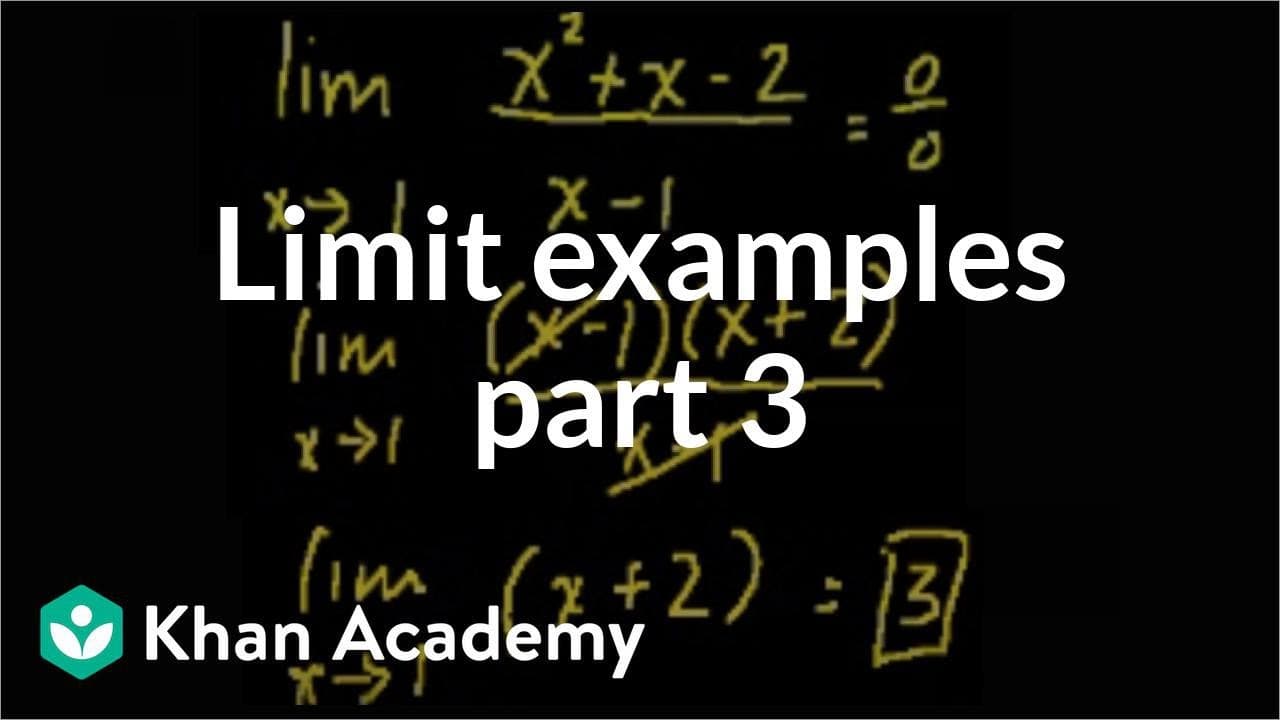
The video explains how to evaluate limits of rational expressions by simplifying them, using examples such as x squared minus 6x plus 9 over x squared minus 9 and x squared plus x minus 2 over x minus 1, and also discusses limits as x approaches infinity.
Transcript
Let's do some more limit examples. So let's get another problem. If I had the limit as x approaches 3 of, let's say, x squared minus 6x plus 9 over x squared minus 9. So the first thing I like to do whenever I see any of these limits problems is just substitute the number in and see if I get something that makes sense, and then we'd be done. Well, ... Read More
Key Insights
- 😑 Substituting the value into the expression is the first step in evaluating limits.
- 😑 Factoring can simplify rational expressions and help find the limit.
- 😑 Cross out terms that would not be zero if x is not equal to the approached value to simplify the expression.
- ☺️ Limits as x approaches infinity can be determined by comparing the growth rates of the fastest-growing terms in the numerator and denominator.
- 📈 Graphing these functions can visually confirm the results of evaluating limits.
- ⏫ Mistakes can occur during mental calculations, so double-checking is important.
- 🌥️ A calculator can provide helpful insights by plugging in extremely large values of x.
Install to Summarize YouTube Videos and Get Transcripts
Explore YouTube Video Summarizer or Get YouTube Transcript Extractor
Questions & Answers
Q: What is the first step when evaluating limits of rational expressions?
The first step is to substitute the given value into the expression and see if it yields a sensible result. If not, further simplification is required.
Q: How can factoring be helpful in simplifying rational expressions?
Factoring can help simplify expressions by identifying and canceling out common factors between the numerator and denominator, making it possible to evaluate the limit.
Q: Why is it necessary to cross out certain terms when evaluating limits?
Cross out terms that would not be zero if x is not equal to the value being approached. This allows us to simplify the expression and find the limit without division by zero.
Q: How can limits as x approaches infinity be determined?
By comparing the growth rates of the fastest-growing terms in the numerator and denominator, it can be determined if the expression approaches zero or a specific value.
Summary & Key Takeaways
-
To evaluate limits of rational expressions, substitute the given value into the expression and simplify if possible.
-
If the expression yields zero in both the numerator and denominator, try factoring the expression to simplify it.
-
When evaluating limits where x approaches a certain value, cross out terms that would be zero if x is not equal to that value, and find the limit of the simplified expression.
-
Limits as x approaches infinity can be determined by comparing the growth rates of the fastest-growing terms in the numerator and denominator.
Read in Other Languages (beta)
Share This Summary 📚
Summarize YouTube Videos and Get Video Transcripts with 1-Click
Try YouTube Summary with ChatGPT & Claude or YouTube Transcript Generator
Explore More Summaries from Khan Academy 📚



Summarize YouTube Videos and Get Video Transcripts with 1-Click
Try YouTube Summary with ChatGPT & Claude or YouTube Transcript Generator