Duty Delta and Base Period
TL;DR
This content discusses the calculation of water requirements for crop irrigation, including terms like duty, flow duty, storage duty, delta, and base period.
Transcript
now let's discuss about the actual amount of of water which is required or which has to be supplied to the the depth of water which has to be maintained on the fringe required for the crop for its nourishment and the period in between this period we are doing the water before the sewing up to the harvesting so this is done as a base period so gener... Read More
Key Insights
- 🤒 Duty is a crucial factor in determining the amount of water required for crop irrigation, and it is measured in hectares per cubic meter (hectares/cumec).
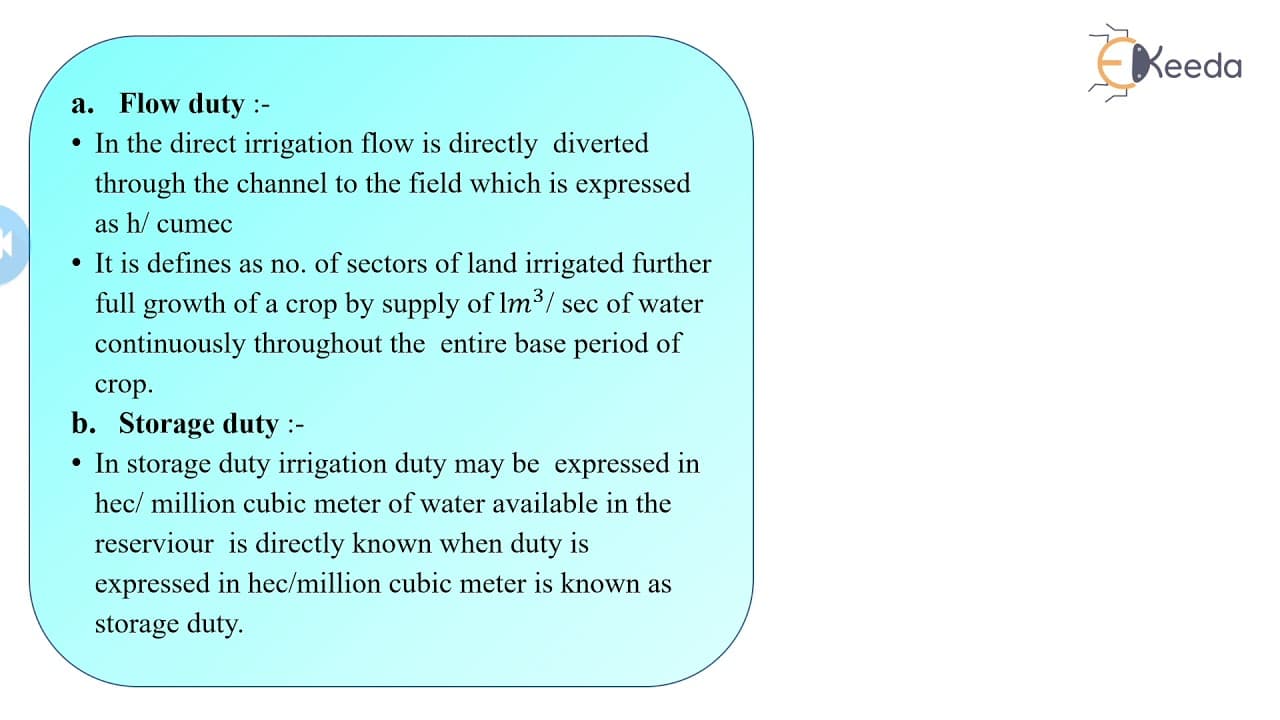
- 💦 Flow duty is used when water can be directly diverted to fields, while storage duty is used when water needs to be stored in reservoirs.
- 💦 The duty of water can be calculated based on the area of land irrigated, the total depth of water required for the crop, and the volume of water supplied or stored.
- 💦 Delta represents the total depth of water required for the crop during the base period, which is determined by the number and interval of waterings.
Install to Summarize YouTube Videos and Get Transcripts
Explore YouTube Video Summarizer or Get YouTube Transcript Extractor
Questions & Answers
Q: What is duty in the context of crop irrigation?
Duty refers to the relationship between the volume of water and the area of land irrigated for a full growth of the crop. It is measured in hectares per cubic meter (hectares/cumec) and can be calculated based on various factors.
Q: What is flow duty?
Flow duty is a type of duty where water is directly diverted through channels to the fields. It involves irrigating a certain number of hectares of land with a continuous supply of water, usually expressed as hectares per cubic meter (hectares/cumec).
Q: What is storage duty?
Storage duty, also known as quantity duty, is a type of duty that involves storing water in reservoirs during non-monsoon periods and discharging it for irrigation when needed. It is expressed as hectares per million cubic meters of stored water.
Q: How is delta calculated?
Delta represents the total depth of water required for the crop during the base period. It can be calculated by multiplying the average depth of water required for each watering by the total number of waterings during the base period.
Summary & Key Takeaways
-
The content explains the concept of duty, which is the relationship between the volume of water and the area of land irrigated for a full growth of the crop.
-
There are two types of duty: flow duty, which is the irrigation of a certain number of hectares with a continuous water supply, and storage duty, which involves storing and discharging water from reservoirs.
-
The duty of water can be calculated based on the number of hectares that one cubic meter of water can irrigate, the total depth of water required for the crop, the number of hectares that can be irrigated by a million cubic meters of stored water, and the amount of water expended per irrigated hectare.
Read in Other Languages (beta)
Share This Summary 📚
Summarize YouTube Videos and Get Video Transcripts with 1-Click
Try YouTube Summary with ChatGPT & Claude or YouTube Transcript Generator
Explore More Summaries from Ekeeda 📚





Summarize YouTube Videos and Get Video Transcripts with 1-Click
Try YouTube Summary with ChatGPT & Claude or YouTube Transcript Generator