GNN Short Course Chapter 9 - Relative Perturbations
TL;DR
Graph neural networks are stable to relative perturbations.
Transcript
graph convolutions are a permutation equivalent unstable to absolute perturbation but absolute perturbations are pointless since they can arbitrarily alter the topology of the graph with no change in the absolute distance measure whatsoever in this segment we will introduce the relative perturbation model that ties the changes to the underlying gra... Read More
Key Insights
- Graph convolutions are permutation equivalent but unstable to absolute perturbations, which can arbitrarily alter graph topology.
- Relative perturbation model ties changes to the graph support, making it more practical for measuring graph changes.
- The relative perturbation distance is defined using the smallest operator norm of error matrices, linking perturbation size to topology.
- Analysis in the frequency domain helps quantify the effect of shift operators on graph filter outputs.
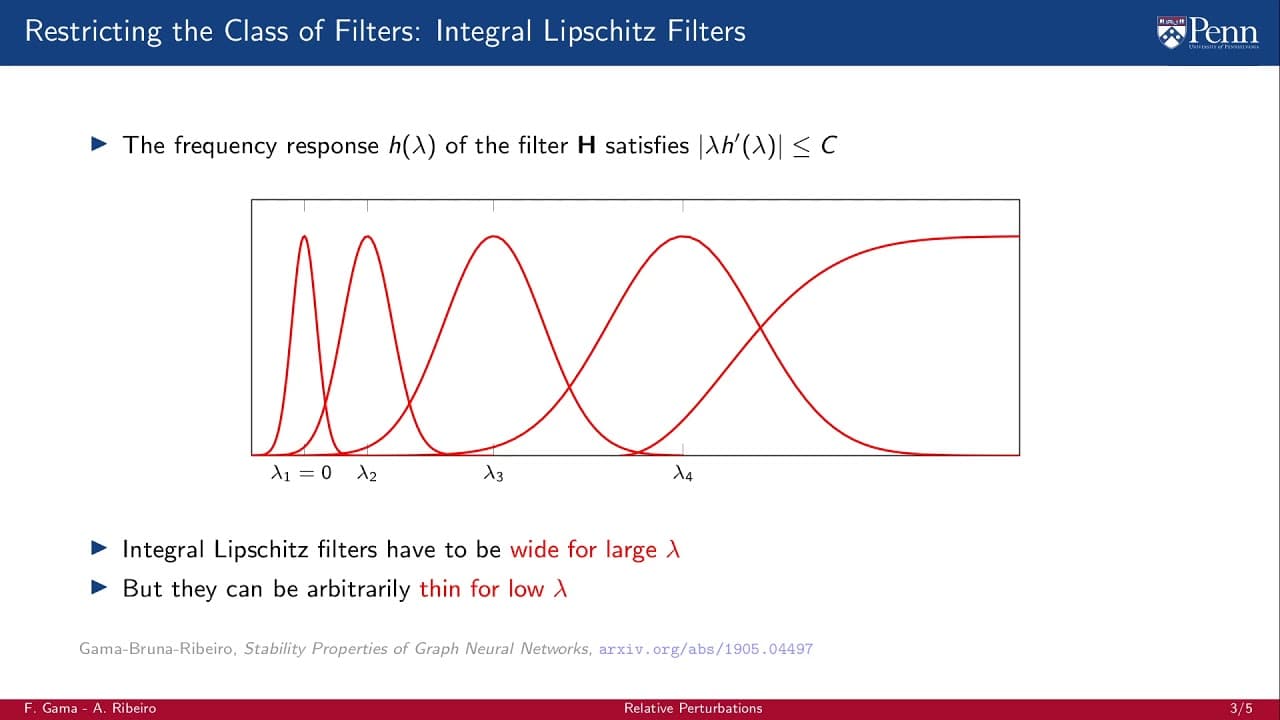
- Integral Lipschitz filters are crucial as they are stable to relative perturbations, with frequency response bounded by a constant.
- Graph convolutions are proven stable to relative perturbations, with output differences bounded by shift operator distances.
- The theorem states that graph neural networks are stable to relative perturbations, with output differences linearly bounded.
- The stability bound depends on the filter, GNN architecture, and eigenvector misalignment, applying universally to graphs with the same node count.
Install to Summarize YouTube Videos and Get Transcripts
Explore YouTube Video Summarizer or Get YouTube Transcript Extractor
Questions & Answers
Q: What is the significance of relative perturbations in graph neural networks?
Relative perturbations are significant in graph neural networks as they provide a more practical approach to measuring changes in graph structure compared to absolute perturbations. By tying changes to the graph support, relative perturbations ensure that alterations in graph topology are meaningful and measurable, allowing for a stable analysis of graph convolutions and neural networks.
Q: How is the relative perturbation distance defined?
The relative perturbation distance is defined using the smallest operator norm of error matrices within the relative error matrix set. This set comprises matrices that, when multiplied with the shift operator and added back to the original operator, yield a permutation of another shift operator. This definition ties the perturbation size to the graph topology, ensuring meaningful measurements.
Q: Why are integral Lipschitz filters important in this context?
Integral Lipschitz filters are important because they are stable to relative perturbations. These filters have a frequency response that is bounded by a constant, which ensures that their output remains stable even when the underlying graph structure changes. This stability is crucial for maintaining the integrity of graph neural networks under varying conditions.
Q: What does the theorem about graph convolutions state?
The theorem about graph convolutions states that they are stable to relative perturbations. Specifically, given two graphs with shift operators and relative distances within a certain threshold, the difference in the output of integral Lipschitz filters on these graphs is linearly bounded by the distance between the shift operators. This highlights the robustness of graph convolutions under relative perturbations.
Q: How does the stability of graph neural networks to relative perturbations manifest?
The stability of graph neural networks to relative perturbations manifests in the bounded difference in outputs when the networks are applied to different graphs with similar shift operators. This difference is linearly related to the relative distances between the operators. The stability ensures that the networks perform consistently despite changes in graph structure, making them reliable for various applications.
Q: What factors influence the stability bound in graph neural networks?
The stability bound in graph neural networks is influenced by several factors, including the integral Lipschitz constant of the filters, the architecture of the neural network (such as the number of layers and features per layer), and the eigenvector misalignment constant. These factors collectively determine how robust the network is to changes in graph topology.
Q: Why is the eigenvector misalignment constant important?
The eigenvector misalignment constant is important because it quantifies the difference in eigenvectors between the shift operators and the relative perturbation matrix. This constant affects the stability bound of graph neural networks, as it determines how sensitive the network is to changes in the graph structure. A lower misalignment indicates greater stability and robustness.
Q: What is the universal applicability of the stability bound?
The stability bound's universal applicability means that it holds true for all graphs with the same number of nodes, regardless of the specific graph structure. This universality ensures that the results of the analysis are broadly applicable and can be used to predict the behavior of graph neural networks across different graph configurations, providing a reliable measure of stability.
Summary & Key Takeaways
-
Graph convolutions are permutation equivalent but unstable to absolute perturbations, which can alter graph topology. This segment introduces the relative perturbation model, linking changes to graph support. It proves that both graph convolutions and neural networks remain stable under relative perturbations, using distance measures between graph filters modulo permutations.
-
The relative perturbation distance is defined through the smallest operator norm of error matrices. This ties the perturbation size to topology via matrix multiplication. Analyzing in the frequency domain, the effect of shift operators on graph filter outputs is quantified, emphasizing the importance of integral Lipschitz filters for stability.
-
Integral Lipschitz filters, with frequency response bounded by a constant, are stable to relative perturbations. The theorem asserts that graph neural networks are stable to such perturbations, with output differences linearly bounded by shift operator distances. The stability bound depends on the filter, GNN architecture, and eigenvector misalignment.
Read in Other Languages (beta)
Share This Summary 📚
Summarize YouTube Videos and Get Video Transcripts with 1-Click
Try YouTube Summary with ChatGPT & Claude or YouTube Transcript Generator
Explore More Summaries from Alelab Alelab 📚



Summarize YouTube Videos and Get Video Transcripts with 1-Click
Try YouTube Summary with ChatGPT & Claude or YouTube Transcript Generator