What Are the Five Modes of Block Cipher Operations?
TL;DR
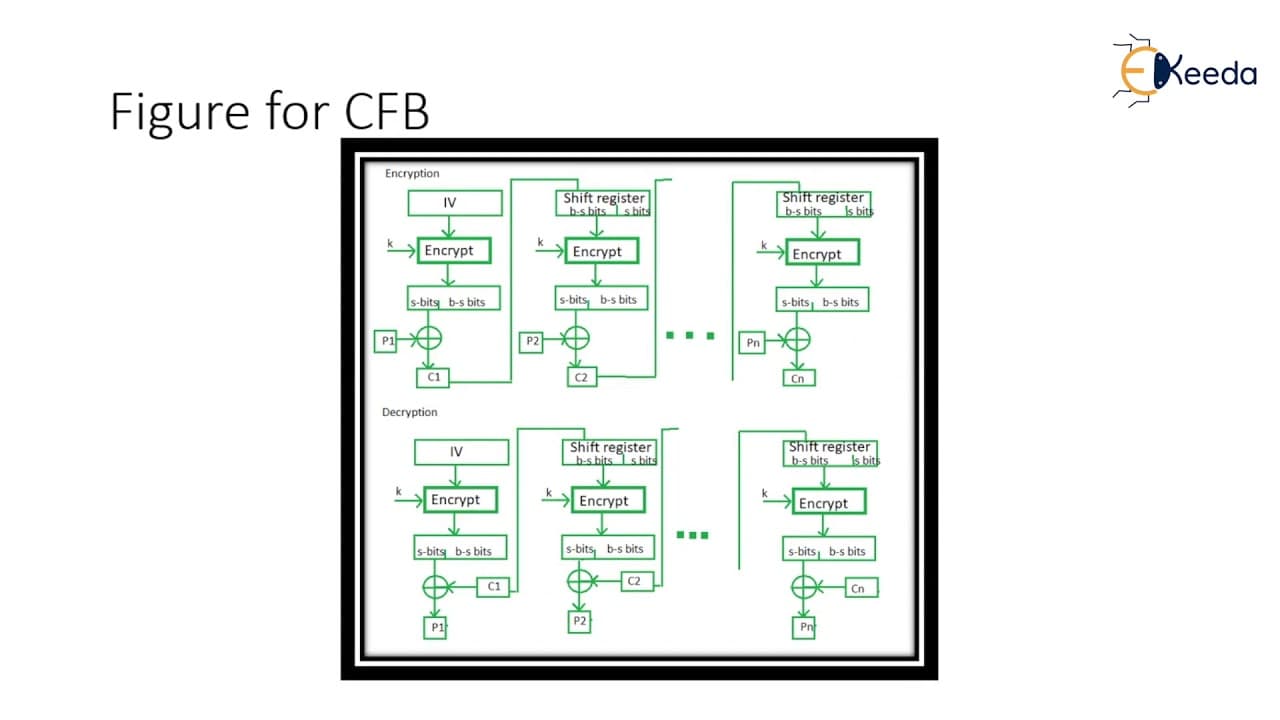
The five modes of block cipher operations defined by NIST are Electronic Code Book (ECB), Cipher Block Chaining (CBC), Cipher Feedback (CFB), Output Feedback (OFB), and Counter Mode (CTR). Each mode varies in security and efficiency: ECB is simple but vulnerable to cryptanalysis, while CBC offers better security, and CFB, OFB, and CTR utilize feedback or counters for encryption.
Transcript
hello friends in the previous lecture we have seen the introduction to what the block cipher is we have also seen the concept of stream cipher then in the later lecture we have already discussed what are the different principles of block cipher when we have seen that the block cipher principle works upon the substitution and permutation technique s... Read More
Key Insights
- 🔠 Block cipher is an encryption algorithm that converts fixed-size input into ciphertext.
- 🚫 NIST has defined five modes of operation for block ciphers: ECB, CBC, CFB, OFB, and CTR.
- 📳 ECB is the simplest mode, while CBC provides better resistance against cryptanalysis.
- 😒 CFB, OFB, and CTR use feedback or counter-based approaches to encrypt data.
Install to Summarize YouTube Videos and Get Transcripts
Explore YouTube Video Summarizer or Get YouTube Transcript Extractor
Questions & Answers
Q: What is block cipher and how does it work?
Block cipher is an encryption algorithm that converts a fixed size input into a ciphertext of the same size using encryption and a key. It works by dividing the input into blocks and applying encryption to each block separately.
Q: What is the advantage of using Electronic Code Book (ECB)?
ECB allows parallel encryption of bits and is faster, but it is less secure due to the direct relationship between the ciphertext and plaintext, making it prone to cryptanalysis.
Q: How does Cipher Block Chaining (CBC) mode work?
In CBC mode, the previous ciphertext block is XORed with the plaintext block before encryption. This prevents direct relationships between ciphertext blocks and provides better resistance against cryptanalysis.
Q: What is the difference between Cipher Feedback Mode (CFB) and Output Feedback Mode (OFB)?
Both CFB and OFB use feedback from previous encryption outputs, but in CFB, the output is XORed with the plaintext, while in OFB, the output is XORed with the initialization vector. OFB is more resistant to transmission errors and decreases the dependency on plaintext.
Q: How does Counter Mode (CTR) work?
CTR mode uses a counter-based approach where a new counter is initiated for each encryption. The counter value is XORed with the plaintext to produce the ciphertext block. It offers parallel encryption and is resistant to transmission errors.
Summary & Key Takeaways
-
Block cipher is an encryption algorithm that takes a fixed size input and produces the same size ciphertext.
-
NIST has defined five modes of operation for block ciphers: ECB, CBC, CFB, OFB, and CTR.
-
ECB is the simplest mode where each block of plaintext is directly encrypted, but it is prone to cryptanalysis.
-
CBC uses the previous ciphertext block as input for the next encryption, providing better resistance against cryptanalysis.
-
CFB and OFB use feedback from previous encryption outputs, while CTR uses a counter-based approach.
Read in Other Languages (beta)
Share This Summary 📚
Summarize YouTube Videos and Get Video Transcripts with 1-Click
Try YouTube Summary with ChatGPT & Claude or YouTube Transcript Generator
Explore More Summaries from Ekeeda 📚





Summarize YouTube Videos and Get Video Transcripts with 1-Click
Try YouTube Summary with ChatGPT & Claude or YouTube Transcript Generator