Rewriting roots as rational exponents | Mathematics I | High School Math | Khan Academy
TL;DR
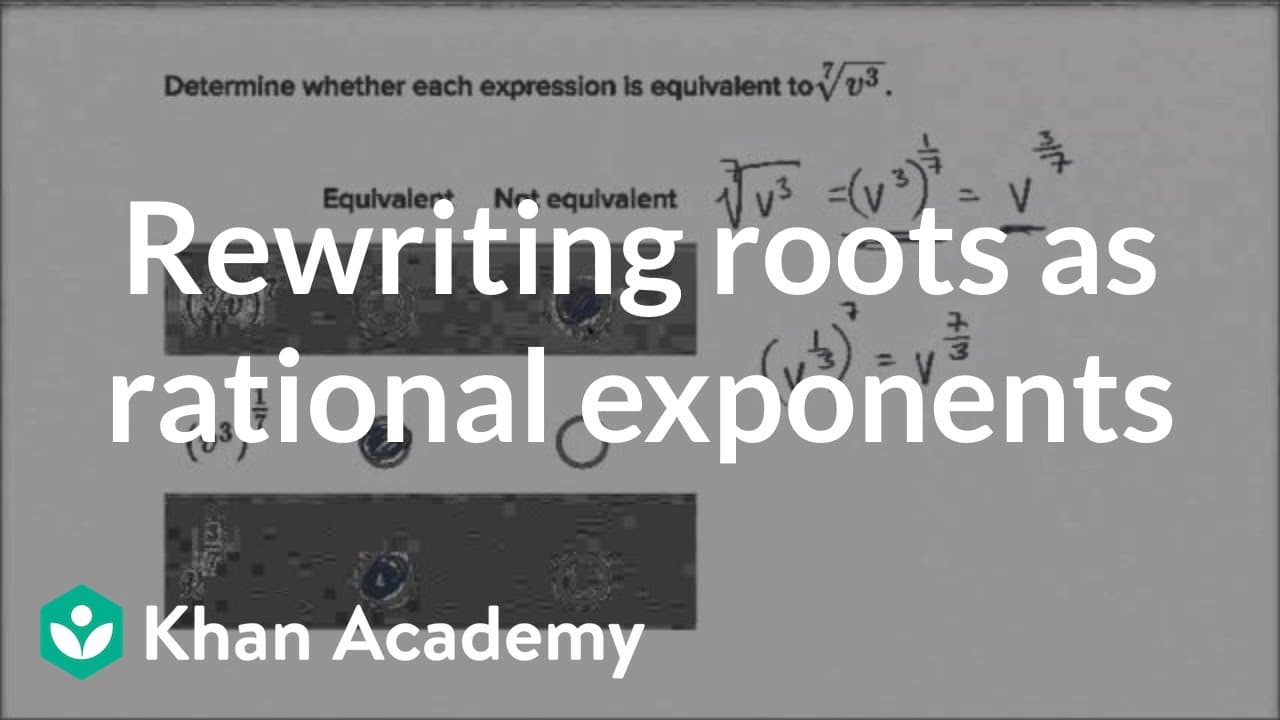
Determine if given expressions are equivalent to the seventh root of v to the third power and solve for constants in equations involving fractional exponents.
Transcript
- [Voiceover] We're asked to determine whether each expression is equivalent to the seventh root of v to the third power. And, like always, pause the video and see if you can figure out which of these are equivalent to the seventh root of v to the third power. Well, a good way to figure out if things are equivalent is to just try to get them all in... Read More
Key Insights
- 🥰 The seventh root of v to the third power can be written as v to the 3/7 power.
- 🥰 The cube root of v to the seventh power is not equivalent to v to the 3/7 power.
- ✊ Exponents can be multiplied when raising a number to a power and then raising that whole thing to another exponent.
- ❓ Constants in equations involving fractional exponents can be determined using exponent properties.
- 🤨 Taking the reciprocal of a number is equivalent to raising it to the negative of the exponent.
- ✊ Raising a number to the 1/7 power is the same as taking the seventh root of that number.
Install to Summarize YouTube Videos and Get Transcripts
Explore YouTube Video Summarizer or Get YouTube Transcript Extractor
Questions & Answers
Q: How can expressions with fractional exponents be simplified?
Expressions with fractional exponents can be simplified by raising the base to the product of the exponents. For example, the seventh root of v to the third power can be written as v to the 3/7 power.
Q: Are the expressions v to the third to the 1/7 power and v to the 3/7 equivalent?
Yes, the expressions v to the third to the 1/7 power and v to the 3/7 are equivalent. This is because the seventh root of v to the third power is the same as raising it to the 1/7 power, which simplifies to v to the 3/7.
Q: Is the cube root of v to the seventh power equivalent to v to the 3/7 power?
No, the cube root of v to the seventh power is not equivalent to v to the 3/7 power. The cube root of v to the seventh power can be written as v to the 7/3 power, which is different from v to the 3/7 power.
Q: How can constants be determined in equations involving fractional exponents?
Constants in equations involving fractional exponents can be determined by using exponent properties. For example, in the equation the sixth root of g to the fifth is equal to g to the 5/6 power, the value of d is 5/6.
Q: What is the value of d in the equation one over the seventh root of x is equal to x to the d?
The value of d in the equation one over the seventh root of x is equal to x to the d is equal to -1/7. This is because when taking the reciprocal of something, it is equivalent to raising it to the negative of that exponent.
Summary & Key Takeaways
-
The seventh root of v to the third power can be written as v to the 3/7 power.
-
The cube root of v to the seventh power is not equivalent to v to the 3/7 power.
-
In the equation the sixth root of g to the fifth is equal to g to the 5/6 power, the value of d is 5/6.
-
In the equation one over the seventh root of x is equal to x to the d, the value of d is -1/7.
Read in Other Languages (beta)
Share This Summary 📚
Summarize YouTube Videos and Get Video Transcripts with 1-Click
Try YouTube Summary with ChatGPT & Claude or YouTube Transcript Generator
Explore More Summaries from Khan Academy 📚



Summarize YouTube Videos and Get Video Transcripts with 1-Click
Try YouTube Summary with ChatGPT & Claude or YouTube Transcript Generator