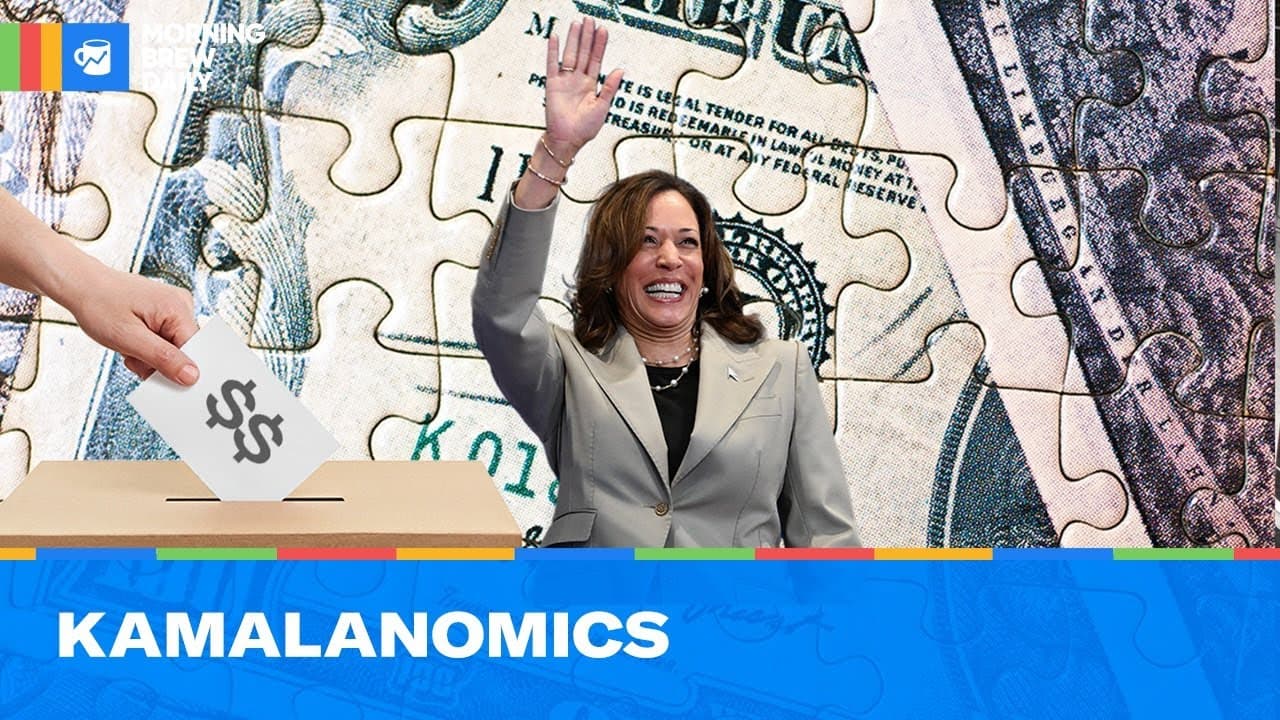
How Does Kamala Harris View the Economy
TL;DR
Kamala Harris's economic views align closely with Biden's.
Transcript
Good Morning Brew Daily Show. I'm Neal Freyman, and I'm Toby Howell. Today, the global I.T. outage was resolved four days ago, but Delta didn't get the memo. What is going on in the Sky club, then? The results are in from the largest universal basic income study in history. It's Tuesday, July 23rd. Let's ride. This will be the first presidential el... Read More
Key Insights
- Kamala Harris's economic policies are largely similar to President Biden's, with minor differences leaning slightly more to the left.
- Harris has proposed a $10 trillion climate plan and supports banning fracking, indicating a strong focus on environmental policies.
- She advocates for student debt relief and free college, aligning with Bernie Sanders on free college initiatives.
- Harris opposes recent free trade deals due to insufficient environmental regulations and job protection, reflecting her focus on climate change and union support.
- She supports regulating AI more than Biden, aiming to balance innovation with public protection.
- A universal basic income study found no significant employment changes but improved financial flexibility for participants.
- Delta Airlines struggled to recover from a major IT outage, highlighting vulnerabilities in its operations.
- The FCC's new regulations aim to reduce the cost of phone calls from prisons, addressing long-standing issues of affordability.
Install to Summarize YouTube Videos and Get Transcripts
Explore YouTube Video Summarizer or Get YouTube Transcript Extractor
Questions & Answers
Q: What are Kamala Harris's main economic policy differences from President Biden?
Kamala Harris's economic policies are largely similar to President Biden's, but she leans slightly more to the left on certain issues. She proposed a more extensive $10 trillion climate plan and supports banning fracking, which Biden does not. Additionally, Harris has been more outspoken on regulating AI, aiming to balance innovation with public safety.
Q: What did the universal basic income study reveal?
The universal basic income study, backed by Sam Altman, revealed that providing $1,000 per month to participants did not lead to significant changes in employment levels. However, it improved recipients' financial flexibility, allowing them to spend more on basic needs like food, housing, and transportation, and reduced their stress levels.
Q: Why did Delta Airlines struggle to recover from the IT outage?
Delta Airlines struggled to recover from the IT outage due to its reliance on systems that were disrupted by a faulty CrowdStrike update. The outage affected Delta's crew scheduling software, leading to widespread flight cancellations. Delta's decision to cancel flights rather than delay them further complicated recovery efforts, highlighting vulnerabilities in its operations.
Q: What actions did the FCC take regarding prison phone call costs?
The FCC voted to dramatically lower the cost of phone calls from prisons, reducing the price of a 15-minute call from over $11 to $0.90 in large jails. The agency also capped video call costs, aiming to reduce financial burdens on incarcerated individuals and their families. These changes are expected to save nearly $400 million.
Q: What trend is associated with Phillies outfielder Nick Castellanos?
Phillies outfielder Nick Castellanos is associated with a humorous trend where he seems to hit home runs during major world events or somber announcements. This correlation has become a popular internet meme, with fans jokingly betting on his home runs whenever significant news breaks.
Q: How is the Olympic Village preparing to feed athletes?
The Olympic Village in Paris is preparing to feed athletes by setting up six restaurants that will operate around the clock. The dining facilities emphasize sustainability, sourcing 80% of ingredients from within France, and cater to diverse dietary needs, including halal and other cultural preferences. The operation is described as the world's largest restaurant.
Q: What is Kamala Harris's stance on free trade agreements?
Kamala Harris has opposed recent free trade agreements like the US-Mexico-Canada Agreement and the Trans-Pacific Partnership, citing insufficient environmental regulations and inadequate protection for American jobs. Her stance reflects a focus on climate change and support for union and blue-collar workers.
Q: What impact does the FCC's decision have on prison telecoms?
The FCC's decision to cap prison phone call costs is expected to significantly impact the prison telecom industry, which is dominated by a few companies. These companies argue that the rate caps could inhibit competition and affect security costs, but the changes are intended to make communication more affordable for incarcerated individuals and their families.
Summary & Key Takeaways
-
Kamala Harris's economic policies are closely aligned with President Biden's, with a few key differences. She focuses on climate change, proposing a $10 trillion climate plan and supporting a ban on fracking. Harris also emphasizes student debt relief and free college initiatives.
-
A recent study on universal basic income, supported by Sam Altman, found that providing $1,000 monthly did not significantly affect employment levels but improved financial flexibility for recipients, allowing them to meet basic needs more comfortably.
-
Delta Airlines faced significant challenges recovering from a global IT outage, which disrupted operations and led to numerous flight cancellations. The incident highlighted the airline's vulnerabilities and prompted criticism from the Transportation Secretary.
Read in Other Languages (beta)
Share This Summary 📚
Summarize YouTube Videos and Get Video Transcripts with 1-Click
Try YouTube Summary with ChatGPT & Claude or YouTube Transcript Generator
Explore More Summaries from Morning Brew Daily 📚


Summarize YouTube Videos and Get Video Transcripts with 1-Click
Try YouTube Summary with ChatGPT & Claude or YouTube Transcript Generator