Constructing linear and exponential functions from graph | Algebra II | Khan Academy
TL;DR
Linear and exponential functions are analyzed using given points, leading to the determination of their equations.
Transcript
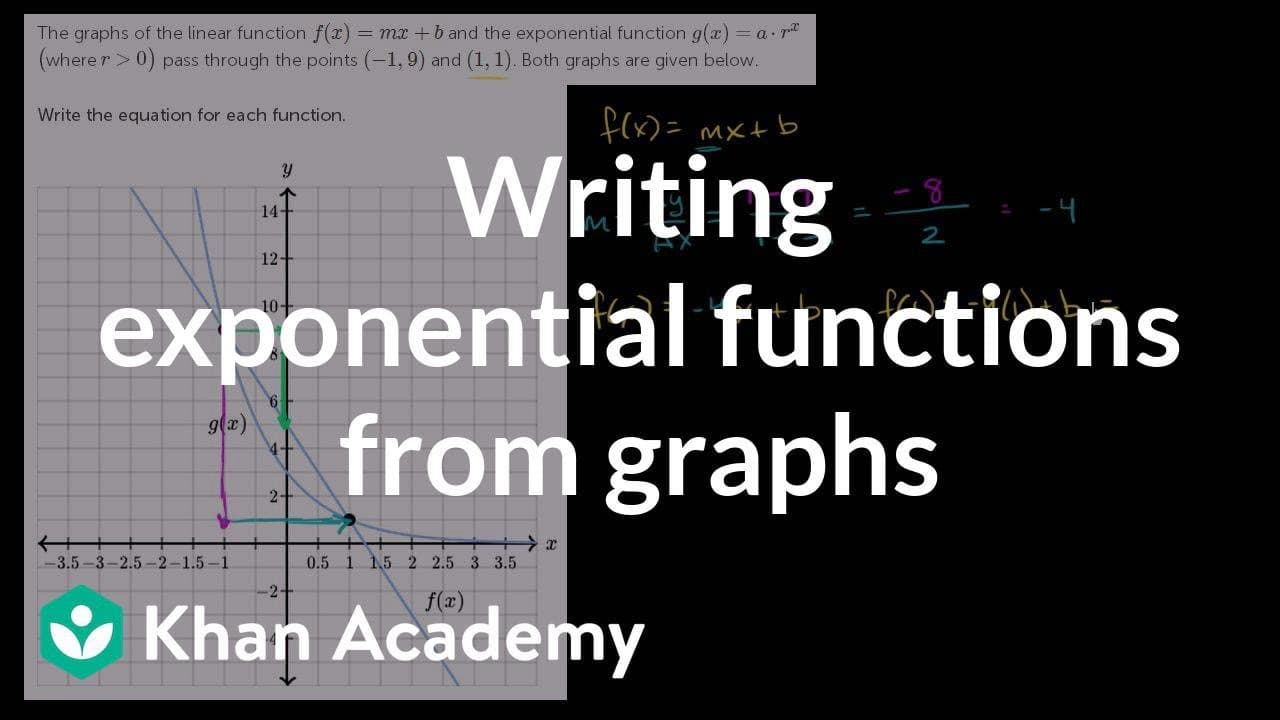
- [Instructor] The graphs of the linear function f of x is equal to mx plus b and the exponential function g of x is equal to a times r to the x where r is greater than zero pass through the points negative one comma nine, so this is negative one comma nine right over here, and one comma one. Both graphs are given below. So this very clearly is the... Read More
Key Insights
- 😥 The slope of a linear function represents the rate of change between two points.
- 😀 The y-intercept of a linear function represents the point where the graph intersects the y-axis.
- ⚾ Exponential functions have a base raised to a variable exponent, and the base determines the growth or decay behavior.
- 😥 The given points are crucial in determining the equations of both linear and exponential functions.
- ☺️ The exponential function decreases as x increases because the base (r) is between 0 and 1.
- 💱 Linear functions have a constant rate of change, while exponential functions have a changing rate of change.
- 💁 The linear function equation is in the form f(x) = mx + b, while the exponential function equation is in the form g(x) = a * r^x.
Install to Summarize YouTube Videos and Get Transcripts
Explore YouTube Video Summarizer or Get YouTube Transcript Extractor
Questions & Answers
Q: How is the slope of the linear function determined?
The slope is found by calculating the change in y divided by the change in x between the two given points. In this case, the slope is -4.
Q: How is the y-intercept of the linear function determined?
The y-intercept is found by substituting one of the given points into the linear function equation and solving for the constant term. In this case, the y-intercept is 5.
Q: How is the exponential function equation determined?
The exponential function equation is determined by substituting the given points into the equation and solving a system of equations. The constant term (a) is found to be 3 and the base (r) is found to be 1/3.
Q: How are linear and exponential functions different?
Linear functions have a constant rate of change and create a straight line, while exponential functions have a varying rate of change and create a curved graph.
Summary & Key Takeaways
-
The content analyzes linear and exponential functions passing through two given points.
-
The linear function is determined using the slope formula, resulting in an equation of f(x) = -4x + 5.
-
The exponential function is determined by substituting the points into the equation and solving a system of equations, resulting in an equation of g(x) = 3(1/3)^x.
Read in Other Languages (beta)
Share This Summary 📚
Summarize YouTube Videos and Get Video Transcripts with 1-Click
Try YouTube Summary with ChatGPT & Claude or YouTube Transcript Generator
Explore More Summaries from Khan Academy 📚



Summarize YouTube Videos and Get Video Transcripts with 1-Click
Try YouTube Summary with ChatGPT & Claude or YouTube Transcript Generator