Equal sign | Addition and subtraction within 20 | Early Math | Khan Academy
TL;DR
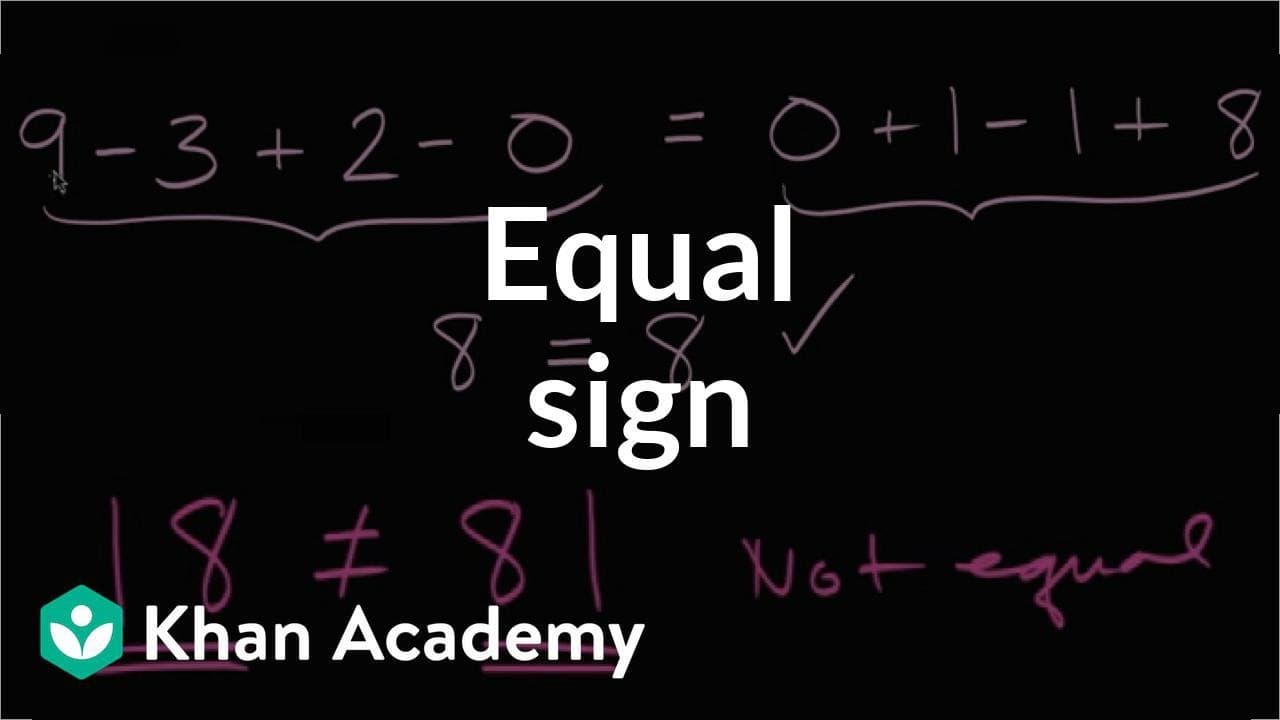
The equal sign in math represents equivalence of quantities, not just finding the answer.
Transcript
- When you first learn math, you see things like two plus three is equal to five, or you might see six plus one is equal to seven, or you might see eight minus two is equal to six. And all of these, you might think that the equal sign just says, hey, give me the answer, figure out what two plus three is. Two plus three, well, the answer is five. Si... Read More
Key Insights
- 🟰 The equal sign conveys the concept of equivalence in mathematics.
- 💨 Equations can be written in different ways while still representing the same equivalence.
- 🟰 The equal sign does not indicate finding the answer but rather the equality of quantities.
- 🟰 The not equal sign (≠) represents inequality between the quantities on both sides.
- 🟰 The equal sign applies to various mathematical operations, not just addition and subtraction.
- 🪈 Swapping the order of numbers in an equation does not change its equality.
- 🟰 Understanding the true meaning of the equal sign is crucial for solving equations accurately.
Install to Summarize YouTube Videos and Get Transcripts
Explore YouTube Video Summarizer or Get YouTube Transcript Extractor
Questions & Answers
Q: What does the equal sign represent in math?
The equal sign signifies that the quantity on the left-hand side of the equation is equivalent to the quantity on the right-hand side. It denotes equality between the two sides.
Q: Can equations be written in different ways and still be equal?
Yes, equations can be written in different forms as long as they represent the same equivalence. For example, 3 + 2 = 5 is the same as 2 + 3 = 5.
Q: Does the equal sign only apply to addition and subtraction?
No, the equal sign can be used in equations involving various operations. It represents equivalence regardless of the arithmetic operation being used.
Q: What is the difference between the equal sign and the not equal sign?
The equal sign represents equivalence, while the not equal sign (≠) indicates that the quantities on both sides are not equivalent. It signifies inequality.
Summary & Key Takeaways
-
The equal sign in math signifies that the quantity on the left is the same as the quantity on the right.
-
Equations can be written in various forms and still represent the same equivalence.
-
The equal sign does not indicate finding the answer, but rather the equality of the quantities on both sides.
Read in Other Languages (beta)
Share This Summary 📚
Summarize YouTube Videos and Get Video Transcripts with 1-Click
Try YouTube Summary with ChatGPT & Claude or YouTube Transcript Generator
Explore More Summaries from Khan Academy 📚



Summarize YouTube Videos and Get Video Transcripts with 1-Click
Try YouTube Summary with ChatGPT & Claude or YouTube Transcript Generator