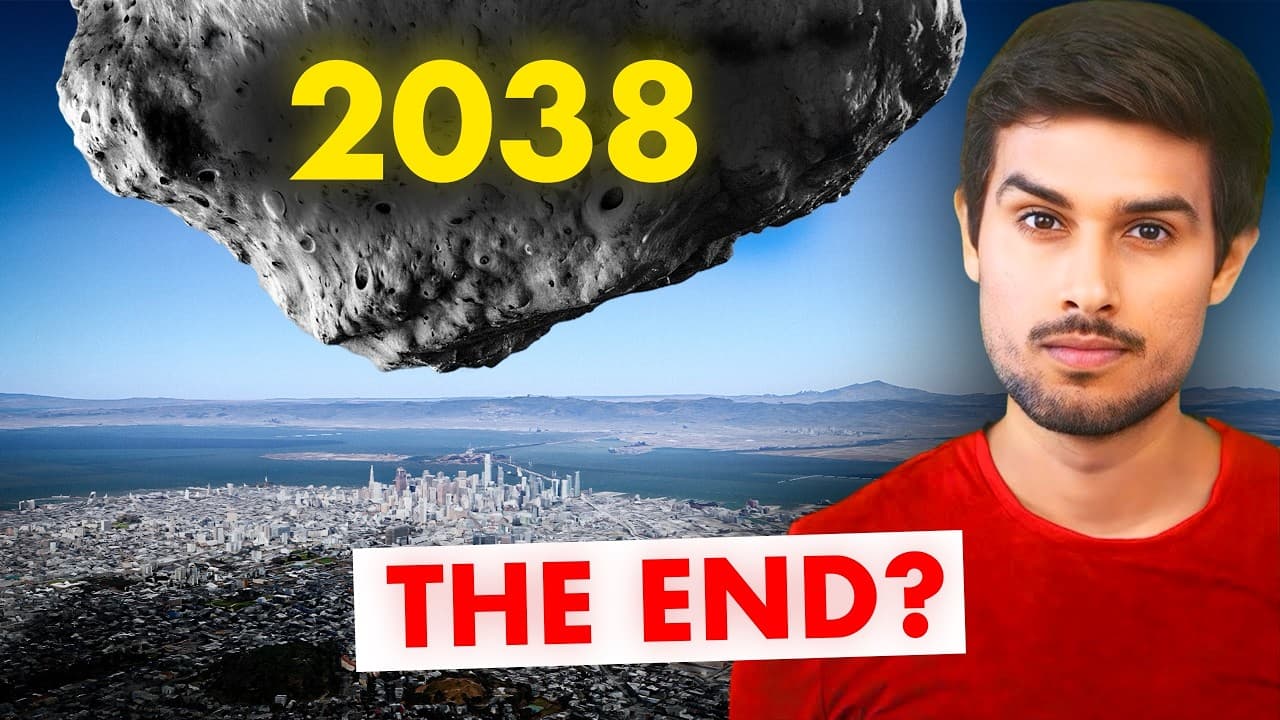
Will this Asteroid DESTROY Earth in 2038? | Dhruv Rathee
TL;DR
Future asteroid threats exist, but current danger is minimal and defenses are improving.
Transcript
Hello friends! 13th April, 2029. A huge asteroid Apophis, more than 1000 feet in diameter, will pass by the Earth at a close prproximity. If it hits the earth, it will bring about such a devastation which has never been seen before in human history. Compared to the bomb dropped on Hiroshima this will release 1 million times more energy. There will ... Read More
Key Insights
- 😨 Apophis poses no threat to Earth despite initial fears, illustrating the importance of accurate scientific communication.
- 🥺 Sensational news headlines can misrepresent scientific findings, leading to public anxiety about asteroid impacts.
- 👾 Space agencies conduct regular hypothetical scenarios to prepare for asteroid impact responses, ensuring a coordinated global response.
- 💀 Asteroids, comets, and meteoroids are classified primarily by composition and environment, reflecting their distinct characteristics and dangers.
- ✳️ The likelihood of dangerous asteroids impacting Earth is quantified through extensive risk assessments conducted by astronomers worldwide.
- 🏆 Kinetic methods have been practically tested and validated, demonstrating that planetary defense strategies can be effective.
- 🕵️ Detecting and tracking Near-Earth Objects is an increasingly sophisticated practice, utilizing cutting-edge technology to reduce risks.
Install to Summarize YouTube Videos and Get Transcripts
Explore YouTube Video Summarizer or Get YouTube Transcript Extractor
Questions & Answers
Q: What is the significance of the asteroid Apophis and its trajectory?
Apophis is a well-known asteroid that will come very close to Earth in April 2029, passing at a distance of just 30,000 km. Initially, its potential for collision was believed to be 2.7%, but further observations confirmed it has a 0% chance of colliding with Earth in the next century. Its name comes from Egyptian mythology, symbolizing chaos, but it poses no real danger to us.
Q: Why are there discrepancies in public news regarding asteroid threats?
Discrepancies arise from sensationalist headlines and misinformation. For instance, reports suggesting a 72% chance of collision in 2038 were based on a hypothetical scenario created by NASA to prepare for potential threats, not an actual finding. Many news outlets sensationalized this hypothetical exercise, which led to public panic over non-existent threats.
Q: How does NASA and other space agencies prepare for asteroid threats?
NASA and global space agencies conduct regular assessments and simulations to prepare for asteroid threats. They utilize methods like the Kinetic Impact Technique, which involves sending a spacecraft to collide with an asteroid to change its orbit. Continuous research and exercises help refine these methods and ensure readiness.
Q: What is the difference between asteroids, comets, and meteoroids?
Asteroids are rocky and metallic bodies mainly found in the Asteroid Belt between Mars and Jupiter. Comets, composed of ice and rock, originate from the Kuiper Belt and often have tails when near the sun. Meteoroids are smaller fragments from asteroids or comets, and when they enter Earth's atmosphere, they are known as meteors or shooting stars.
Q: What methods are proposed for dealing with potentially hazardous asteroids?
Three primary methods include Kinetic Impact (colliding a spacecraft with the asteroid to alter its path), Slow Push-Pull (gradually changing the asteroid's orbit using solar energy), and Nuclear Methods (theoretical use of nuclear bombs to destroy hazardous asteroids). Each has advantages and significant challenges concerning practicality and safety.
Q: How does data science contribute to asteroid detection?
Data science plays a crucial role in accurately predicting asteroid paths by analyzing vast amounts of observational data. Various detection systems, like LINEAR and CSS, utilize advanced algorithms and imaging techniques to improve asteroid tracking and collision probability assessments, enhancing our preparedness for potential threats.
Summary & Key Takeaways
-
On April 13, 2029, asteroid Apophis will pass near Earth but poses no collision threat, debunking dire warnings.
-
NASA's hypothetical exercises assessed asteroid threats; erroneous claims about a 72% impact danger from another asteroid gained media traction but are untrue.
-
Earth's defense strategies against potential asteroid impacts include kinetic methods and monitoring systems, ensuring preparedness and risk mitigation.
Read in Other Languages (beta)
Share This Summary 📚
Summarize YouTube Videos and Get Video Transcripts with 1-Click
Try YouTube Summary with ChatGPT & Claude or YouTube Transcript Generator
Explore More Summaries from Dhruv Rathee 📚






Summarize YouTube Videos and Get Video Transcripts with 1-Click
Try YouTube Summary with ChatGPT & Claude or YouTube Transcript Generator