Combination Circuits: Calculating Currents and Voltages
TL;DR
Conducting math calculations to determine current and voltage in different combination circuits.
Transcript
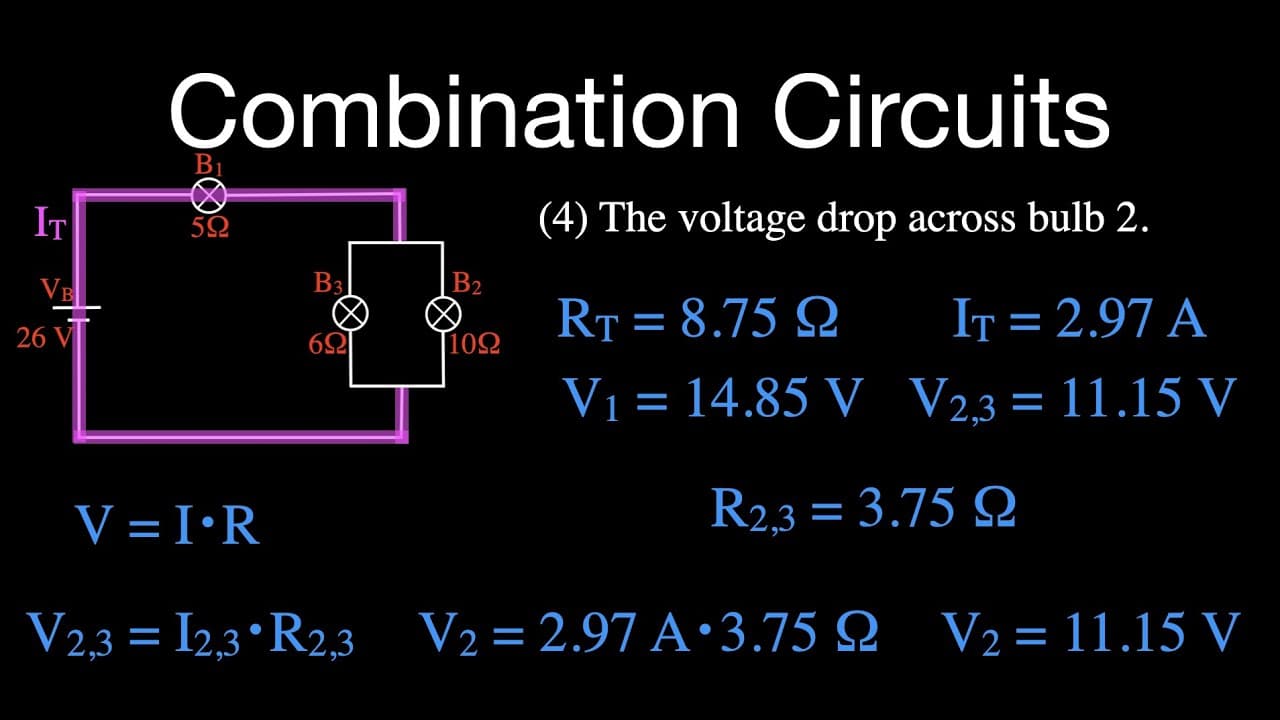
in the previous video which you can link to in the upper hand corner of this video the upper right hand corner of this video we went over kind of a qualitative analysis of the two different combination circuits in this video we're going to do a quantitative analysis which means we're going to do the math and calculate the current and the voltages a... Read More
Key Insights
- ⚡ Quantitative analysis involves calculating currents and voltages using Ohm's Law.
- 💡 Combination circuits with different arrangements of bulbs require step-by-step calculations for determining total values.
- ⚡ Understanding parallel and series connections is essential for accurately analyzing current and voltage distribution.
- 🖐️ Equivalent resistances of parallel elements and total resistances in series connections play a crucial role in circuit analysis.
- 💦 Voltage drops across bulbs are proportional to the current flowing through them and their individual resistances.
- 👮 Current distribution in a circuit follows the path of least resistance and obeys Kirchhoff's laws.
- ⚡ Precise calculations and mathematical methods are used to derive accurate results for current and voltage in complex circuits.
Install to Summarize YouTube Videos and Get Transcripts
Explore YouTube Video Summarizer or Get YouTube Transcript Extractor
Questions & Answers
Q: How is the total resistance of combination circuits calculated?
The total resistance is found by first determining the equivalent resistance of parallel elements, then adding it to the series resistance for the complete circuit.
Q: How is the total current in a combination circuit determined?
The total current is obtained by dividing the total voltage by the total resistance, considering the combined resistances in the circuit.
Q: What factors influence the voltage drop across individual bulbs in a circuit?
The voltage drop across each bulb depends on the current flowing through it and its resistance, which determine the energy dissipated as heat and light.
Q: How is the current distribution analyzed in series and parallel combination circuits?
Currents split at junctions in the circuit depending on the resistances, flowing through different paths and ensuring conservation of current throughout the circuit.
Summary & Key Takeaways
-
Two types of combination circuits analyzed: one with bulbs in parallel and series, and another with bulbs in series and parallel.
-
Total resistance, current, and voltage drop across different bulbs calculated using Ohm's Law.
-
Step-by-step calculations show how currents and voltages are distributed in each circuit.
Read in Other Languages (beta)
Share This Summary 📚
Summarize YouTube Videos and Get Video Transcripts with 1-Click
Try YouTube Summary with ChatGPT & Claude or YouTube Transcript Generator
Explore More Summaries from Step by Step Science 📚

Summarize YouTube Videos and Get Video Transcripts with 1-Click
Try YouTube Summary with ChatGPT & Claude or YouTube Transcript Generator