What Is Maclaurin's Series and How Is It Used?
TL;DR
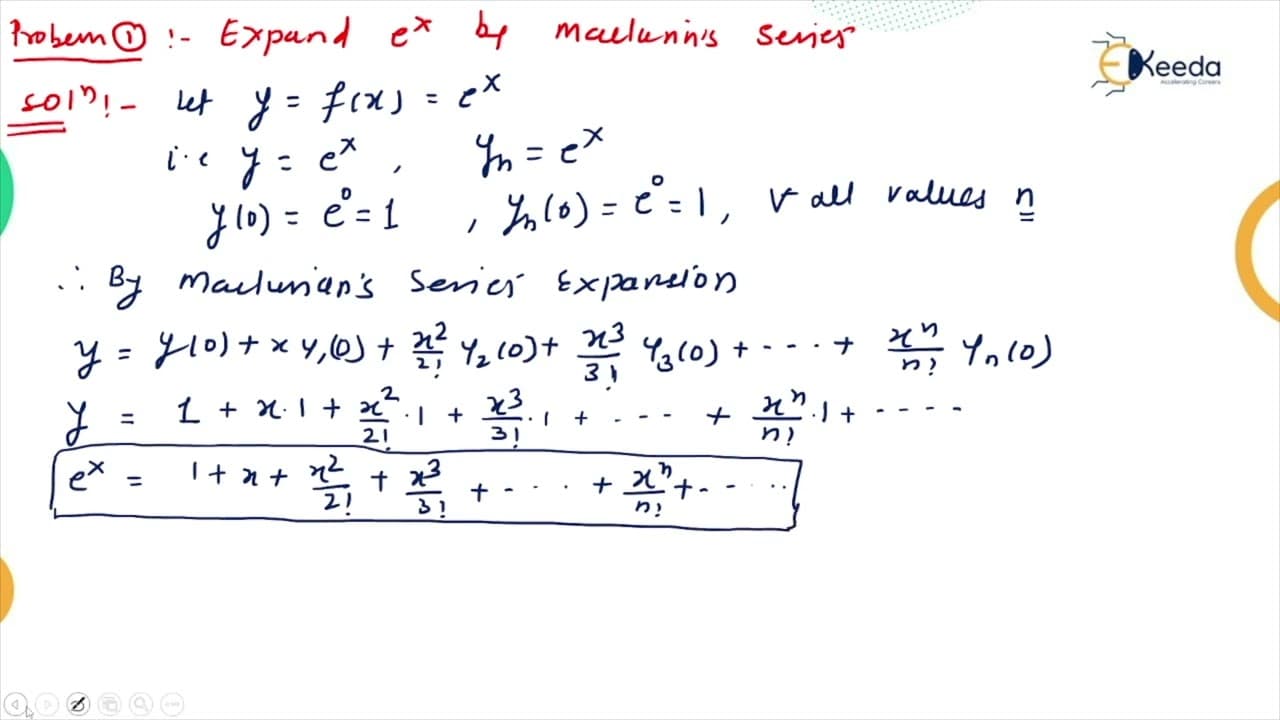
Maclaurin's series is an expansion method for expressing functions as infinite sums of terms calculated from the function's derivatives at the point zero. It involves using the formula f(x) = f(0) + xf'(0) + x²f''(0)/2! + ..., facilitating the approximation of functions like e^x, sin x, and cos x with polynomial series.
Transcript
hi everyone today's topic we have to discuss here maclaurin series expansion so this is the series expansion of some standard function is there by using this uh macron series we have to find series of some standard functions so that's why this is very important to understand what is the series and how to write the maclaurin series expansion so in t... Read More
Key Insights
- 😑 Maclaurin series expansion involves finding the nth derivatives of a function at x = 0 and expressing it as a sum of terms involving x raised to different powers.
- ☺️ The expansion is used to find the series expansion of standard functions like e^x, sin x, and cos x, and enables the approximation of functions using a polynomial series.
- 😑 The process of finding the Maclaurin series expansion involves calculating the values of the nth derivatives of a function at x = 0 and expressing them in a specific formula.
Install to Summarize YouTube Videos and Get Transcripts
Explore YouTube Video Summarizer or Get YouTube Transcript Extractor
Questions & Answers
Q: What is the Maclaurin series expansion?
The Maclaurin series expansion is a method used to express a function as an infinite series using ascending powers of x. It involves finding the nth derivatives of the function at x = 0 and expressing it as a sum of terms involving x raised to different powers divided by factorials.
Q: How is the Maclaurin series expansion used to find the series expansion of standard functions?
By applying the Maclaurin series formula, we can find the series expansion of standard functions like e^x, sin x, and cos x. The formula involves finding the nth derivatives of the function at x = 0 and expressing it as a summation of terms involving x raised to different powers divided by factorials.
Q: What are some examples of finding the Maclaurin series expansion?
Examples include finding the series expansion of functions like e^x, sin x, and cos x. By applying the Maclaurin series formula, we can determine the specific terms involved in the series expansion for each function.
Q: How is the series expansion of a function derived using the Maclaurin series?
The series expansion of a function is derived by finding the nth derivatives of the function at x = 0 and expressing it as a sum of terms involving x raised to different powers divided by factorials. This method allows for the approximation of a function using a polynomial series.
Summary & Key Takeaways
-
Maclaurin series expansion is a method for finding the series expansion of standard functions in terms of ascending powers of x.
-
The expansion involves finding the nth derivatives of the function at x = 0 and expressing it as a summation of terms involving x raised to different powers divided by factorials.
-
Examples are provided for finding the Maclaurin series expansion of functions like e^x, sin x, cos x, and for expressing equations in terms of ascending powers of x.
Read in Other Languages (beta)
Share This Summary 📚
Summarize YouTube Videos and Get Video Transcripts with 1-Click
Try YouTube Summary with ChatGPT & Claude or YouTube Transcript Generator
Explore More Summaries from Ekeeda 📚





Summarize YouTube Videos and Get Video Transcripts with 1-Click
Try YouTube Summary with ChatGPT & Claude or YouTube Transcript Generator