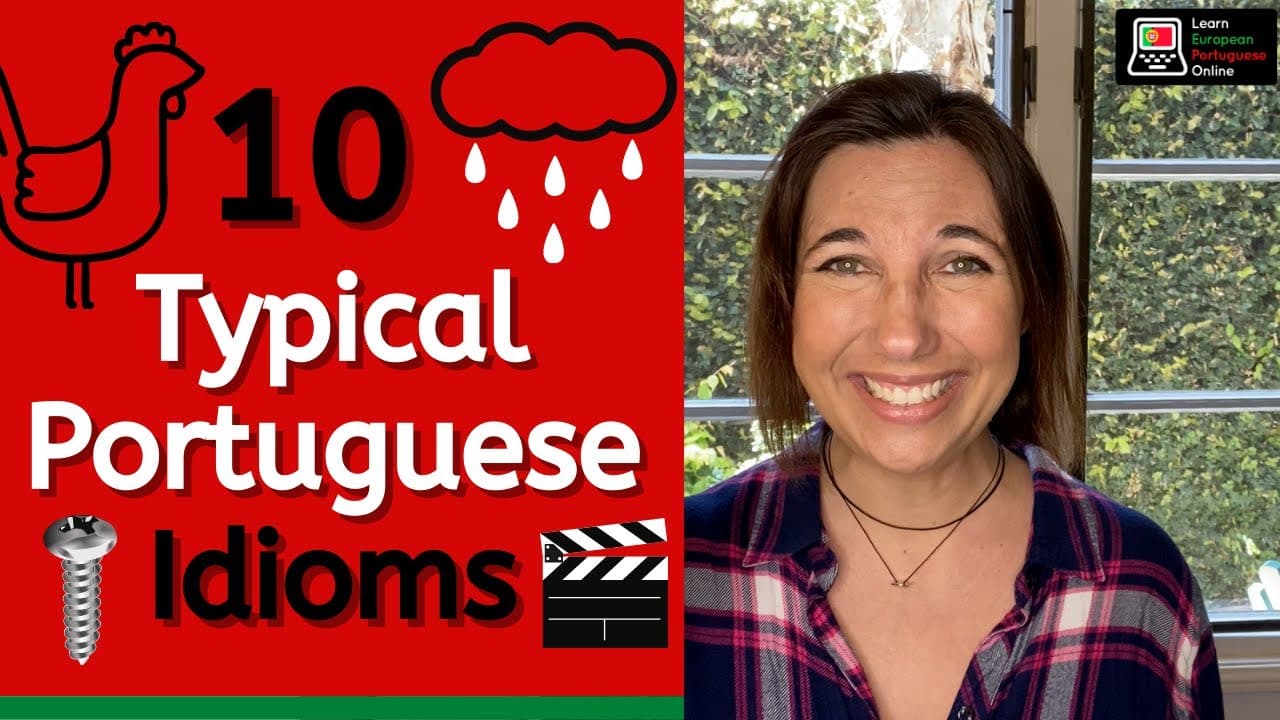
10 European Portuguese Fun Expressions! Learn How to Use Them.
TL;DR
Discover popular Portuguese idioms and their practical uses.
Transcript
eu tirei aí Robson vídeo about And Beautiful portuguese Williams em português expressões idiomáticas Resort Park ou portugueses Expression On Fire the conversations and Twitter and other language is leaving many times McDonald's enemies or very for and download and would define limite estão like and have tried and extending your secrets One and one... Read More
Key Insights
- The video introduces 10 popular Portuguese idiomatic expressions, providing practical examples for each to help learners use them correctly in conversations.
- Understanding idiomatic expressions is crucial for sounding like a native speaker and enhancing language proficiency in Portuguese.
- Expressions such as 'ao preço da chuva' and 'apanhar com a boca na botija' are explained with their English equivalents, aiding comprehension.
- The expression 'dormir com as galinhas' is used to describe going to bed early, highlighting cultural nuances in language.
- Using idioms like 'encher chouriços' can reflect laziness or stalling, showcasing how language reflects cultural attitudes.
- The video emphasizes the importance of context when using idiomatic expressions, as their meanings can vary significantly.
- Expressions like 'entrar em parafuso' describe states of confusion or stress, illustrating the emotional depth language can convey.
- The presenter encourages viewers to engage with more content to deepen their understanding of European Portuguese.
Install to Summarize YouTube Videos and Get Transcripts
Explore YouTube Video Summarizer or Get YouTube Transcript Extractor
Questions & Answers
Q: What is the purpose of the video?
The purpose of the video is to introduce viewers to 10 common Portuguese idiomatic expressions. By providing practical examples, the video aims to help learners understand and use these expressions correctly in conversations, thereby enhancing their language proficiency and helping them sound more like native speakers.
Q: How does the video help learners use idiomatic expressions?
The video helps learners by providing practical examples for each idiomatic expression, explaining their meanings and contexts. This approach aids in understanding how to use these expressions correctly in everyday conversations, making it easier for learners to integrate them into their language use and sound more natural when speaking Portuguese.
Q: Why are idiomatic expressions important in language learning?
Idiomatic expressions are important in language learning because they reflect cultural nuances and emotional depth, making communication more authentic and relatable. Understanding and using idioms correctly can help learners sound more like native speakers and enhance their overall language proficiency, allowing them to engage more fully in conversations.
Q: What is the expression 'ao preço da chuva' used for?
The expression 'ao preço da chuva' is used to describe something that is very cheap or inexpensive. It is equivalent to the English phrase 'dirt cheap' or 'next to nothing.' This idiom helps convey the idea of getting something at a very low cost, reflecting the cultural context in which it is used.
Q: What does 'apanhar com a boca na botija' mean?
The expression 'apanhar com a boca na botija' means to catch someone in the act or red-handed. It is used to describe situations where someone is caught doing something they shouldn't be doing, similar to the English expression 'caught in the act.' This idiom highlights the importance of context in language use.
Q: How is 'dormir com as galinhas' used in Portuguese?
The expression 'dormir com as galinhas' is used to describe going to bed early. It literally translates to 'sleep with the chickens,' reflecting the idea of retiring for the night as early as chickens do. This idiom illustrates cultural attitudes towards sleep and daily routines in Portuguese-speaking communities.
Q: What does 'encher chouriços' imply?
The expression 'encher chouriços' implies wasting time or filling space without doing anything productive. It is equivalent to the English phrase 'to fill time' or 'to waffle.' This idiom reflects cultural attitudes towards productivity and can be used to describe situations where someone is stalling or not being efficient.
Q: What is the significance of 'entrar em parafuso'?
The expression 'entrar em parafuso' is used to describe a state of confusion, stress, or being overwhelmed. It literally translates to 'enter a screw,' metaphorically indicating a mental state where someone feels like they are spiraling. This idiom conveys emotional depth and is useful for expressing complex feelings in Portuguese.
Summary & Key Takeaways
-
This video explores 10 common Portuguese idiomatic expressions, providing practical examples to help learners use them correctly. Understanding these expressions is key to sounding more like a native speaker and enhancing language proficiency.
-
Expressions such as 'ao preço da chuva' and 'apanhar com a boca na botija' are explained alongside their English equivalents. The video emphasizes the importance of context in using idioms, as meanings can vary widely.
-
The presenter encourages viewers to engage with more content to deepen their understanding of European Portuguese. Cultural nuances and emotional depth are explored through idioms like 'dormir com as galinhas' and 'entrar em parafuso'.
Read in Other Languages (beta)
Share This Summary 📚
Summarize YouTube Videos and Get Video Transcripts with 1-Click
Try YouTube Summary with ChatGPT & Claude or YouTube Transcript Generator
Explore More Summaries from Learn European Portuguese Online 📚



Summarize YouTube Videos and Get Video Transcripts with 1-Click
Try YouTube Summary with ChatGPT & Claude or YouTube Transcript Generator