Energy, Work & Power (12 of 31) Work Energy Principle, Net Work Done on an Object
TL;DR
Calculate net work done by forces to find change in velocity using work-energy theorem.
Transcript
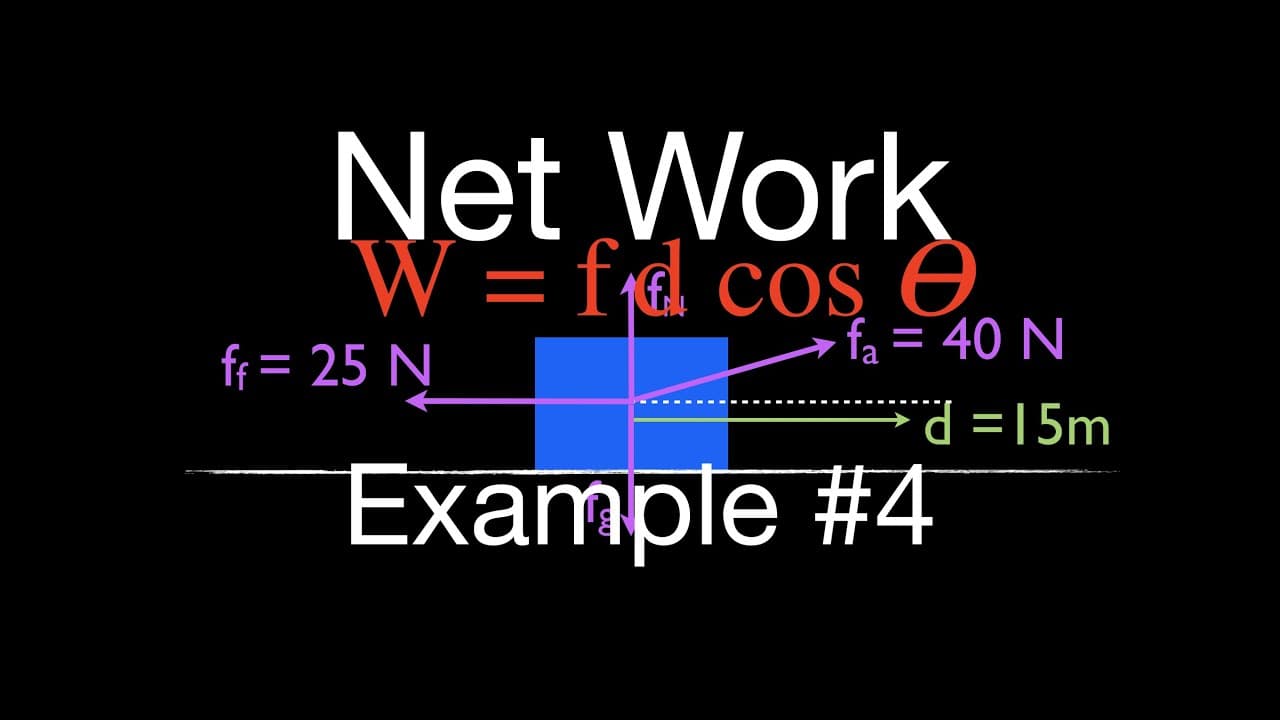
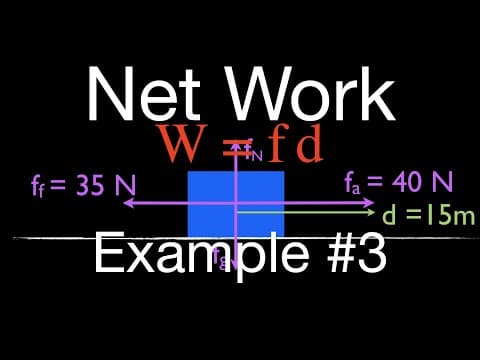
okay in today's video we are going to do two things we are going to calculate first of all the net work that is done on this object by these four forces and then based on the network we're gonna calculate free of charge no extra charge bonus content the change in velocity of the object after that work has been acted upon it now you can see in this ... Read More
Key Insights
- 💦 Applied force contributes positively, friction force negatively to net work.
- 💦 Gravitational force, normal force do no work due to being perpendicular to displacement.
- 💦 Net work calculated as 97 joules by summing up individual force contributions.
- 💦 Change in velocity calculated using work-energy theorem.
- 💦 Work-energy principle utilized to determine change in kinetic energy.
- 😀 Final velocity of the object found to be 5.94 m/s.
- 💦 Understanding of work calculation and its relation to change in velocity demonstrated.
Install to Summarize YouTube Videos and Get Transcripts
Explore YouTube Video Summarizer or Get YouTube Transcript Extractor
Questions & Answers
Q: What forces are acting on the object in the video?
The four forces acting on the object are applied force, friction force, normal force, and gravitational force. The applied force contributes positively to work done, while the friction force does negative work.
Q: How is net work calculated in the video?
Net work is calculated by considering the work done by each force individually and summing them up. The applied force and friction force contributions are crucial in determining the net work done on the object.
Q: Why do gravitational force and normal force do no work?
Gravitational force and normal force do no work because they are perpendicular to the displacement of the object. The cosine of 90 degrees is zero, indicating no work is done by these forces on the object.
Q: How is the change in velocity of the object calculated in the video?
The change in velocity is calculated using the work-energy theorem, equating net work done on the object to the change in kinetic energy. By solving for final velocity using the equation provided, the final velocity of 5.94 m/s is obtained.
Summary & Key Takeaways
-
Four forces acting on object: applied force, friction force, normal force, gravitational force.
-
Net work calculated as 97 joules, with applied force contributing positively and friction force negatively.
-
Change in velocity found to be 5.94 m/s using work-energy theorem.
Read in Other Languages (beta)
Share This Summary 📚
Summarize YouTube Videos and Get Video Transcripts with 1-Click
Try YouTube Summary with ChatGPT & Claude or YouTube Transcript Generator
Explore More Summaries from Step by Step Science 📚
Summarize YouTube Videos and Get Video Transcripts with 1-Click
Try YouTube Summary with ChatGPT & Claude or YouTube Transcript Generator