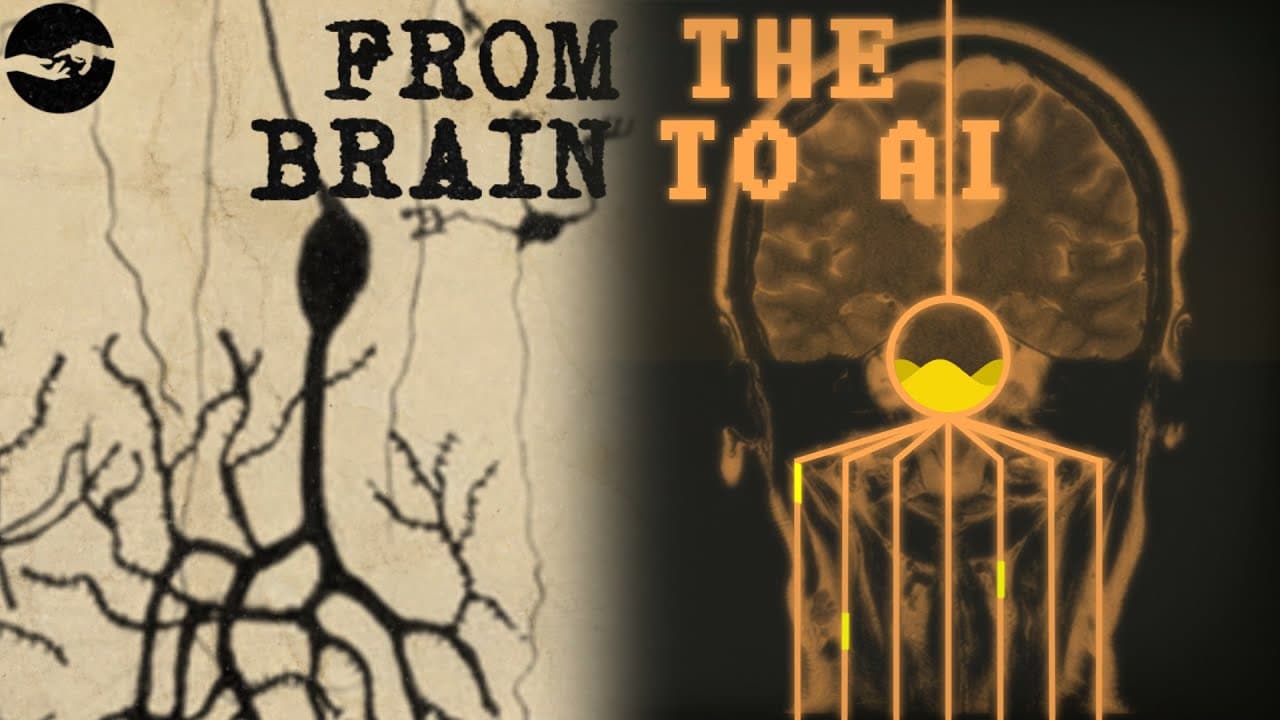
From The Brain To AI (What Are Neural Networks)
TL;DR
Exploring the structure and function of artificial neural networks compared to the human brain.
Transcript
To support the production of more high-quality content consider supporting us on Patreon or YouTube membership. Additionally, consider visiting our parent company, EarthOne. For sustainable living made simple! In the last video in this series, we discussed the differences between deep-learning and machine-learning. How and when the field of deep le... Read More
Key Insights
- 🧠 Neural networks mimic the brain's pattern recognition but excel at specialized tasks.
- 🧠 A neuron's structure in artificial systems mirrors the brain's components - soma, axon, and dendrites.
- 📶 Connection strengths between neurons determine signal transmission and data representation.
- 🏑 Neural networks enhance automation and data processing in fields like image recognition and predictive modeling.
- 🥺 Understanding neural networks can lead to insights in artificial intelligence and automation.
- 🍵 Complex neural networks can handle various types of data for predictive analysis.
- 🛰️ Artificial systems can benefit from neural network modeling for efficient automation.
Install to Summarize YouTube Videos and Get Transcripts
Explore YouTube Video Summarizer or Get YouTube Transcript Extractor
Questions & Answers
Q: How do artificial neural networks compare to the human brain?
Artificial neural networks excel at specific tasks, unlike the complex, multi-functional human brain. They mimic the brain's pattern recognition but are designed for specialized functions.
Q: What are the components of a neuron in the context of neural networks?
The soma serves as the information processing center, the axon transmits signals, and dendrites receive inputs from other neurons, replicating the brain's structure in artificial systems.
Q: How do connections between neurons work in a neural network?
Connections, known as synapses, determine the strength of signal transmission between neurons. Varying connection strengths enable data representation and processing in complex neural networks.
Q: What role do neural networks play in automation and data processing?
Neural networks can analyze massive amounts of data, extract meaningful representations, and automate tasks like image recognition, speech processing, and predictions in various fields.
Summary & Key Takeaways
-
Artificial neural networks, like the human brain, process information but excel at specific tasks.
-
Neurons in neural networks have three main components - soma, axon, and dendrites.
-
Neural networks can represent complex data and enhance automation in various fields.
Read in Other Languages (beta)
Share This Summary 📚
Summarize YouTube Videos and Get Video Transcripts with 1-Click
Try YouTube Summary with ChatGPT & Claude or YouTube Transcript Generator
Explore More Summaries from Futurology — An Optimistic Future 📚





Summarize YouTube Videos and Get Video Transcripts with 1-Click
Try YouTube Summary with ChatGPT & Claude or YouTube Transcript Generator