Boundary Layer Problem 1 - Boundary Layer Flow - Fluid Mechanics 1
TL;DR
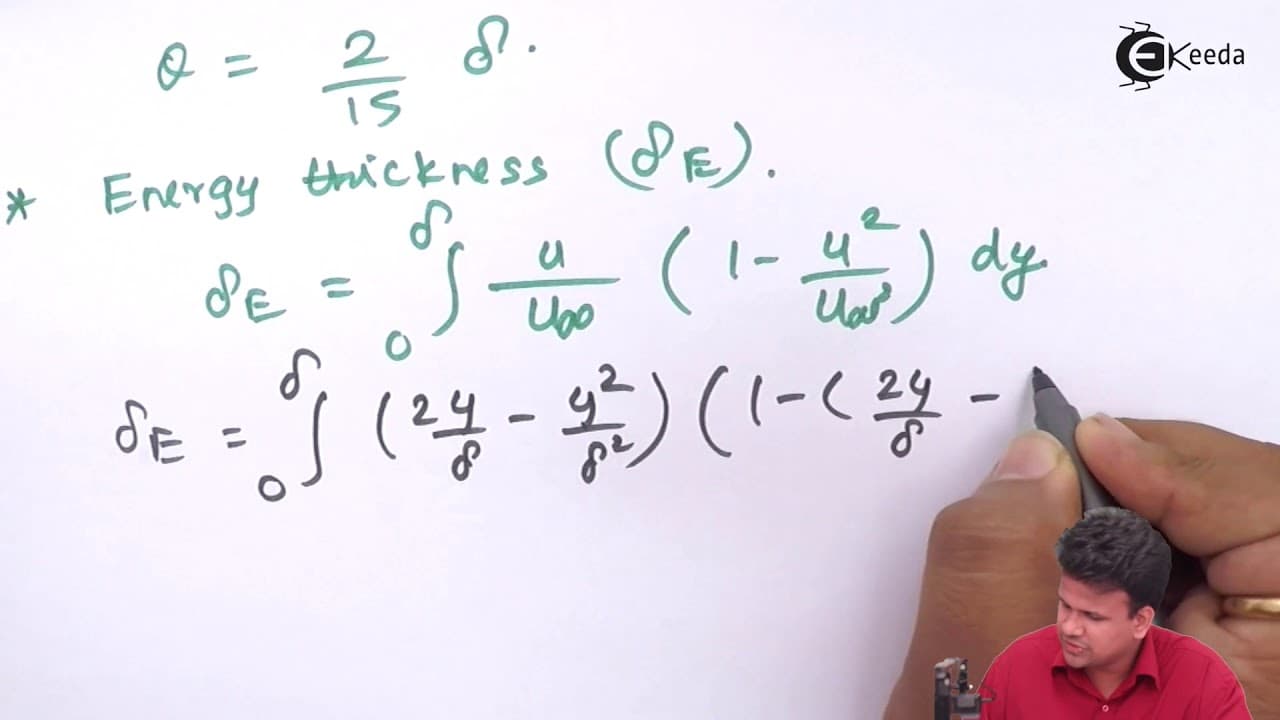
This analysis explores the application of boundary layer theory to solve a specific problem and calculate various parameters such as boundary layer thickness, shear stress, momentum thickness, energy thickness, and coefficient of drag.
Transcript
as we have studied in boundary layer theory that is conservation of mass momentum and energy which will give us energy thickness momentum thickness as well as the displacement thickness as well as we have seen what is one garments integral equation so applying all those formulas will solve problems on boundary layer theory so we have a problem over... Read More
Key Insights
- 💆 Boundary layer theory is based on the principles of conservation of mass, momentum, and energy.
- ❓ Displacement thickness, momentum thickness, and energy thickness are important parameters in boundary layer theory.
- ❓ Calculations involving boundary layer theory can be simplified using substitution and integration techniques.
- 🐲 Shear stress, drag force, and coefficient of drag are key quantities related to the boundary layer and can be determined using boundary layer theory and relevant equations.
- 🎴 Reynolds number plays a significant role in determining various properties of the boundary layer and drag forces experienced by bodies in fluid flow.
- 🦾 Understanding boundary layer theory and its applications is essential for solving complex fluid mechanics problems.
- 😒 Shortcut methods and the use of calculators can expedite the calculations involved in boundary layer problems.
Install to Summarize YouTube Videos and Get Transcripts
Explore YouTube Video Summarizer or Get YouTube Transcript Extractor
Questions & Answers
Q: What is the displacement thickness?
Displacement thickness is a measure of the reduction in thickness of the boundary layer due to the flow separation from the body. It is calculated by integrating the difference between the free stream velocity and the local velocity distribution across the boundary layer.
Q: How is momentum thickness calculated?
Momentum thickness is a measure of the boundary layer's ability to transport momentum. It is calculated by integrating the product of the velocity distribution and the difference between the free stream velocity and the local velocity across the boundary layer.
Q: What is energy thickness?
Energy thickness represents the energy loss caused by the boundary layer. It is calculated by integrating the product of the velocity distribution and the difference between the free stream velocity squared and the local velocity squared across the boundary layer.
Q: How is shear stress related to the boundary layer?
Shear stress is the force per unit area acting parallel to the surface in the boundary layer. It is calculated using Carman's momentum equation, which relates shear stress to the velocity gradient within the boundary layer.
Q: How is the drag force determined?
The drag force is determined by multiplying the shear stress by the width of the body and the length of the boundary layer. It represents the resistance experienced by the body due to the flow of the fluid around it.
Q: How is the coefficient of drag calculated?
The coefficient of drag is the ratio of drag force to the dynamic pressure of the fluid. It is calculated by dividing the drag force by half the fluid density multiplied by the free stream velocity squared and the planform area of the body.
Summary & Key Takeaways
-
The content explains the use of conservation of mass, momentum, and energy in boundary layer theory to solve problems.
-
The problem given involves finding the expression for boundary layer thickness, shear stress, coefficient of drag, and other parameters in terms of Reynolds number.
-
The content provides step-by-step calculations using formulas and substitution methods to find the values of displacement thickness, momentum thickness, energy thickness, and other parameters.
Read in Other Languages (beta)
Share This Summary 📚
Summarize YouTube Videos and Get Video Transcripts with 1-Click
Try YouTube Summary with ChatGPT & Claude or YouTube Transcript Generator
Explore More Summaries from Ekeeda 📚


Summarize YouTube Videos and Get Video Transcripts with 1-Click
Try YouTube Summary with ChatGPT & Claude or YouTube Transcript Generator