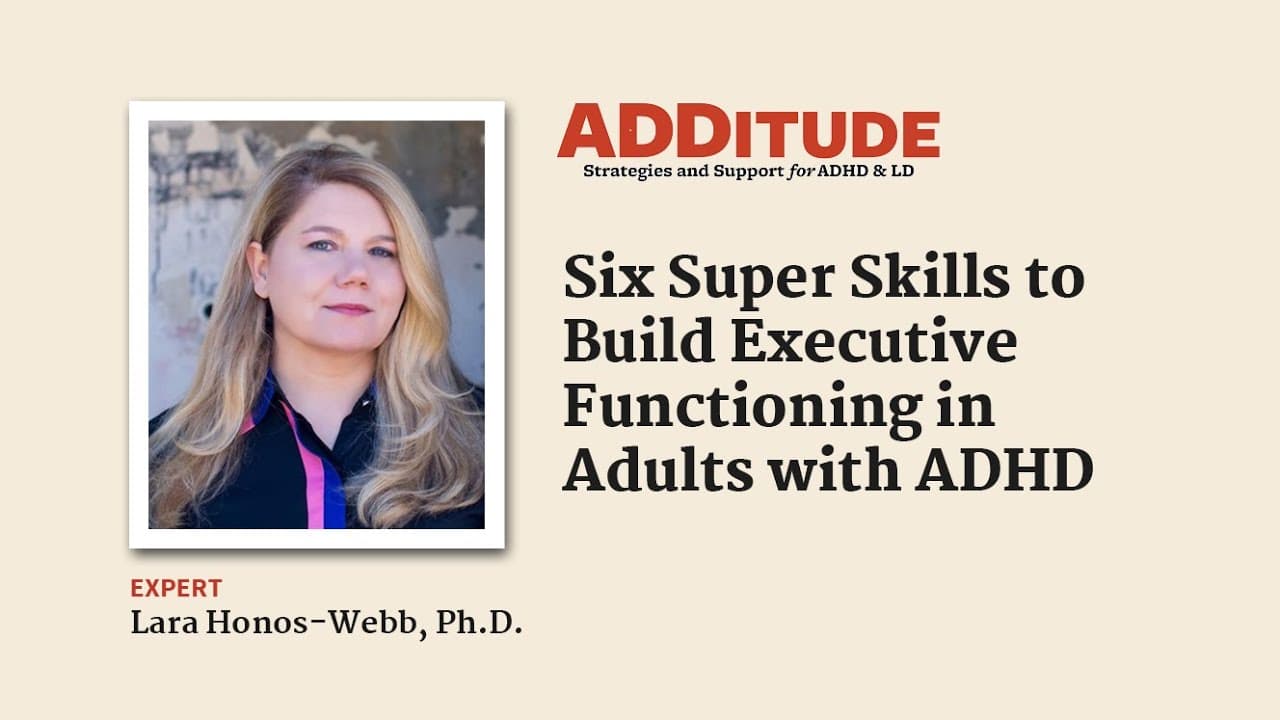
Six Super Skills to Build Executive Functioning in Adults with ADHD (with Lara Honos-Webb, Ph.D.)
TL;DR
Dr. Lara Honos-Webb shares six skills to enhance executive functioning in adults with ADHD.
Transcript
hey everyone hello attitude listeners i'm susan kaufman i'm here for attitude magazine thank you all so much for joining us this week for our adhd experts presentation building executive functioning in adults with adhd this is this will be podcast episode 359 for our podcast listeners um you may be wondering what executive function ... Read More
Key Insights
- Executive functioning is crucial for planning, taking action, and maintaining focus, especially for adults with ADHD.
- Dr. Lara Honos-Webb introduces six super skills that can improve executive functioning: finding gifts, setting goals, chunking, boosting motivation, managing mood, and attention management.
- The concept of 'finding gifts' involves recognizing personal strengths and utilizing them to counter negative self-beliefs, which can reduce anxiety and depression.
- Setting goals across various life domains, such as relationships and health, can enhance planning skills and provide a sense of control, boosting happiness.
- Chunking is the process of breaking tasks into smaller, manageable steps, which can significantly increase motivation and reduce procrastination.
- Motivational interviewing techniques can help develop a discrepancy between procrastination and action, fostering self-efficacy and enhancing motivation.
- Managing mood is closely linked to motivation; practices like self-compassion and empathy for one's future self can reduce procrastination.
- Attention can be improved through interest, sleep, stress management, exercise, and time in nature, which are all supported by scientific research.
Install to Summarize YouTube Videos and Get Transcripts
Explore YouTube Video Summarizer or Get YouTube Transcript Extractor
Questions & Answers
Q: What are the six super skills introduced by Dr. Lara Honos-Webb?
The six super skills are finding gifts, setting goals, chunking, boosting motivation, managing mood, and attention management. These skills are designed to improve executive functioning in adults with ADHD by leveraging personal strengths, breaking tasks into manageable steps, and enhancing focus and motivation.
Q: How does finding gifts help adults with ADHD?
Finding gifts involves identifying personal strengths and using them to counteract negative self-beliefs. This approach can reduce anxiety and depression by shifting focus from perceived weaknesses to inherent strengths, fostering a positive self-image and increasing motivation.
Q: What is the role of chunking in managing tasks?
Chunking involves breaking tasks into smaller, manageable steps, which can significantly increase motivation and reduce procrastination. By focusing on the next actionable step, individuals can overcome the overwhelming nature of large tasks and make consistent progress toward their goals.
Q: How can motivational interviewing enhance motivation?
Motivational interviewing helps develop a discrepancy between procrastination and action by encouraging individuals to envision the consequences of both paths. Supporting self-efficacy and task-specific confidence, this technique fosters a proactive mindset and enhances motivation to take action.
Q: What strategies can help manage mood in adults with ADHD?
Managing mood involves practices like self-compassion, empathy for one's future self, and focusing on past accomplishments. These strategies help shift negative emotions, reduce procrastination, and enhance motivation by fostering a positive outlook and emotional regulation.
Q: How does attention management relate to executive functioning?
Attention management is crucial for executive functioning as it involves maintaining focus and avoiding distractions. Techniques such as interest-driven tasks, adequate sleep, stress management, and time in nature can enhance attention, leading to improved cognitive performance and task completion.
Q: What is the significance of setting goals in improving executive functions?
Setting goals enhances planning skills, provides a sense of control, and boosts happiness by shifting focus from fears to attainable future outcomes. Writing down goals and their purposes increases the likelihood of progress and helps maintain motivation by clarifying the 'why' behind each goal.
Q: How can nature exposure benefit cognitive functioning?
Nature exposure has been shown to improve cognitive functioning without any known side effects. It can enhance attention, reduce stress, and improve overall well-being, making it a valuable, cost-effective strategy for boosting executive functioning in adults with ADHD.
Summary & Key Takeaways
-
Dr. Lara Honos-Webb discusses the importance of executive functioning in adults with ADHD, highlighting six super skills that can enhance these abilities. These skills aim to leverage personal strengths, set achievable goals, and improve attention and motivation.
-
The six super skills include finding personal gifts, setting goals, chunking tasks, boosting motivation, managing mood, and practicing attention management. Each skill is designed to address common challenges faced by adults with ADHD.
-
Dr. Honos-Webb emphasizes the significance of mood management and motivation, noting that techniques like motivational interviewing and self-compassion can help overcome procrastination. Additionally, environmental factors like nature exposure can enhance cognitive functioning.
Read in Other Languages (beta)
Share This Summary 📚
Summarize YouTube Videos and Get Video Transcripts with 1-Click
Try YouTube Summary with ChatGPT & Claude or YouTube Transcript Generator
Explore More Summaries from ADDitude Magazine 📚

Summarize YouTube Videos and Get Video Transcripts with 1-Click
Try YouTube Summary with ChatGPT & Claude or YouTube Transcript Generator