How to Determine if an Improper Integral Converges
TL;DR
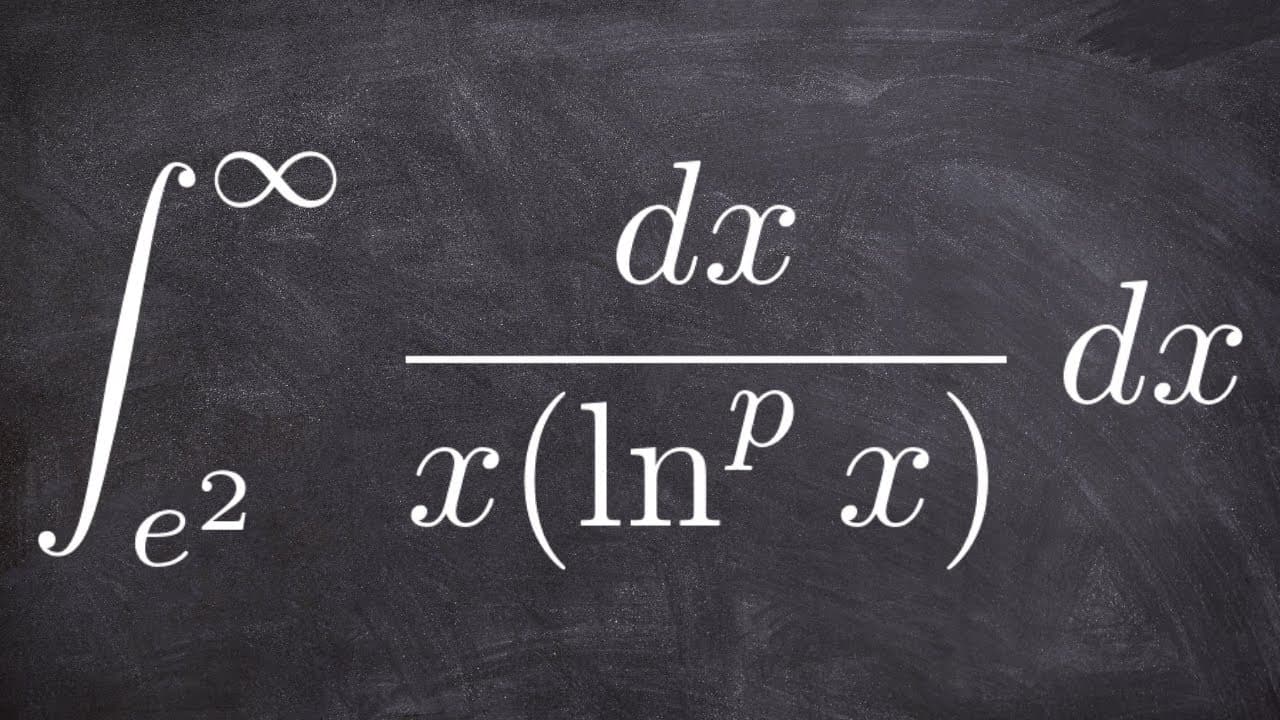
An improper integral of the form ∫(1/(x(lnx)ⁱ)) from e² to infinity converges if it results in a finite number. In this case, it converges to 1/((e-1)(2^(e-1))) when p > 1, where p is the exponent in the natural log term.
Transcript
i in this problem we're going to evaluate this improper integral and determine if it converges or if it diverges so if we get a real number as an answer then we can say that the improper integral converges if we get infinity negative infinity or does not exist then it will diverge in order to do this problem just to simplify the process i'm going t... Read More
Key Insights
- ❓ Simplifying indefinite integrals before tackling improper integrals streamlines the process.
- ☺️ Utilizing u substitution with u as the natural log of x helps in integrating the function effectively.
- ⛔ Replacing infinity with a limit in improper integrals is crucial for definite integral calculations.
Install to Summarize YouTube Videos and Get Transcripts
Explore YouTube Video Summarizer or Get YouTube Transcript Extractor
Questions & Answers
Q: What is the approach to solving improper integrals in this problem?
The approach involves simplifying the process by first doing the indefinite integral, followed by making a u substitution with u as the natural log of x.
Q: How does the natural log manipulation help in this problem?
By letting u be the natural log of x, the derivative simplifies to 1/x, aiding in integrating the function and determining convergence.
Q: Why is it crucial to replace infinity with a limit in improper integrals?
Replacing infinity with a limit allows for a definite integral calculation, crucial in determining convergence or divergence of the improper integral.
Q: What is key to identifying convergence or divergence in improper integrals?
Understanding that for an improper integral to converge, the result should be a real number, such as the final answer of 1/(e-1)(2^(e-1)) indicating convergence.
Summary & Key Takeaways
-
Simplifying the process by first doing the indefinite integral.
-
Making a u substitution by letting u be the natural log of x.
-
Integrating from e² to infinity to determine convergence.
Read in Other Languages (beta)
Share This Summary 📚
Summarize YouTube Videos and Get Video Transcripts with 1-Click
Try YouTube Summary with ChatGPT & Claude or YouTube Transcript Generator
Explore More Summaries from The Math Sorcerer 📚
Summarize YouTube Videos and Get Video Transcripts with 1-Click
Try YouTube Summary with ChatGPT & Claude or YouTube Transcript Generator