Human evolution overview | Life on earth and in the universe | Cosmology & Astronomy | Khan Academy
TL;DR
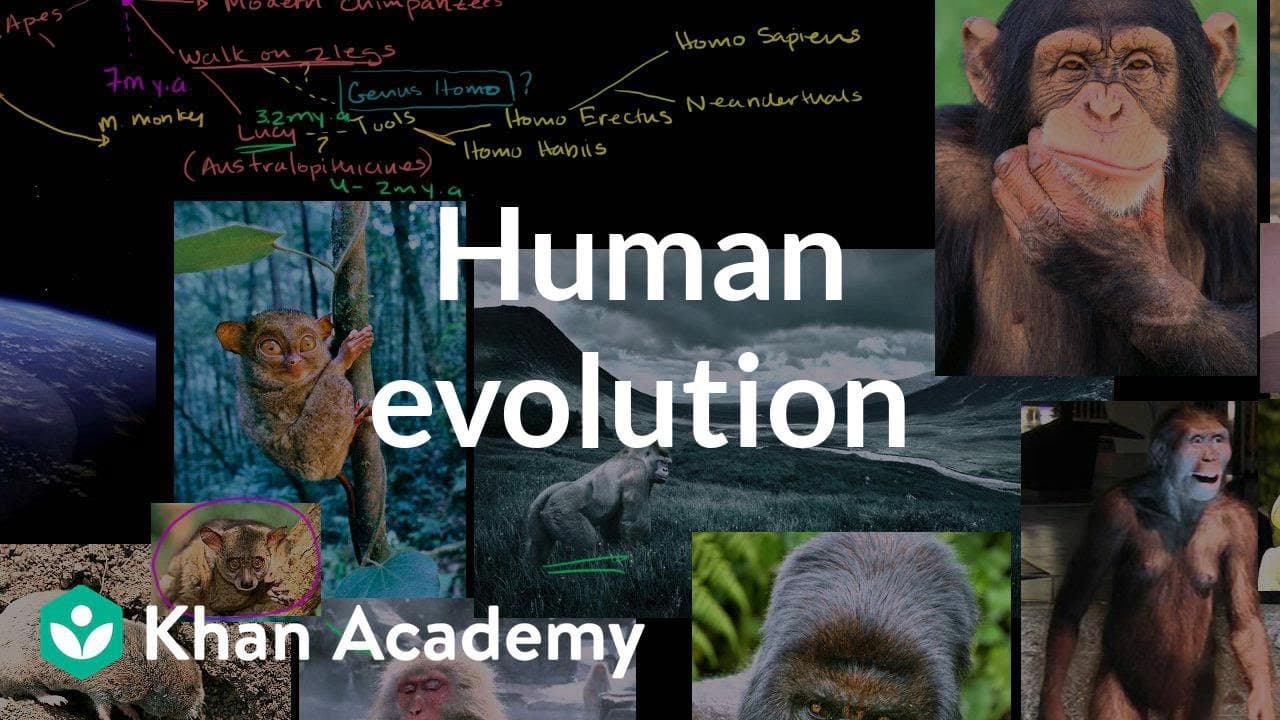
A comprehensive analysis of the evolution of humans, starting from primitive rodent-like ancestors to the emergence of Homo sapiens.
Transcript
If we were to rewind the clock back about 70 million years, you would see dinosaurs roaming the Earth. And this is a very nice picture here of a dinosaur enjoying a sunset at the beach. But unfortunately for the dinosaurs, about 65 million years ago, we believe that a huge meteorite struck the earth and essentially wiped out the dinosaurs. And it p... Read More
Key Insights
- 🫤 A mass extinction event, including a meteorite strike, wiped out dinosaurs and numerous other species around 65 million years ago.
- 🙈 Primitive primates, resembling rodent-like animals, survived the extinction event and evolved into primitive primates, followed by monkeys and then apes.
- 🫤 Humans share a common ancestor with chimpanzees, separating approximately 7 million years ago, while the earliest human fossils date back around 200,000 years.
Install to Summarize YouTube Videos and Get Transcripts
Explore YouTube Video Summarizer or Get YouTube Transcript Extractor
Questions & Answers
Q: What caused the extinction of dinosaurs?
A massive meteorite strike is believed to have wiped out dinosaurs around 65 million years ago, causing a mass extinction event.
Q: How did primitive primates survive the extinction event?
Primitive primates, similar to mole-like rodents, may have survived due to their ability to hibernate underground and have access to nearby food sources.
Q: How did monkeys and apes evolve from primitive primates?
Descendants of primitive primates who were good at climbing trees and finding food and protection in trees eventually evolved into primitive monkeys and apes.
Q: What distinguishes great apes from monkeys?
Great apes, including gorillas and chimpanzees, are larger than monkeys and do not have tails like monkeys do.
Q: When did humans have a common ancestor with chimpanzees?
Based on DNA and fossil evidence, it is believed that humans had a common ancestor with chimpanzees about 7 million years ago.
Q: What is the significance of the Lucy fossil?
The Lucy fossil, belonging to the australopithecine species, provides insight into an ancestral primate that lived approximately 3.2 million years ago and had the ability to stand upright.
Q: When did Homo habilis and Homo erectus exist?
Homo habilis, also known as "handy man," and Homo erectus coexisted between 2.3 and 1.4 million years ago.
Q: Were Neanderthals more primitive than humans?
Neanderthals, part of the Homo genus, were either cousin species or sub-species of humans, and there is evidence of possible interbreeding with Homo sapiens.
Summary & Key Takeaways
-
Around 70 million years ago, dinosaurs roamed the Earth until a meteorite strike wiped them out, along with many other species.
-
Primitive rodent-like animals survived the mass extinction event and evolved into primitive primates, followed by primitive monkeys.
-
Some of these monkeys evolved into apes, including gorillas, chimpanzees, and eventually the ancestor of humans.
Read in Other Languages (beta)
Share This Summary 📚
Summarize YouTube Videos and Get Video Transcripts with 1-Click
Try YouTube Summary with ChatGPT & Claude or YouTube Transcript Generator
Explore More Summaries from Khan Academy 📚



Summarize YouTube Videos and Get Video Transcripts with 1-Click
Try YouTube Summary with ChatGPT & Claude or YouTube Transcript Generator