Life History Traits | Biology
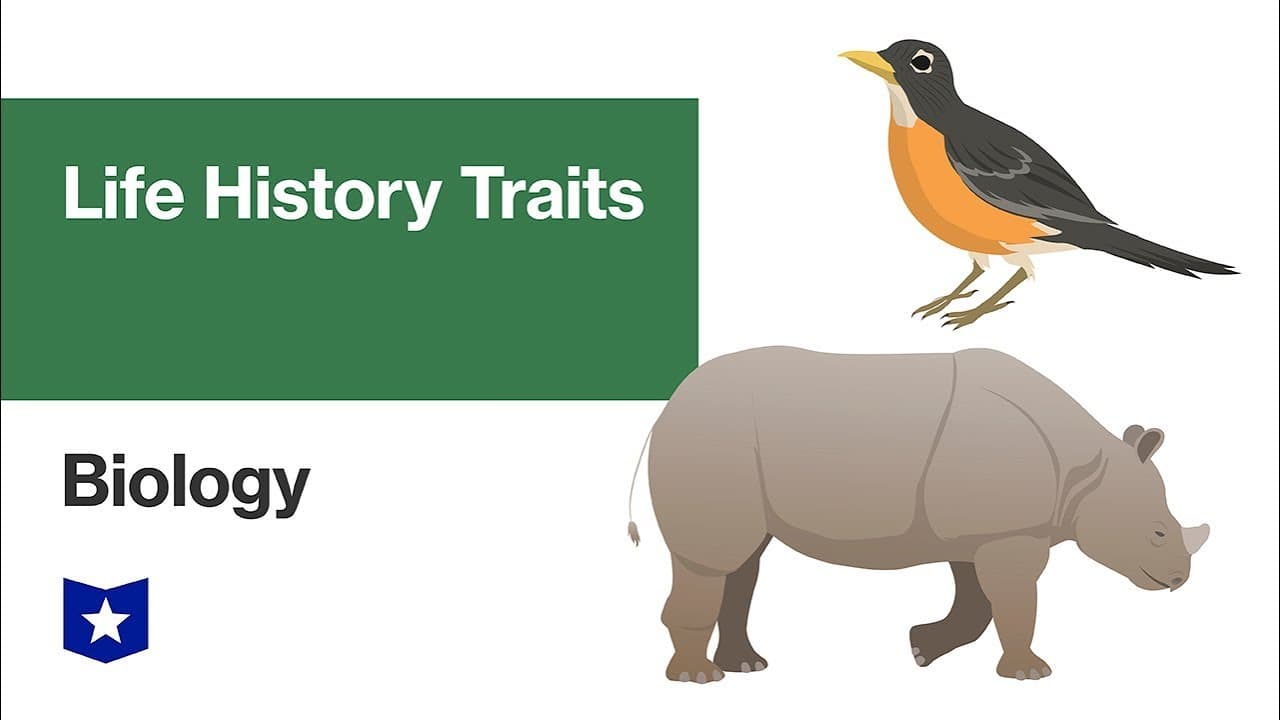
TL;DR
Evolution favors traits that balance survival and reproduction, seen in species life history traits and population demographics.
Transcript
natural selection favors traits that improve an organism's chances of survival and reproductive success in every species there are trade-offs between survival and traits such as frequency of reproduction a number of offspring produced the traits that affect an organism schedule of reproduction and survival make up its life history life history trai... Read More
Key Insights
- 🛟 Natural selection shapes life history traits to optimize organisms' fitness by balancing survival and reproduction.
- 😒 Demographers use life tables to track population vital statistics and understand demographic changes.
- ☠️ Survivorship curves categorize species based on mortality rates at different life stages, influencing reproductive strategies.
- 😋 Fecundity and mortality rates vary among species and are influenced by environmental factors like food supply.
- 🛟 Understanding the interplay between life history traits, demography, and environmental pressures is crucial for predicting species' evolutionary trajectories.
- 🛟 Different species exhibit varying reproductive strategies based on their life history traits and survivorship curves.
- ☠️ Environmental stresses can impact fecundity rates and mortality, shaping the dynamics of populations over time.
Install to Summarize YouTube Videos and Get Transcripts
Explore YouTube Video Summarizer or Get YouTube Transcript Extractor
Questions & Answers
Q: How do life history traits like growth rate and reproductive lifespan evolve in species?
Life history traits are shaped by natural selection, balancing survival and reproduction to maximize fitness. Species adapt based on environmental pressures and trade-offs to enhance their chances of reproductive success.
Q: How do demographers use life tables to study populations?
Life tables track vital statistics like survival rates at different developmental stages, providing insights into population dynamics and changes over time. Demographers analyze these data to understand how demographics influence species' evolution.
Q: What do survivorship curves reveal about species' mortality rates?
Survivorship curves categorize species based on mortality patterns, influencing their reproductive strategies. Understanding these curves helps predict how different species allocate resources between survival and reproduction.
Q: How do environmental factors like food supply impact fecundity and mortality rates?
Environmental stresses like low food supply can affect fecundity rates, altering species' reproductive strategies. Mortality rates may also increase due to disease, predation, or other factors, shaping population dynamics and evolutionary trajectories.
Summary & Key Takeaways
-
Natural selection favors traits that enhance survival and reproduction, balancing trade-offs such as growth rate and reproductive lifespan.
-
Demographers study vital statistics of populations, using life tables to track survival rates across developmental stages.
-
Survivorship curves categorize species based on mortality rates at different life stages, influencing reproductive strategies.
Read in Other Languages (beta)
Share This Summary 📚
Summarize YouTube Videos and Get Video Transcripts with 1-Click
Try YouTube Summary with ChatGPT & Claude or YouTube Transcript Generator
Explore More Summaries from Course Hero 📚




Summarize YouTube Videos and Get Video Transcripts with 1-Click
Try YouTube Summary with ChatGPT & Claude or YouTube Transcript Generator