Algebra 44 - Solving Systems of Equations in Three Variables
TL;DR
In this lecture, Professor Von Schmohawk explains how to solve systems of three linear equations in three variables using elimination and substitution methods.
Transcript
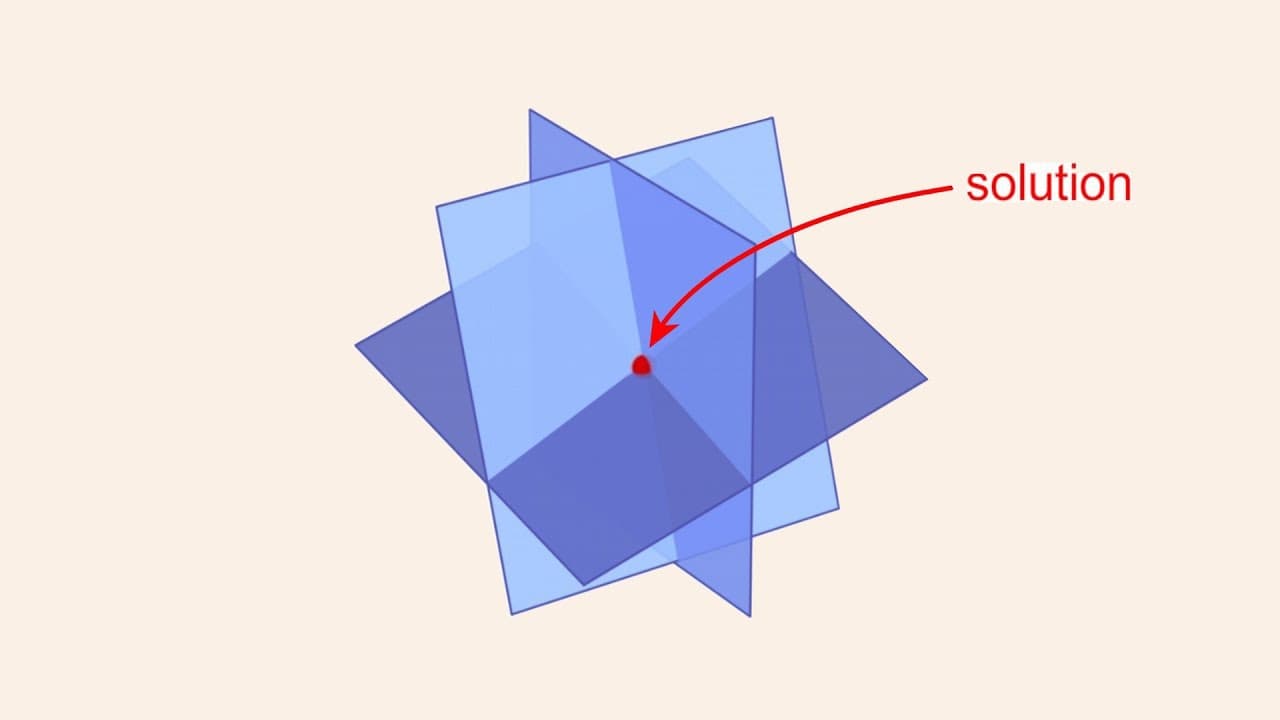
Hello. I'm Professor Von Schmohawk and welcome to Why U. In the last lecture, we saw that just as systems of two linear equations in two variables have a single unique solution when the two lines in the system intersect at a single point systems of three linear equations in three variables have a unique solution when the three planes intersect at ... Read More
Key Insights
- 😥 Systems of three linear equations in three variables have a unique solution when the three planes intersect at a single point.
- ❓ The elimination method can be used to solve systems of equations in two variables and can also be applied to systems of equations in three variables.
- ❓ Solving a system of three equations in three variables involves more steps than solving a system of two equations, but the basic techniques remain the same.
- ☺️ By choosing different pairs of equations and eliminating variables, a system of two equations in two variables is created to find the values of x and z.
- 🤪 The values of x, y, and z can then be substituted back into any of the original equations to find the value of the remaining variable.
- ❓ This method of solving systems of equations can determine a unique solution, but it does not determine whether there are infinite solutions or no solution.
Install to Summarize YouTube Videos and Get Transcripts
Explore YouTube Video Summarizer or Get YouTube Transcript Extractor
Questions & Answers
Q: How can systems of three linear equations in three variables be solved?
Systems of three equations in three variables can be solved using the elimination and substitution methods. By eliminating one variable, creating a system of two equations in two variables, and then substituting the values found, the solution can be determined.
Q: What is the purpose of the elimination method in solving systems of equations?
The elimination method is used to eliminate one variable from a system of equations. By adding or subtracting equations, a new equation is formed with fewer variables, making it solvable.
Q: What is the importance of creating a system of two equations in two variables?
Creating a system of two equations in two variables allows for the solution of x and z. This is achieved by using a different pair of equations than the ones used to obtain the first equation, ensuring a unique solution.
Q: How is the value of the remaining variable, y, determined?
Once the values of x and z are found, they can be substituted back into any of the original equations to solve for y. This step completes the solution for the system of three equations.
Summary & Key Takeaways
-
Systems of three linear equations in three variables have a unique solution when the three planes intersect at a single point.
-
The elimination method can be used to solve systems of equations in two variables and can also be applied to systems of equations in three variables.
-
To solve a system of three equations in three variables, choose two equations and eliminate one variable using the elimination method, then create a system of two equations in two variables to find the values of x and z, and finally substitute these values to find the value of y.
Read in Other Languages (beta)
Share This Summary 📚
Summarize YouTube Videos and Get Video Transcripts with 1-Click
Try YouTube Summary with ChatGPT & Claude or YouTube Transcript Generator
Explore More Summaries from MyWhyU 📚



Summarize YouTube Videos and Get Video Transcripts with 1-Click
Try YouTube Summary with ChatGPT & Claude or YouTube Transcript Generator