The Standard Turing Machine Problem 5
TL;DR
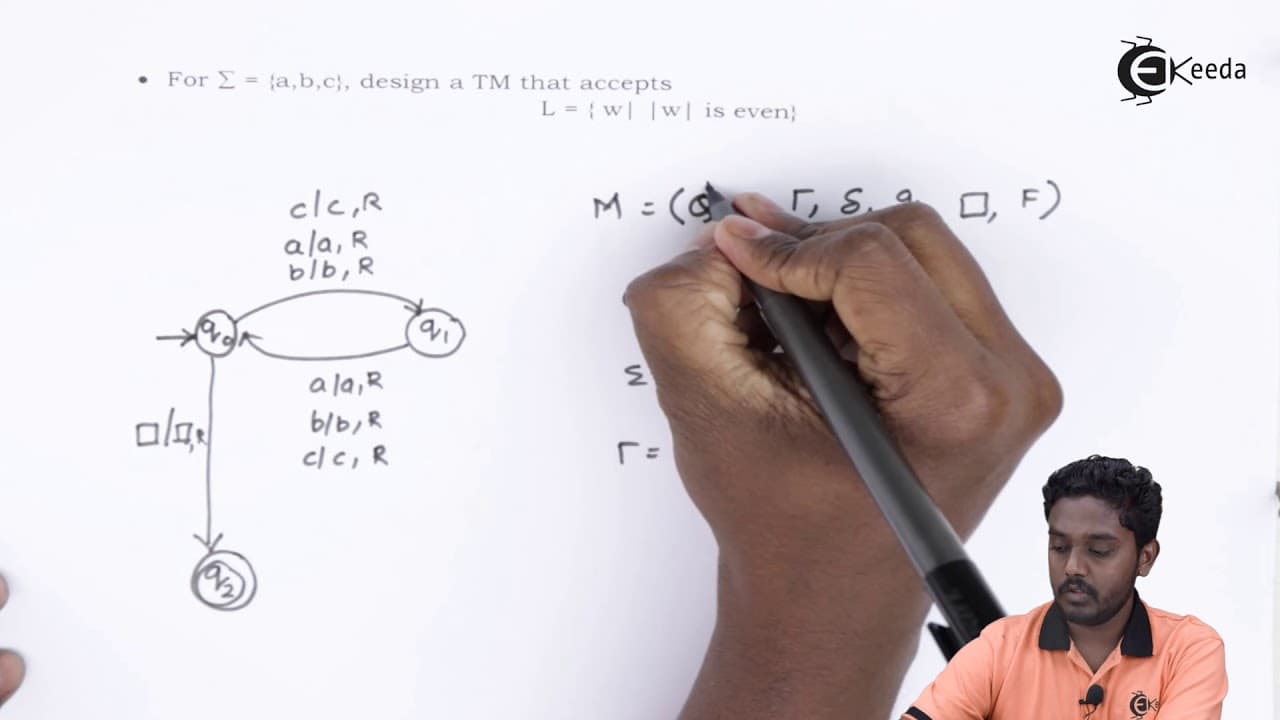
Designing a Turing machine to recognize regular languages, specifically accepting all strings of even length.
Transcript
click the Bell icon to get latest videos from equator hello friends let us see one more example in which we are designing a turing machine for a regular language we are taking Sigma to be a B or C and accepting all strings of even length let's start with the construction of the TM first q0 is taken as the initial state on the first inbound prints o... Read More
Key Insights
- 🤟 Turing machines can be designed to recognize and process regular languages.
- 😫 Symbol sets and state transitions play a crucial role in determining the acceptance of a string.
- 👷 Mathematical components like states, alphabets, transition functions, and final states are essential in constructing Turing machines.
- 👻 Instantaneous description notation allows for the tracking of machine states during string processing.
Install to Summarize YouTube Videos and Get Transcripts
Explore YouTube Video Summarizer or Get YouTube Transcript Extractor
Questions & Answers
Q: What is the purpose of designing a Turing machine for a regular language?
Designing a Turing machine for a regular language allows for the recognition and processing of specific patterns and structures within strings. It enables the identification of strings that meet certain criteria.
Q: How does the Turing machine determine the evenness of the string length?
The Turing machine starts in state q0 and moves to state q1 whenever it encounters symbol B or C. It loops back to q0 when it encounters any other symbols. When it reaches q0 again with a blank symbol, it transitions to the final state q2, indicating an even number of symbols in the string.
Q: What are the mathematical components involved in the construction of the Turing machine?
The components of the Turing machine include the set of states (Q), the input alphabet (Sigma), the tape alphabet (Tau), the initial state (Q0), the blank symbol, the transition function (Delta), and the set of final states (F).
Q: How is the Turing machine able to recognize and accept strings of even length using the constructed machine?
The Turing machine uses the states and transition rules to keep track of the number of symbols encountered. By reaching state q0 with a blank symbol, it indicates that the count of symbols encountered is even, and thus transitions to the final state q2, accepting the string.
Summary & Key Takeaways
-
Turing machine is designed to recognize a regular language for strings of even length.
-
Symbol set Sigma includes B and C, and the machine accepts all strings of even length.
-
The machine uses states q0, q1, and q2 to determine the evenness of the string length.
Read in Other Languages (beta)
Share This Summary 📚
Summarize YouTube Videos and Get Video Transcripts with 1-Click
Try YouTube Summary with ChatGPT & Claude or YouTube Transcript Generator
Explore More Summaries from Ekeeda 📚


Summarize YouTube Videos and Get Video Transcripts with 1-Click
Try YouTube Summary with ChatGPT & Claude or YouTube Transcript Generator