Aspects Of Database Design - Database Design and the E-R Model - Database Management System
TL;DR
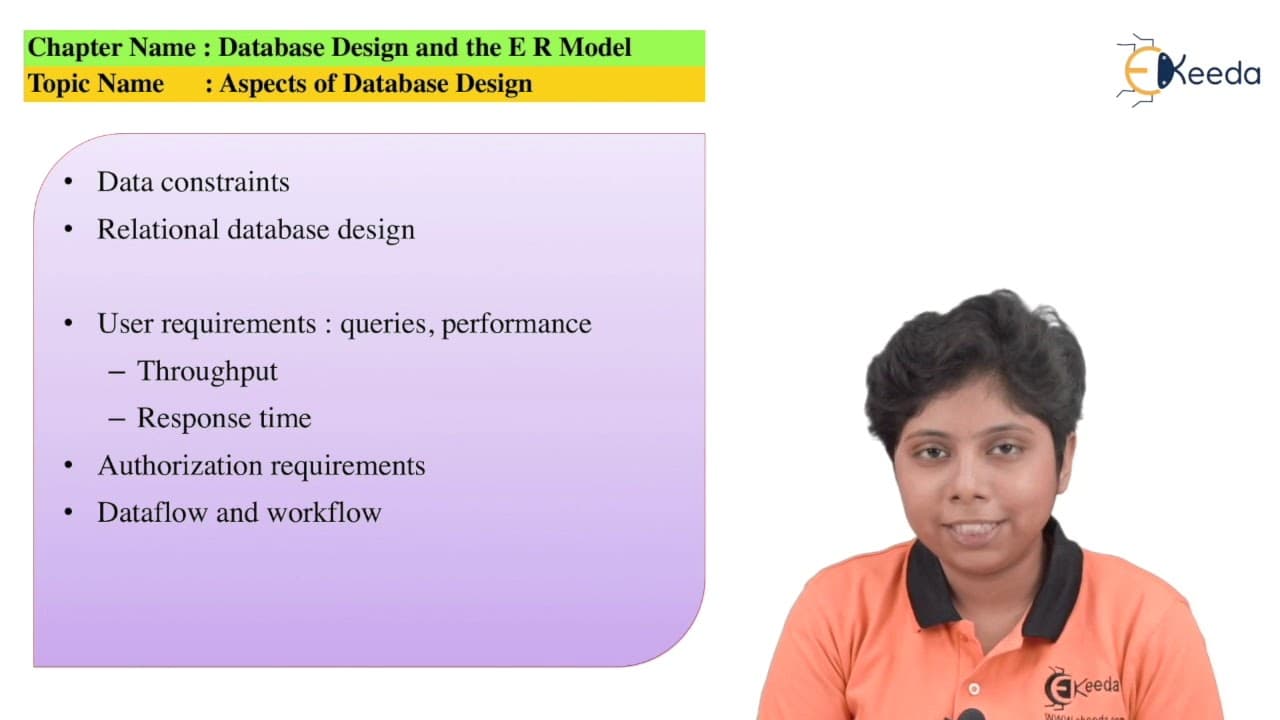
This video discusses the key aspects of database design, including data constraints, relational schemas, authorization, throughput, response time, data flow, workflow, and user interaction.
Transcript
click the bell icon to get latest videos from ekeeda hello friends today we will discuss about the aspects of database design as a whole we will first discuss about the data constraints and the relational schemas next we will go to the authorization next we will go to the throughput and the response time and last we will discuss all the workflow an... Read More
Key Insights
- 🖐️ Data constraints, including integrity constraints and referential integrity, play a crucial role in maintaining data quality and consistency.
- 🚰 Relational schemas establish relationships between tables, enabling efficient data retrieval and manipulation.
- 👤 Authorization defines user privileges, ensuring secure access to data and preventing unauthorized actions.
- ⌛ Throughput and response time are important metrics in database design, indicating the efficiency and performance of the system.
- 💁 Data flow and workflow design are essential for organized and smooth information transfer within a database.
- 👤 User interaction and feedback in the design process are critical for creating a functional and user-friendly database.
- ⚖️ Preservation and modification of fundamental schema requirements strike a balance between maintaining consistency and accommodating changes.
Install to Summarize YouTube Videos and Get Transcripts
Explore YouTube Video Summarizer or Get YouTube Transcript Extractor
Questions & Answers
Q: What are data constraints and why are they important in database design?
Data constraints, such as integrity and referential integrity constraints, ensure that data in a database follows predefined rules and restrictions. These constraints maintain data integrity, prevent data inconsistencies, and enforce data quality.
Q: How do relational schemas connect different tables in a database?
Relational schemas define relationships between tables in a database, such as the relationship between an instructor and a student. By establishing these relationships, we can connect data from different tables and ensure the consistency and integrity of the overall database structure.
Q: What is the role of authorization in database design?
Authorization determines the privileges and access rights granted to users for specific data or tables. It ensures that users only have the necessary permissions to perform certain actions, preventing unauthorized access and maintaining data security.
Q: How do throughput and response time impact database design?
Throughput measures the number of queries or transactions a database can handle per unit of time, while response time is the time it takes to complete a query or transaction. A good database design aims to maximize throughput by minimizing response time, ensuring efficient data retrieval and manipulation.
Summary & Key Takeaways
-
Data constraints and relational schemas are important considerations in database design, ensuring that the structure and integrity of the database are maintained.
-
Authorization plays a crucial role in defining access privileges for different users, allowing them to view, update, or modify specific data.
-
Throughput and response time are key metrics in database design, indicating the efficiency of query processing and the speed of transaction execution.
-
Data flow and workflow design are essential for smooth and organized information transfer within a database, facilitating tasks and completing meaningful work.
Read in Other Languages (beta)
Share This Summary 📚
Summarize YouTube Videos and Get Video Transcripts with 1-Click
Try YouTube Summary with ChatGPT & Claude or YouTube Transcript Generator
Explore More Summaries from Ekeeda 📚






Summarize YouTube Videos and Get Video Transcripts with 1-Click
Try YouTube Summary with ChatGPT & Claude or YouTube Transcript Generator