2015 AP Physics 1 free response 1b
TL;DR
This video explains how to derive the magnitude of acceleration for block 2 by analyzing the net forces acting on the block.
Transcript
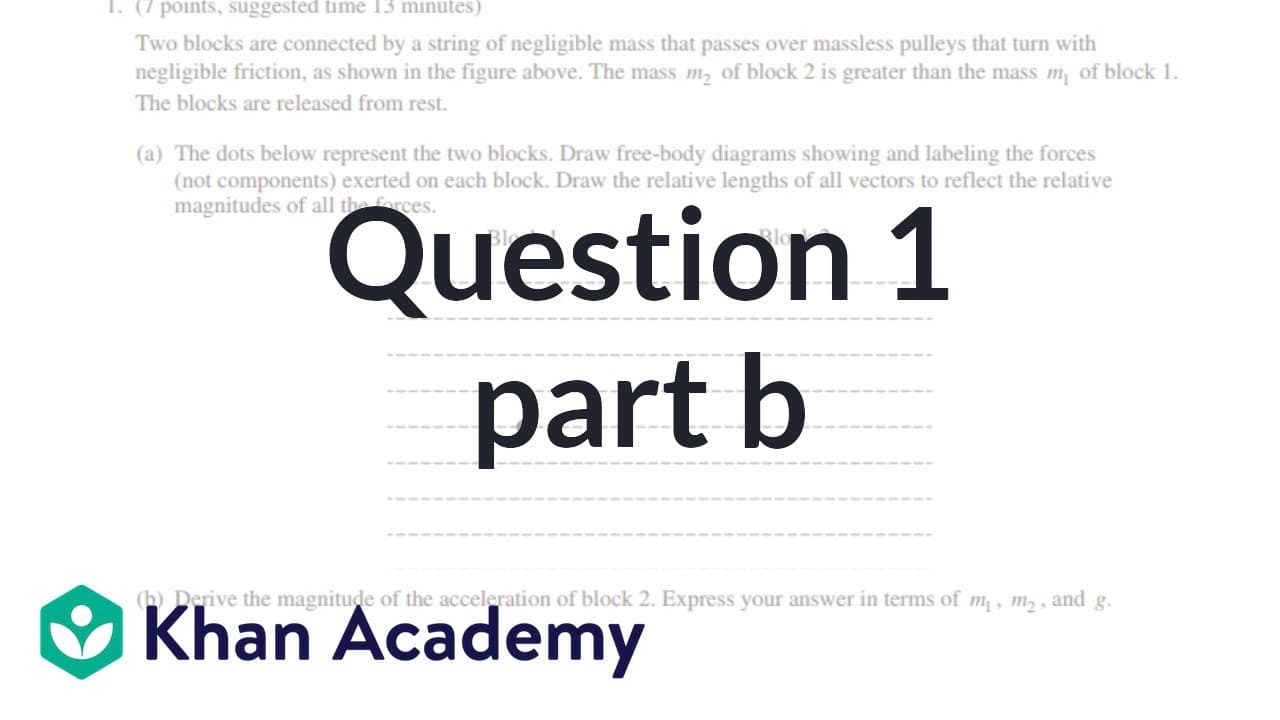
- Alright, let's tackle part b, now. Derive the magnitude of the acceleration of block 2. Express your answer in terms of m1, m2, and g. And like always, try to pause the video and see if you can work through it yourself. We already worked through part 1, or part a, I should say, based on this diagram above, and there's a previous video. So, now we... Read More
Key Insights
- 🚫 The acceleration of block 2 can be determined by analyzing the net forces acting on it, considering the weight of block 2 and the tension in the string.
- 🚫 The magnitude of acceleration for block 2 is the same as the magnitude of acceleration for block 1 due to their connection with the string.
- 🚫 Setting up equations for block 2 and block 1 allows us to solve for the acceleration by eliminating the tension.
- 🧑🏭 An alternative approach can be used by treating the two blocks as one combined mass and analyzing the net forces acting on it. Both approaches yield the same result.
- 😑 The derived equation for the magnitude of acceleration allows us to express it in terms of the masses of the blocks and the acceleration due to gravity.
- 🪐 Understanding the net forces and their effects on the acceleration helps in solving physics problems related to connected objects.
Install to Summarize YouTube Videos and Get Transcripts
Explore YouTube Video Summarizer or Get YouTube Transcript Extractor
Questions & Answers
Q: How is the magnitude of the acceleration of block 2 derived?
The magnitude of the acceleration of block 2 is derived by setting up two equations based on the net forces acting on block 2 and block 1. By eliminating the tension in the equations, we can solve for the acceleration in terms of the masses of the blocks and the acceleration due to gravity.
Q: Why is the magnitude of the acceleration the same for block 1 and block 2?
The magnitude of the acceleration is the same for block 1 and block 2 because they are connected by a string. The net forces acting on both blocks are equal in magnitude, resulting in the same acceleration for both blocks.
Q: Can an alternative approach be used to derive the same answer?
Yes, an alternative approach can be used by considering the two blocks as one combined mass. By analyzing the net forces acting on the combined mass, the magnitude of acceleration can be derived. This approach simplifies the calculation by treating the system as a single object.
Q: What is the significance of eliminating the tension in the equations?
Eliminating the tension allows us to solve the equations for the magnitude of acceleration without directly involving the tension. This allows us to express the acceleration in terms of the masses of the blocks and the acceleration due to gravity, which are known quantities.
Summary & Key Takeaways
-
The video discusses how the acceleration of block 2 can be determined based on the weight of block 2 and the tension in the string connecting the two blocks.
-
The acceleration of block 2 is found to be the same magnitude as the acceleration of block 1 due to their connection with the string.
-
Two equations, one for block 2 and one for block 1, are set up to solve for the acceleration by eliminating the tension in the equations.
-
The derived equation for the magnitude of acceleration of either block 1 or block 2 is presented in terms of the masses of the blocks and the acceleration due to gravity.
Read in Other Languages (beta)
Share This Summary 📚
Summarize YouTube Videos and Get Video Transcripts with 1-Click
Try YouTube Summary with ChatGPT & Claude or YouTube Transcript Generator
Explore More Summaries from Khan Academy 📚



Summarize YouTube Videos and Get Video Transcripts with 1-Click
Try YouTube Summary with ChatGPT & Claude or YouTube Transcript Generator