What Is the First Shifting Theorem in Laplace Transform?
TL;DR
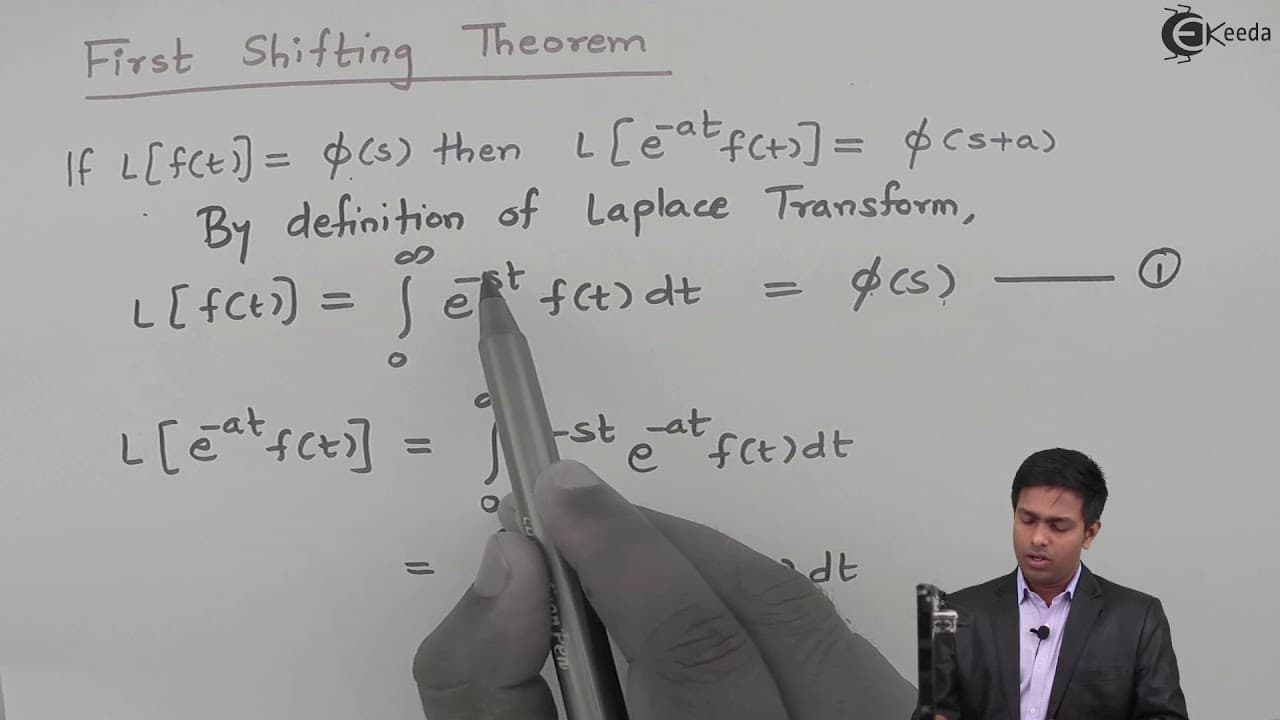
The first shifting theorem states that if a function is multiplied by e^(-at), its Laplace Transform equals the original function evaluated at s+a. This theorem helps in shifting the function's evaluation, making it easier to solve problems in Laplace Transform by understanding how the exponential term affects the outcome.
Transcript
hello friends so today we are gonna learn what is first shifting theorem of laplace transform so if laplace of function of t is given as function of s then the laplace of e raised to minus a t into function of t is equal to function of s plus a so it means that whenever in laplace if our function is getting multiplied with the e raised to minus 80 ... Read More
Key Insights
- ✖️ The first shifting theorem relates the multiplication of a function by e^(-at) to the shifting of its Laplace Transform.
- ❓ The derivation of the theorem involves substituting the exponential function in the definition of Laplace Transform.
- 🍉 The coefficient of t in the exponential term determines the shift in the Laplace Transform.
- ❓ The first shifting theorem can be used to simplify calculations and solve problems in Laplace Transform.
- 😃 The theorem can also be applied when the coefficient of t is positive, resulting in the subtraction of a from the original Laplace Transform.
- 💦 Understanding the first shifting theorem is essential for working with Laplace Transform and solving related problems.
- 🎮 The property can be used in various applications, such as electrical engineering, control systems, and signal processing.
Install to Summarize YouTube Videos and Get Transcripts
Explore YouTube Video Summarizer or Get YouTube Transcript Extractor
Questions & Answers
Q: What is the first shifting theorem of Laplace Transform?
The first shifting theorem states that multiplying a function by e^(-at) results in the Laplace Transform of the original function evaluated at s+a.
Q: How is the first shifting theorem derived?
The theorem is derived by using the definition of Laplace Transform and substituting e^(-at) for the function in the integration.
Q: What is the interpretation of the coefficient of t in the exponential term?
The coefficient of t determines whether the Laplace Transform is evaluated at s+a or s-a. If the coefficient is negative, it is s+a, and if it is positive, it is s-a.
Q: What are the applications of the first shifting theorem?
The first shifting theorem is used in solving problems based on Laplace Transform and simplifying calculations involving exponential terms.
Summary & Key Takeaways
-
The first shifting theorem of Laplace Transform states that multiplying a function by e^(-at) results in the Laplace Transform of the original function evaluated at s+a.
-
The theorem can be derived using the definition of Laplace Transform.
-
The coefficient of t in the exponential term determines whether the Laplace Transform is evaluated at s+a or s-a.
Read in Other Languages (beta)
Share This Summary 📚
Summarize YouTube Videos and Get Video Transcripts with 1-Click
Try YouTube Summary with ChatGPT & Claude or YouTube Transcript Generator
Explore More Summaries from Ekeeda 📚


Summarize YouTube Videos and Get Video Transcripts with 1-Click
Try YouTube Summary with ChatGPT & Claude or YouTube Transcript Generator