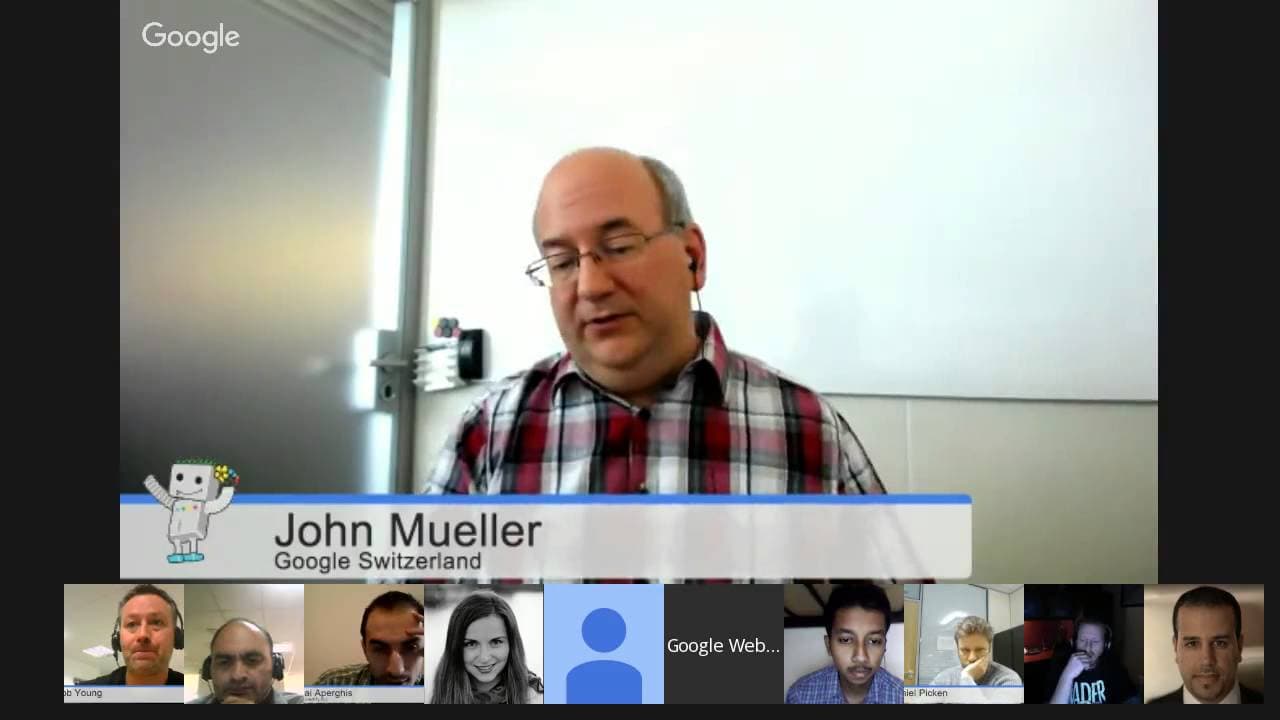
English Google Webmaster Central office-hours hangout
TL;DR
John Mueller discusses SEO and webmaster issues in a Hangout.
Transcript
JOHN MUELLER: All right. Welcome everyone to today's Google Webmaster Central Office Hours Hangouts. My name is John Mueller. I am a Webmaster Trends Analyst here at Google in Switzerland. And part of what I do is talk with webmasters and publishers like the folks here in the Hangout, and also the people who submitted questions, of course. As alway... Read More
Key Insights
- John Mueller explains that Search Console data is based on actual search results shown to users, and discrepancies may arise due to personalization and location settings.
- He clarifies that a text mention without a link does not pass PageRank, and exchanging articles for links can be problematic.
- Mueller advises against using no-follow tags within a website unless necessary, as it may hinder crawling.
- He confirms that HTTPS provides a ranking benefit, but it is minor and acts as a tiebreaker.
- Canonical tags pointing to the canonicalized URL itself are acceptable and can be used by default.
- Hreflang tags can be used for blogs to avoid duplicate content issues across different regions.
- Mueller states that page layout and font sizes do not impact rankings unless they affect the visibility of content.
- HTTP/2 is a protocol that enhances server request handling, while HTTPS ensures secure connections.
Install to Summarize YouTube Videos and Get Transcripts
Explore YouTube Video Summarizer or Get YouTube Transcript Extractor
Questions & Answers
Q: Why is there a discrepancy between Search Console rankings and actual impressions?
Discrepancies between Search Console rankings and actual impressions can occur due to personalization and location settings. Search Console shows data based on actual search results shown to users. If a query has high expected impressions but shows low numbers in Search Console, it might be due to personalization affecting the visibility of the site.
Q: Does a text mention without a link provide any ranking benefit?
A text mention without a link does not pass PageRank and does not provide a direct ranking benefit. However, a link with a no-follow attribute can still encourage users to visit the site, providing an indirect benefit. Exchanging articles for links can be problematic and is discouraged by Google's web spam team.
Q: Is it necessary to use no-follow tags within a website?
Using no-follow tags within a website is generally unnecessary unless it is crucial to prevent crawling of specific pages. Overuse of no-follow tags can hinder Google's ability to crawl the site effectively. It is recommended to use no-follow tags only when there is a specific need to control crawling.
Q: What is the impact of HTTPS on search rankings?
HTTPS provides a minor ranking benefit and acts as a tiebreaker when comparing two otherwise equivalent URLs. Although the ranking boost is small, it is more than having no benefit at all. Google encourages sites to adopt HTTPS for secure connections, and it is a step towards implementing HTTP/2 for better server request handling.
Q: Can canonical tags point to the canonicalized URL itself?
Yes, canonical tags can point to the canonicalized URL itself, and this is perfectly acceptable. Using self-referential canonical tags is a common practice and can be implemented by default to indicate that a page is its own canonical version.
Q: How can hreflang tags be used for blogs?
Hreflang tags can be used for blogs to indicate language and regional targeting, helping to avoid duplicate content issues. They are applicable to any type of site, including blogs, where different language or regional versions of the same content exist. Implementing hreflang tags ensures that the correct version is shown to the appropriate audience.
Q: Do page layout and font sizes affect search rankings?
Page layout and font sizes generally do not affect search rankings unless they impact the visibility of content. Google's algorithms focus on the content itself rather than its presentation. However, if ads or large elements block content visibility, it may influence rankings negatively due to poor user experience.
Q: What is the difference between HTTP/2 and HTTPS?
HTTP/2 is a protocol that improves server request handling by allowing multiple requests to be sent simultaneously, enhancing page load speed. HTTPS, on the other hand, ensures a secure connection between the user and the website. While they serve different purposes, most browsers require HTTPS to fully implement HTTP/2, making them complementary.
Summary & Key Takeaways
-
John Mueller from Google Webmaster Central discusses various webmaster issues in a Hangout session. Topics include Search Console data discrepancies, the impact of HTTPS on rankings, and the proper use of canonical tags. Mueller also addresses questions about hreflang tags and the effects of page layout on search rankings.
-
Mueller clarifies that Search Console data reflects actual search results shown to users and that personalization can cause discrepancies. He advises against using no-follow tags within a website unless necessary and confirms that HTTPS provides a minor ranking benefit.
-
Canonical tags pointing to themselves are acceptable, and hreflang tags can be used for blogs across regions. Mueller explains that HTTP/2 enhances server request handling, while HTTPS ensures security. Page layout and font sizes do not impact rankings unless they affect content visibility.
Read in Other Languages (beta)
Share This Summary 📚
Summarize YouTube Videos and Get Video Transcripts with 1-Click
Try YouTube Summary with ChatGPT & Claude or YouTube Transcript Generator
Explore More Summaries from Google Search Central 📚




Summarize YouTube Videos and Get Video Transcripts with 1-Click
Try YouTube Summary with ChatGPT & Claude or YouTube Transcript Generator