Physics, Net Torque (5 of 13) Five Forces Applied to a Door
TL;DR
Calculate individual torque from forces on a door to find the net torque, considering angles and directions.
Transcript
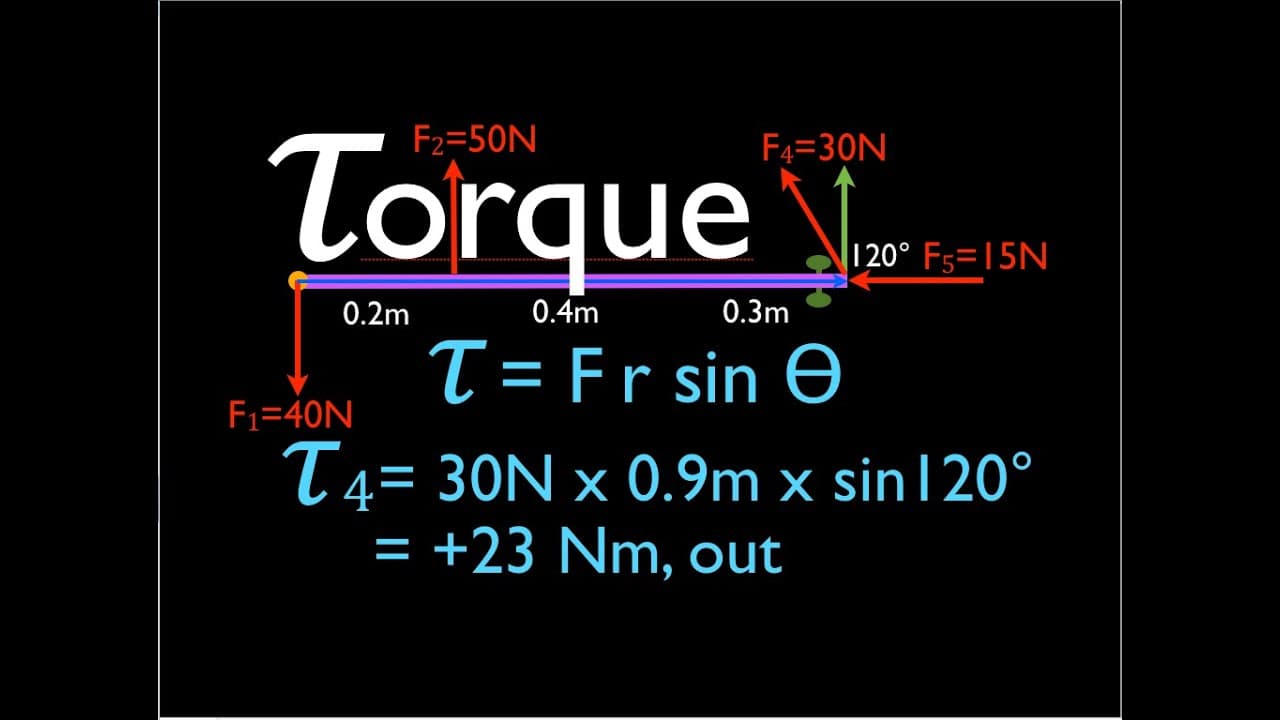
okay in today's video we're gonna go a problem involving torque and this is a situation we have we have these five forces one two three four five they are all acting on this purple or pink object whatever color that is and that is a door you're looking at the door from the top these are the handles the door this is the hinge for the door the axis o... Read More
Key Insights
- 🦾 Torque is calculated by multiplying force, lever arm, and sin(angle).
- 🔄 Positive torques cause counterclockwise rotation, negative torques induce clockwise rotation.
- 0️⃣ Forces at the axis of rotation produce zero torque.
- 🍹 Net torque is the sum of individual torques, determining the overall rotational effect.
- ❓ Understanding torque direction and magnitude is crucial in analyzing rotational systems.
- ❓ Perpendicular component of a force contributes to torque production.
- ❓ Torque is a vector quantity, indicating both magnitude and direction.
Install to Summarize YouTube Videos and Get Transcripts
Explore YouTube Video Summarizer or Get YouTube Transcript Extractor
Questions & Answers
Q: How is torque calculated from forces on a door?
Torque is calculated by multiplying force, lever arm, and sin(angle) for each force applied on the door, considering the direction and magnitude of the torque vector.
Q: Why does a force at the axis of rotation produce zero torque?
A force at the axis of rotation results in zero torque because the lever arm is zero, and the force doesn't produce any rotational effect on the object.
Q: How do positive and negative torques affect the rotation of an object?
Positive torques (counterclockwise) cause objects to rotate in one direction, while negative torques (clockwise) cause rotation in the opposite direction, based on the direction of the torque vector.
Q: Why does a force parallel to the radial vector produce zero torque?
A force parallel to the radial vector produces zero torque because the sine of the angle between them is zero, indicating no rotational effect on the object.
Summary & Key Takeaways
-
Explanation of calculating torque from forces acting on a door.
-
Torque equation: Torque = Force x Lever Arm x sin(angle).
-
Net torque is the sum of individual torques, considering direction and magnitude.
Read in Other Languages (beta)
Share This Summary 📚
Summarize YouTube Videos and Get Video Transcripts with 1-Click
Try YouTube Summary with ChatGPT & Claude or YouTube Transcript Generator
Explore More Summaries from Step by Step Science 📚

Summarize YouTube Videos and Get Video Transcripts with 1-Click
Try YouTube Summary with ChatGPT & Claude or YouTube Transcript Generator