Graphing logarithmic functions (example 2) | Algebra 2 | Khan Academy
TL;DR
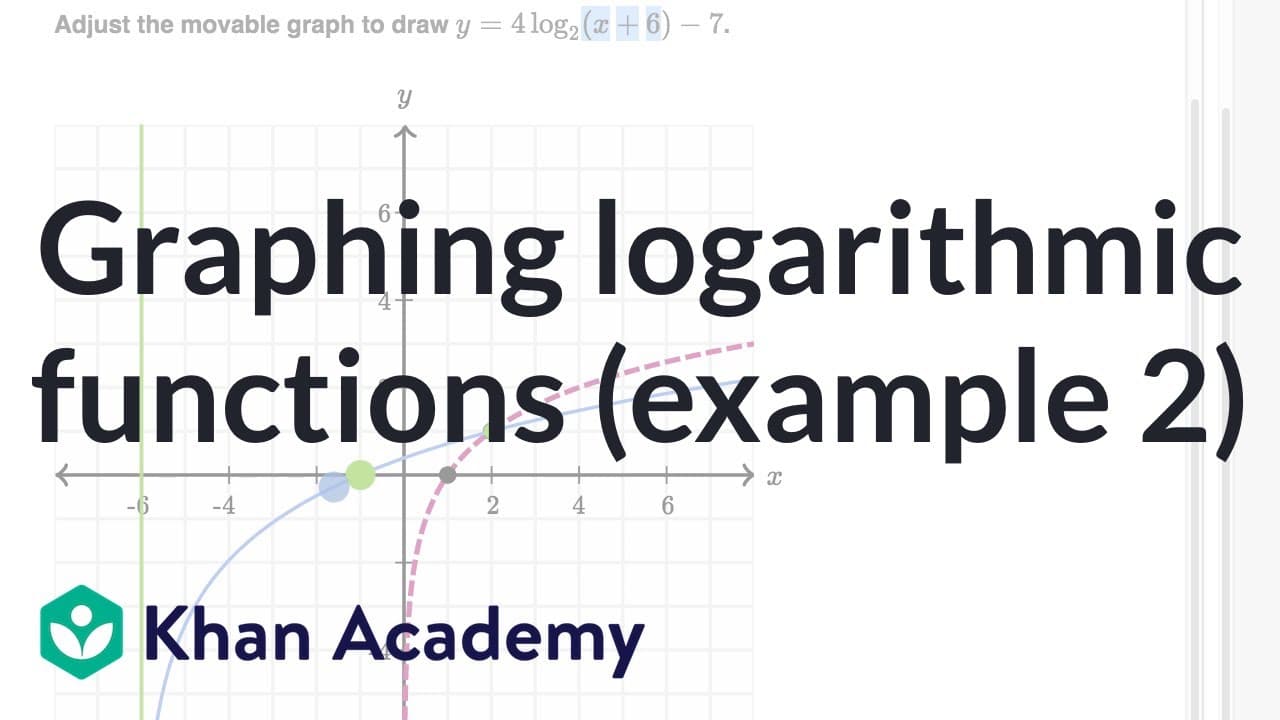
This video demonstrates how to transform the graph of y=log base 2 of x into y=4*log base 2 of x + 6 - 7 using specific transformations.
Transcript
- [Instructor] This is a screenshot from an exercise on Khan Academy, and it says the intergraphic, the interactive graph below contains the graph of y is equal to log base two of x as a dashed curve, and you can see it down there as a dashed curve, with the points one comma zero and two comma one highlighted. Adjust the movable graph to draw y is ... Read More
Key Insights
- 🚦 The graph transformation involves shifting, scaling, and vertical adjustments.
- ❣️ Replacing x with x+6 shifts the graph of y=log base 2 of x six units to the left.
- ✖️ Multiplying the y-values by four scales the graph vertically.
- 🕖 Subtracting seven moves all the points downward by seven units.
- 🚦 The vertical asymptote shifts along with the graph during the transformations.
- 🏃 Understanding shifting transformations is essential to grasp the concept behind this exercise.
- 🪈 The order of transformations is crucial to obtaining the correct final graph.
Install to Summarize YouTube Videos and Get Transcripts
Explore YouTube Video Summarizer or Get YouTube Transcript Extractor
Questions & Answers
Q: What is the purpose of shifting the graph of y=log base 2 of x six units to the left?
Shifting the graph to the left by replacing x with x+6 moves all the points and the vertical asymptote six units to the left. This is a transformation that helps achieve the desired graph.
Q: What effect does multiplying the y-values by four have on the graph?
Multiplying the y-values by four scales the graph vertically. This means that for every point on the original graph, the corresponding y-value on the new graph will be four times larger.
Q: How does subtracting seven affect the graph of y=4*log base 2 of x + 6?
Subtracting seven from the y-values of the graph shifts all the points down by seven units. This transformation modifies the vertical position of each point, resulting in the final graph.
Q: What is the significance of the vertical asymptote in the transformed graph?
The vertical asymptote, which indicates the values of x for which the function is undefined, moves from x=0 to x=-6 in the transformed graph. It shifts along with all the other points during the transformation process.
Summary & Key Takeaways
-
The video explains how to graph the equation y=log base 2 of x and transform it into y=4*log base 2 of x + 6 - 7 using vertical shifts and scaling.
-
By replacing x with x+6, the graph shifts six units to the left and the vertical asymptote moves from x=0 to x=-6.
-
Multiplying the y-values by four scales the graph vertically, and subtracting seven moves all the points downward by seven units.
Read in Other Languages (beta)
Share This Summary 📚
Summarize YouTube Videos and Get Video Transcripts with 1-Click
Try YouTube Summary with ChatGPT & Claude or YouTube Transcript Generator
Explore More Summaries from Khan Academy 📚



Summarize YouTube Videos and Get Video Transcripts with 1-Click
Try YouTube Summary with ChatGPT & Claude or YouTube Transcript Generator