How Did the Industrial Revolution Fuel Imperialism?
TL;DR
The Industrial Revolution fueled imperialism by increasing demand for raw materials and markets for finished goods, driven by technological advancements like the steam engine and telegraph. These innovations enabled greater productivity in factories and facilitated military control over distant territories, allowing European powers to expand their empires significantly throughout Africa and Asia.
Transcript
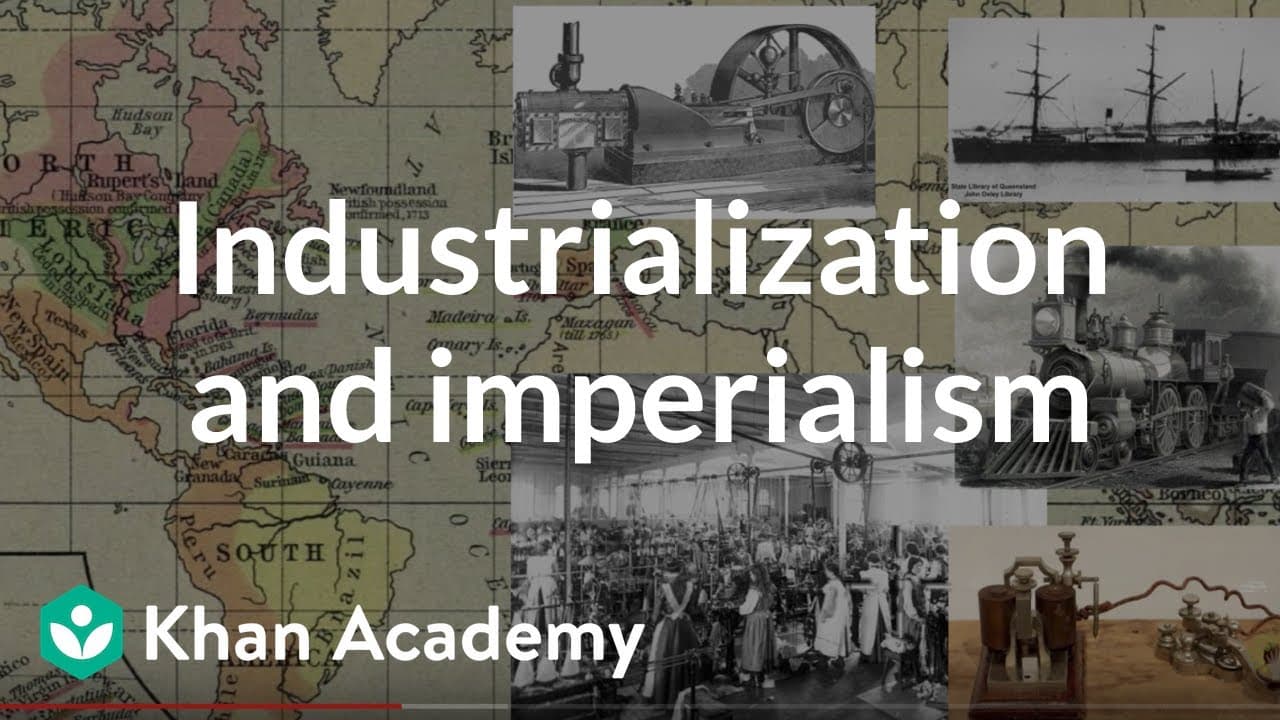
- [Sal] This is a map of European colonial possessions in the early to mid 1700s. And you immediately see a few things. Spain has a lot of territory in Central and South America. Even the small country of Portugal, because of its prowess during the Age of Exploration, a significant amount of territory in what would become Brazil, but they also have... Read More
Key Insights
- 🥳 European colonial possessions in the early 1700s were concentrated in the Americas, parts of Africa, and India.
- 🥺 The Industrial Revolution, driven by technological innovation, led to increased productivity and efficiency in factories.
- 🧑🌾 Imperialism and colonization were motivated by the need for more raw materials, expanded markets, and easier control over far-flung empires.
- ✊ The technology of the Industrial Revolution, such as steamships, railroads, and the telegraph, facilitated the enforcement and projection of power in colonial territories.
- 🖐️ Capitalism played a significant role in driving industrialization and the need for expansion.
- ™️ The desire for freer trade also motivated imperialism, sometimes leading to forced trade agreements.
- 🥳 Africa and parts of Asia were heavily colonized as colonial powers sought to control resources and markets.
Install to Summarize YouTube Videos and Get Transcripts
Explore YouTube Video Summarizer or Get YouTube Transcript Extractor
Questions & Answers
Q: What were the main European colonial possessions in the early to mid-1700s?
Spain had a significant amount of territory in Central and South America, while Portugal had possessions in Brazil, Africa, and India. France also had substantial possessions in North America.
Q: How did the Industrial Revolution impact productivity?
The steam engine and other technological advancements allowed factories to amplify human labor, leading to increased productivity. Power looms and sewing machines, for example, enabled the production of fabric and goods on a much larger scale.
Q: What role did transportation play in imperialism?
The Industrial Revolution saw advancements in transportation, such as steamships and railroads, which allowed colonial powers to transport goods, people, and military forces more efficiently. This facilitated trade, control over territories, and projection of military power.
Q: How did the Industrial Revolution change communication?
The telegraph revolutionized communication by enabling instant global communication for the first time in history. This facilitated coordination of military power and faster access to information for trade and control purposes.
Summary & Key Takeaways
-
European colonial possessions in the early to mid-1700s were mainly concentrated in Central and South America, along with some territories in Africa and India.
-
The Industrial Revolution, driven by technological innovations like the steam engine and electrification, revolutionized transportation, communication, and productivity.
-
The desire for more raw materials and markets for finished goods, along with the ease of controlling far-flung empires through technology, fueled imperialism and colonization.
Read in Other Languages (beta)
Share This Summary 📚
Summarize YouTube Videos and Get Video Transcripts with 1-Click
Try YouTube Summary with ChatGPT & Claude or YouTube Transcript Generator
Explore More Summaries from Khan Academy 📚



Summarize YouTube Videos and Get Video Transcripts with 1-Click
Try YouTube Summary with ChatGPT & Claude or YouTube Transcript Generator