Rectangular Equation to Polar Equations, Precalculus, Examples and Practice Problems
TL;DR
Learn how to convert rectangular equations (with x and y variables) into polar equations (with r and theta variables) using specific formulas.
Transcript
in this video we're going to talk about how to convert rectangular equations into polar equations so what exactly is a rectangular equation and what are some examples of polar equations you need to be able to distinguish these two first a rectangular equation typically contains an x or y variable so x plus y equals 4 that's a rectangular equation x... Read More
Key Insights
- ❣️ Rectangular equations contain x or y variables, while polar equations have r and theta variables.
- 🤩 The key formulas for converting rectangular equations into polar equations are x = r cos(theta), y = r sin(theta), and r^2 = x^2 + y^2.
- 🐻❄️ It is crucial to identify the conversion formulas and understand how to isolate r to obtain the polar equation.
- 💼 In some cases, the r value can be zero, leading to a simplified equation.
- 🐻❄️ Trigonometric functions such as secant, cosecant, tangent, and cotangent can be used to simplify polar equations.
- 🧑🏭 Expanding squared terms and factoring out r are essential steps in converting certain rectangular equations.
Install to Summarize YouTube Videos and Get Transcripts
Explore YouTube Video Summarizer or Get YouTube Transcript Extractor
Questions & Answers
Q: What is the difference between rectangular equations and polar equations?
Rectangular equations have x or y variables, while polar equations have r and theta variables. Rectangular equations are generally represented as x + y = 4, x = 3, or x^2 + y^2 = 9, while polar equations can be written as r = 4, theta = pi/3, or r = 7sin(theta).
Q: What are the key formulas for converting rectangular equations to polar equations?
The key formulas are x = r cos(theta), y = r sin(theta), and r^2 = x^2 + y^2. These formulas help relate the rectangular coordinates (x, y) to the polar coordinates (r, theta).
Q: How do you convert x = 8 into a polar equation?
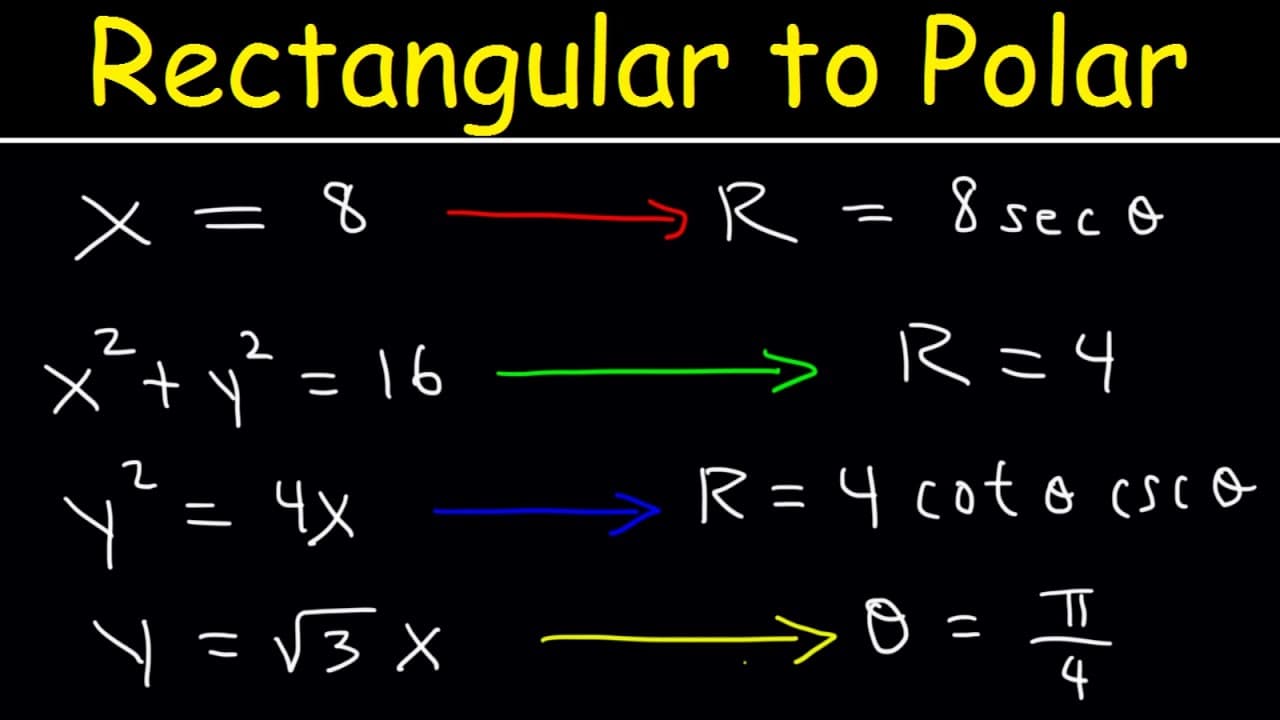
Using the formula x = r cos(theta), we can substitute x with r cos(theta). Thus, r cos(theta) = 8. To isolate r, we can divide both sides by cos(theta). This gives us r = 8/cos(theta), or we can simplify it as r = 8sec(theta).
Q: How do you convert y = 5 into a polar equation?
Using the formula y = r sin(theta), we can substitute y with r sin(theta). This gives us r sin(theta) = 5. To isolate r, we can divide both sides by sin(theta), resulting in r = 5/sin(theta), or we can simplify it as r = 5csc(theta).
Q: How do you convert 5x + 4y = 8 into a polar equation?
By substituting x with r cos(theta) and y with r sin(theta), we can rewrite the equation as 5r cos(theta) + 4r sin(theta) = 8. To isolate r, divide both sides by 5 cos(theta) + 4 sin(theta). This gives us r = 8 / (5 cos(theta) + 4 sin(theta)).
Q: What is the first step in converting x^2 + y^2 = 16 into a polar equation?
The first step is to realize that r^2 is equal to x^2 + y^2. Therefore, we can replace x^2 + y^2 with r^2, resulting in r^2 = 16.
Q: How do you convert x^2 + y - 6x = 0 into a polar equation?
Firstly, expand (x - 3)^2 to get x^2 - 6x + 9. Replacing x^2 - 6x with its expanded form, the equation becomes r^2 + 9 - 6x = 0. To isolate r, factor out r, giving r(r - 6cos(theta)) = -9. Thus, the polar equation is r = 6cos(theta) - 9/r.
Q: What is the polar form of y^2 = 4x?
By substituting y with r sin(theta) and squaring it, the equation becomes r^2 sin^2(theta) = 4r cos(theta). Dividing both sides by r gives r sin^2(theta) = 4 cos(theta). Simplifying further yields r = 4cos(theta)/sin^2(theta), which can be rewritten as r = 4cot(theta)csc(theta).
Summary & Key Takeaways
-
Rectangular equations contain x or y variables, while polar equations have r and theta variables.
-
Key formulas for converting rectangular equations into polar equations include x = r cos(theta), y = r sin(theta), and r^2 = x^2 + y^2.
-
In some cases, the r value can be zero, and the equation can be simplified further using trigonometric functions.
Read in Other Languages (beta)
Share This Summary 📚
Summarize YouTube Videos and Get Video Transcripts with 1-Click
Try YouTube Summary with ChatGPT & Claude or YouTube Transcript Generator
Explore More Summaries from The Organic Chemistry Tutor 📚



Summarize YouTube Videos and Get Video Transcripts with 1-Click
Try YouTube Summary with ChatGPT & Claude or YouTube Transcript Generator