Limits and Logarithms
TL;DR
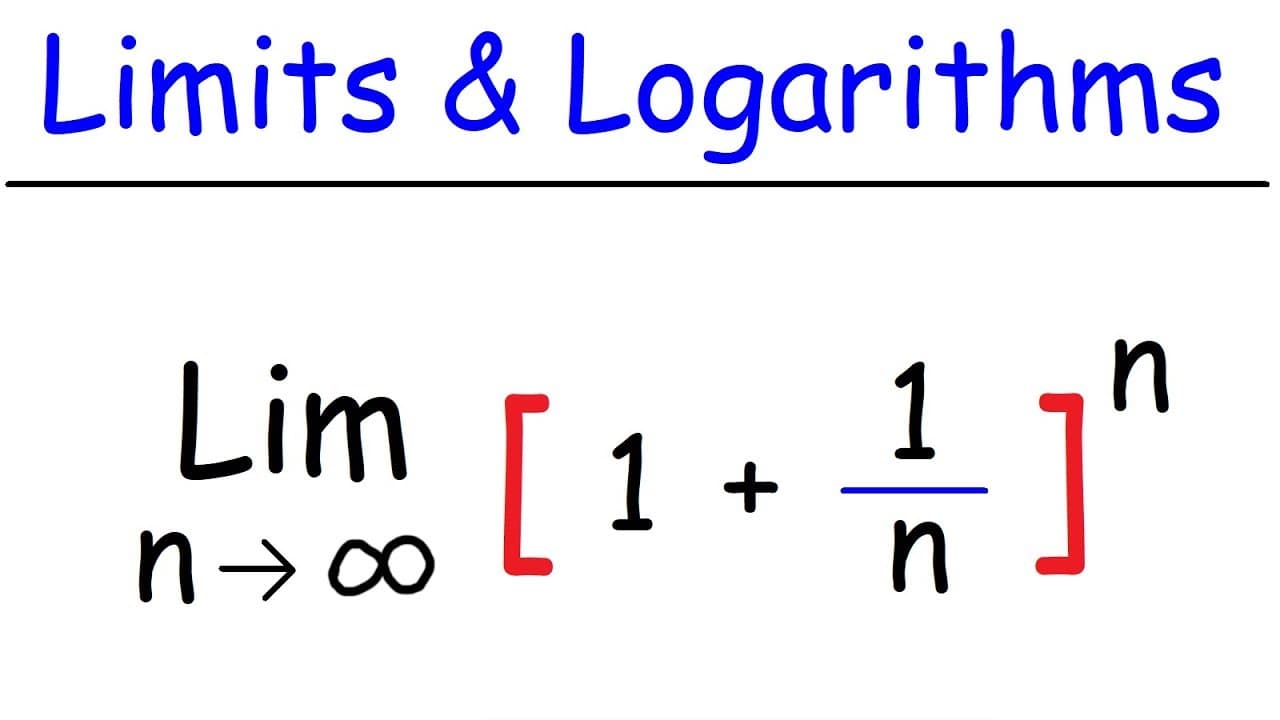
This video explains how to evaluate the limit of the expression (1 + 1/n)^n as n goes to infinity, which equals the number e.
Transcript
here's a question for you how would you evaluate this limit what is the limit as n goes to infinity of a 1 plus 1 over n raised to the n power well in this video we're going to talk about how to evaluate this limit so the first thing we're going to do is we're going to set the entire expression equal to y so our goal is to solve for y if we can do ... Read More
Key Insights
- 😑 The limit (1 + 1/n)^n can be evaluated by taking the natural logarithm of the expression and applying L'Hospital's rule.
- 😑 Converting the expression into a quotient allows for easier evaluation of the limit.
- 😑 As n increases in value, the expression approaches the constant e, which is approximately 2.71828.
- #️⃣ The number e is important in mathematics and frequently appears in exponential growth, compound interest, and other applications.
- 💁 L'Hospital's rule provides a powerful technique for evaluating limits involving indeterminate forms.
- ☺️ The derivative of the natural log function is 1/x, and the derivative of 1/n is -1/n^2.
- 😑 Canceling terms and simplifying the expression helps in determining the final value of the limit.
Install to Summarize YouTube Videos and Get Transcripts
Explore YouTube Video Summarizer or Get YouTube Transcript Extractor
Questions & Answers
Q: How do you evaluate the limit of (1 + 1/n)^n as n approaches infinity?
To evaluate this limit, you can set the expression equal to y and take the natural logarithm of both sides. Applying L'Hospital's rule and simplifying the expression, you will find that the limit is equal to the number e.
Q: Can you explain L'Hospital's rule and how it is used in this problem?
L'Hospital's rule allows you to evaluate limits involving indeterminate forms by taking the derivative of the numerator and denominator separately. In this problem, by applying L'Hospital's rule and simplifying the expression, you can evaluate the limit of (1 + 1/n)^n as n approaches infinity.
Q: What is the significance of the number e?
The number e is a mathematical constant that represents the base of the natural logarithm. It is approximately equal to 2.71828 and frequently appears in various mathematical and scientific applications.
Q: Is there a numerical approximation for the limit (1 + 1/n)^n as n approaches infinity?
As n gets larger, the expression (1 + 1/n)^n gets closer to the number e. By plugging in progressively larger values of n, such as a thousand, a million, or a billion into the expression, you can obtain numerical approximations that converge to e.
Summary & Key Takeaways
-
The video demonstrates how to evaluate the limit (1 + 1/n)^n as n approaches infinity by taking the natural logarithm of the expression and applying L'Hospital's rule.
-
The process involves converting the expression into a quotient, finding the derivatives, canceling terms, and simplifying the expression.
-
By taking the limit as n goes to infinity, the final result is found to be the number e (approximately 2.71828).
Read in Other Languages (beta)
Share This Summary 📚
Summarize YouTube Videos and Get Video Transcripts with 1-Click
Try YouTube Summary with ChatGPT & Claude or YouTube Transcript Generator
Explore More Summaries from The Organic Chemistry Tutor 📚





Summarize YouTube Videos and Get Video Transcripts with 1-Click
Try YouTube Summary with ChatGPT & Claude or YouTube Transcript Generator