See invisible motion, hear silent sounds. Cool? Creepy? We can't decide | Michael Rubinstein
TL;DR
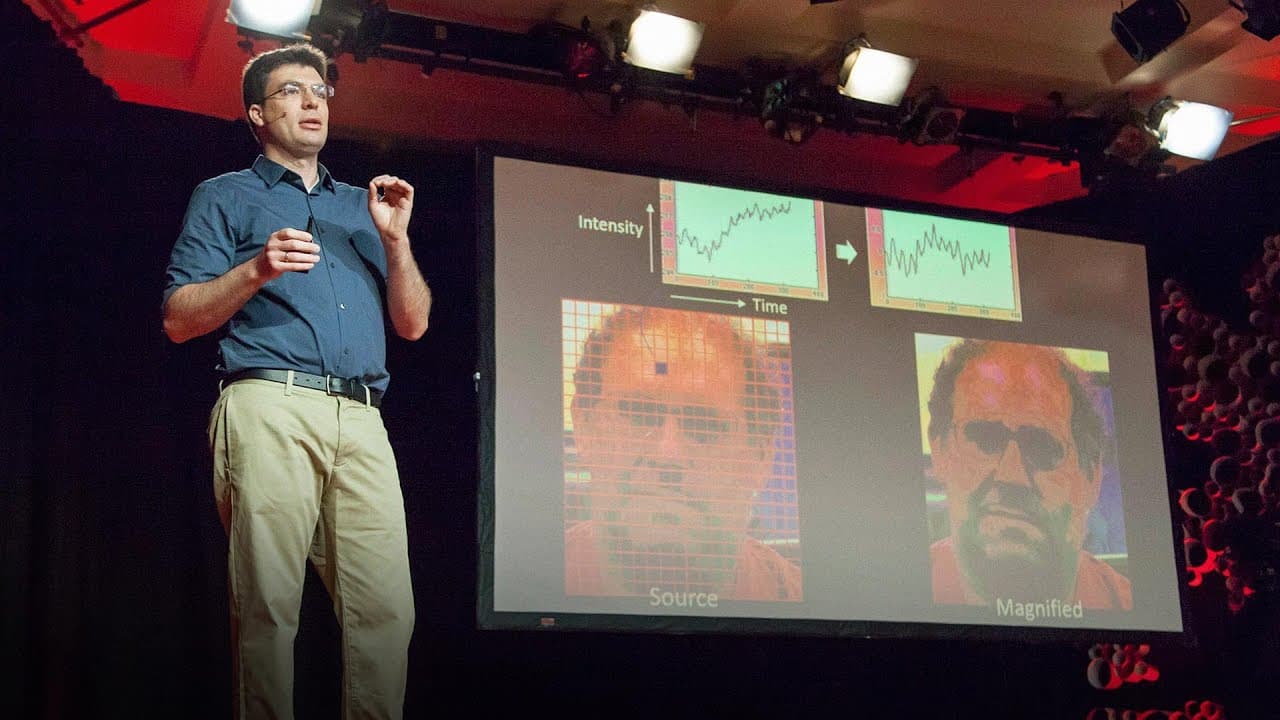
In this presentation, the speaker introduces a new type of microscope that uses video cameras and image processing to reveal tiny motions and color changes in objects and people that are impossible to see with the naked eye.
Transcript
So over the past few centuries, microscopes have revolutionized our world. They revealed to us a tiny world of objects, life and structures that are too small for us to see with our naked eyes. They are a tremendous contribution to science and technology. Today I'd like to introduce you to a new type of microscope, a microscope for changes. It does... Read More
Key Insights
- 🔍 Microscopes have revolutionized our world by revealing the tiny world of objects, life, and structures too small for the naked eye to see. The new type of microscope introduced in the content doesn't use optics but a video camera and image processing to reveal the tiniest motions and color changes in objects and people. This microscope allows us to see small changes in the color of the skin, including the human pulse and blood flow in the face. We can measure heart rates accurately using regular cameras and without touching patients.
- 🔬 The microscope can also magnify and reveal small motions in objects, such as breathing patterns, facial expressions, mechanical movements, and the way buildings and structures react to forces. It offers a new way of looking at the world and pushes the boundaries of what can be done with cameras. The code for this new technology is available online, making it accessible even to those without programming experience.
- 🎨 People have creatively used the microscope to magnify various phenomena, including belly movements during pregnancy, pulsing veins, and even the motions of a guinea pig. Some have used it for artistic purposes, magnifying and animating still pictures. The tool provides a new way of observing and exploring the world.
- 🎥 The technology also has the capability to recover sound from videos by analyzing the tiny vibrations sound waves create in objects. This allows everyday objects to function as microphones. The experiments showed that sound can be recovered from objects like a bag of chips, plants, and even speech. The quality of the recovered sound is similar to that of early sound recording devices like Thomas Edison's phonograph.
- 📸 The applications of this technology are not limited to surveillance but can also be useful for recovering sound from a distance or in space. The possibilities for using this technology are still being explored, and it opens up a new world of observing physical processes that were previously invisible to the human eye. The content highlights the collaborative efforts of the team behind the technology and invites others to join in exploring the world of tiny motions.
Install to Summarize YouTube Videos and Get Transcripts
Explore YouTube Video Summarizer or Get YouTube Transcript Extractor
Questions & Answers
Q: What is the new type of microscope being introduced in the video?
The new type of microscope introduced in the video is a microscope for changes. It uses a video camera and image processing to reveal the tiniest motions and color changes in objects and people, which are impossible to see with the naked eye.
Q: How does the microscope for changes work?
The microscope for changes analyzes the changes in light recorded at every pixel in a video over time. It then uses image processing techniques to measure the color at each pixel and how it changes over time. These changes are then amplified to create magnified videos that show the tiny motions and color changes.
Q: What can the microscope for changes reveal about the human body?
The microscope for changes can reveal the small changes in color of the skin caused by blood flow, allowing the visualization of a human pulse and the measurement of heart rates. It can also reveal the pulsing of veins and arteries, the constant motion of the eyes, and other breathing patterns and small facial expressions.
Q: How can the microscope for changes be used beyond the human body?
The microscope for changes can also be used to magnify small mechanical movements, such as vibrations in engines, to help diagnose machinery problems. It can also be used to observe how buildings and structures sway in the wind and react to forces. The technology opens up new possibilities for measuring and visualizing various types of motions.
Q: What is the visual microphone?
The visual microphone is a concept introduced in the video where sound can be recovered from video by analyzing the tiny vibrations that sound waves create in objects. By observing how light bounces off objects and is recorded by cameras, it is possible to convert these vibrations back into the sounds that produced them, turning everyday objects into microphones.
Summary & Key Takeaways
-
Microscopes have revolutionized science and technology by allowing us to see the tiny world of objects and structures that are too small for the naked eye.
-
A new type of microscope, called a microscope for changes, uses video cameras and image processing to reveal the tiniest motions and color changes in objects and people.
-
This new technology can be used to visualize pulse and heart rates, magnify small mechanical movements, and even extract sound from video recordings.
Read in Other Languages (beta)
Share This Summary 📚
Summarize YouTube Videos and Get Video Transcripts with 1-Click
Try YouTube Summary with ChatGPT & Claude or YouTube Transcript Generator
Explore More Summaries from TED 📚






Summarize YouTube Videos and Get Video Transcripts with 1-Click
Try YouTube Summary with ChatGPT & Claude or YouTube Transcript Generator