Mass and Inertia | Dynamics | AP Physics I | Khan Academy
TL;DR
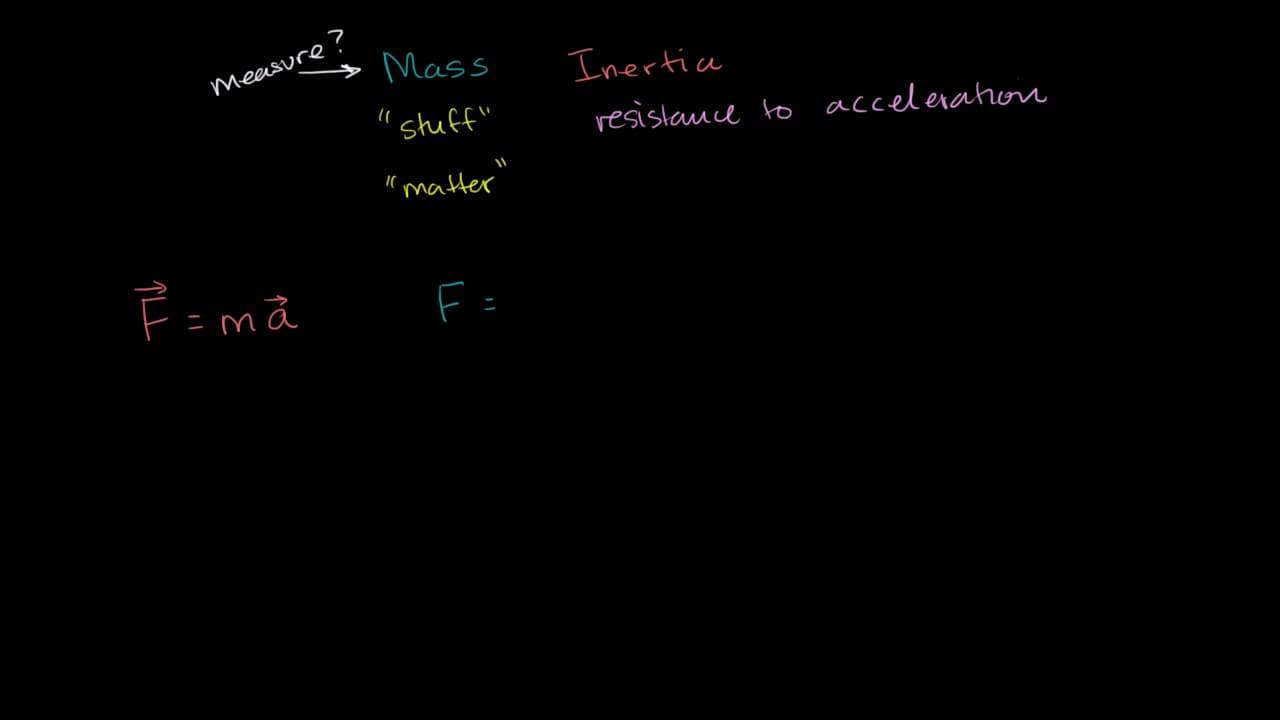
Mass and inertia are closely related in physics, with mass quantifying an object's inertia and resistance to acceleration.
Transcript
in your study of physics you will often encounter the idea of mass and you will also might encounter the idea of inertia and what i want to do in this video is think about what is the similarity or the difference between these two concepts or these two ideas in physics and i'm going to give you a little bit of time to do it i encourage you to ask p... Read More
Key Insights
- ❓ Mass represents the amount of matter in an object, while inertia describes an object's resistance to acceleration.
- 👮 Newton's second law provides a tool for measuring an object's mass through force and acceleration.
- 💆 Gravitational interactions between objects can also be used to measure mass.
- 💆 The definitions of mass and inertia can be debated, but they essentially refer to the same concept.
- ❓ Mass can be challenging to measure directly, especially in subatomic domains, which is why methods like force and gravitational interactions are used.
- 💄 Mass is related to an object's resistance to acceleration, making it a measure of inertia.
- 💆 In classical mechanics, mass is commonly associated with both inertial and gravitational mass.
Install to Summarize YouTube Videos and Get Transcripts
Explore YouTube Video Summarizer or Get YouTube Transcript Extractor
Questions & Answers
Q: What is the difference between mass and inertia?
Mass refers to the amount of matter in an object, while inertia describes an object's resistance to acceleration. Mass is a quantitative measure, while inertia is a qualitative property.
Q: How can mass be measured using Newton's second law?
Newton's second law states that force is equal to the product of mass and acceleration. By applying a known force and measuring the resulting acceleration, mass can be calculated using the equation F = ma.
Q: Can mass be measured through gravitational interactions?
Yes, mass can also be determined by measuring the gravitational force between two objects with known masses. By using Newton's law of gravitation and knowing the distance between the objects, the unknown mass can be calculated.
Q: Are inertial mass and gravitational mass equivalent?
Yes, it has been verified that inertial mass and gravitational mass are equivalent. This means that the resistance to acceleration and the gravitational force of an object are directly proportional.
Summary & Key Takeaways
-
Mass represents the amount of matter in an object, while inertia describes an object's resistance to acceleration.
-
Newton's second law provides a tool for measuring mass by relating force, mass, and acceleration.
-
Mass can also be measured through gravitational interactions between objects.
Read in Other Languages (beta)
Share This Summary 📚
Summarize YouTube Videos and Get Video Transcripts with 1-Click
Try YouTube Summary with ChatGPT & Claude or YouTube Transcript Generator
Explore More Summaries from Khan Academy 📚



Summarize YouTube Videos and Get Video Transcripts with 1-Click
Try YouTube Summary with ChatGPT & Claude or YouTube Transcript Generator