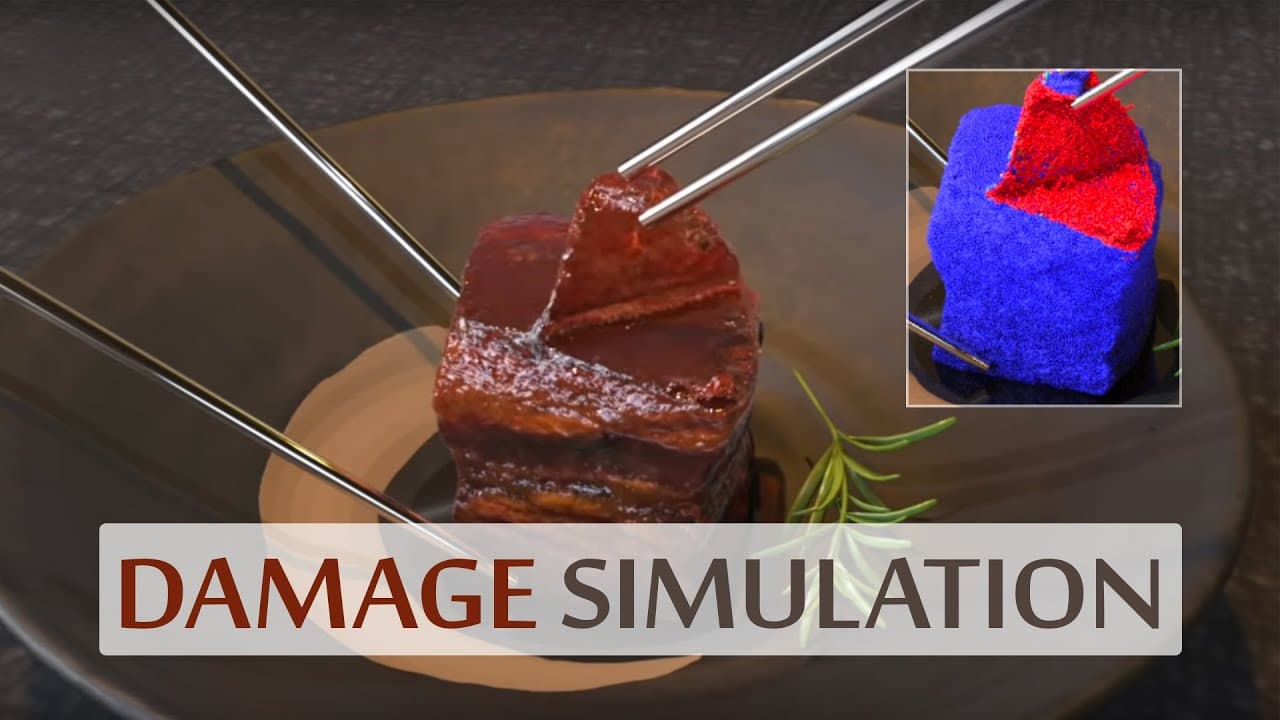
Can We Simulate Tearing Meat? 🥩
TL;DR
This video explores a new method for physics simulations in computer graphics, allowing for more realistic and customizable material separation and damage, with impressive results.
Transcript
Dear Fellow Scholars, this is Two Minute Papers with Dr. Károly Zsolnai-Fehér. Perhaps the best part of being a computer graphics researcher is creating virtual worlds on a daily basis and computing beautiful simulations in these worlds. And what you see here is not one, but two kinds of simulations. One is a physics simulation that computes how th... Read More
Key Insights
- ❓ The Material Point Method is a hybrid simulation technique that combines particles and grids to create realistic animations.
- 😂 The previous method using the Material Point Method had limitations when simulating cracking and tearing phenomena.
- 👶 The new method improves material separation and supports anisotropic damage and elasticity.
- 👶 Parameters like crack propagation speed and resistance against fractures can be customized in the new simulation method.
- 👻 The new method produces more realistic and convincing simulations, allowing for extreme topological changes in virtual objects.
- 🧀 The simulations can simulate peeling off entire layers of objects, such as meat and cheese.
- ☠️ The new method takes longer to compute for more demanding experiments involving stiff materials like bones.
Install to Summarize YouTube Videos and Get Transcripts
Explore YouTube Video Summarizer or Get YouTube Transcript Extractor
Questions & Answers
Q: What is the Material Point Method and how does it contribute to physics simulations?
The Material Point Method is a hybrid simulation technique that combines particles and grids to create realistic animations. It is used to compute how objects move and look in virtual worlds.
Q: What are the limitations of the Material Point Method when it comes to simulating cracking and tearing phenomena?
The previous method using the Material Point Method was unable to properly simulate cracking and tearing phenomena. This was addressed in a recently discussed paper.
Q: How does the new method improve material separation in physics simulations?
The new method allows for more extreme topological changes in virtual objects, resulting in better material separation. It creates more realistic and convincing simulations, as demonstrated in the video.
Q: Can parameters like crack propagation speed and resistance against fractures be customized in the new simulation method?
Yes, the new method allows for customization of parameters like crack propagation speed and the Young modulus, which describes the material's resistance against fractures. This customization gives artists more control over the simulation results.
Summary & Key Takeaways
-
The video discusses the Material Point Method, a hybrid simulation technique that combines particles and grids to create realistic animations.
-
The previous method of simulation had limitations when it came to simulating cracking and tearing phenomena, which have been addressed in a recent paper.
-
The new method improves material separation, supports anisotropic damage and elasticity, and allows for customization of parameters like crack propagation speed and resistance against fractures.
Read in Other Languages (beta)
Share This Summary 📚
Summarize YouTube Videos and Get Video Transcripts with 1-Click
Try YouTube Summary with ChatGPT & Claude or YouTube Transcript Generator
Explore More Summaries from Two Minute Papers 📚


Summarize YouTube Videos and Get Video Transcripts with 1-Click
Try YouTube Summary with ChatGPT & Claude or YouTube Transcript Generator