Measurement of High Resistance by Loss of Charge Method problem No 2
TL;DR
This video explains how to measure high resistances using the loss of charge method and provides a step-by-step solution to a specific problem.
Transcript
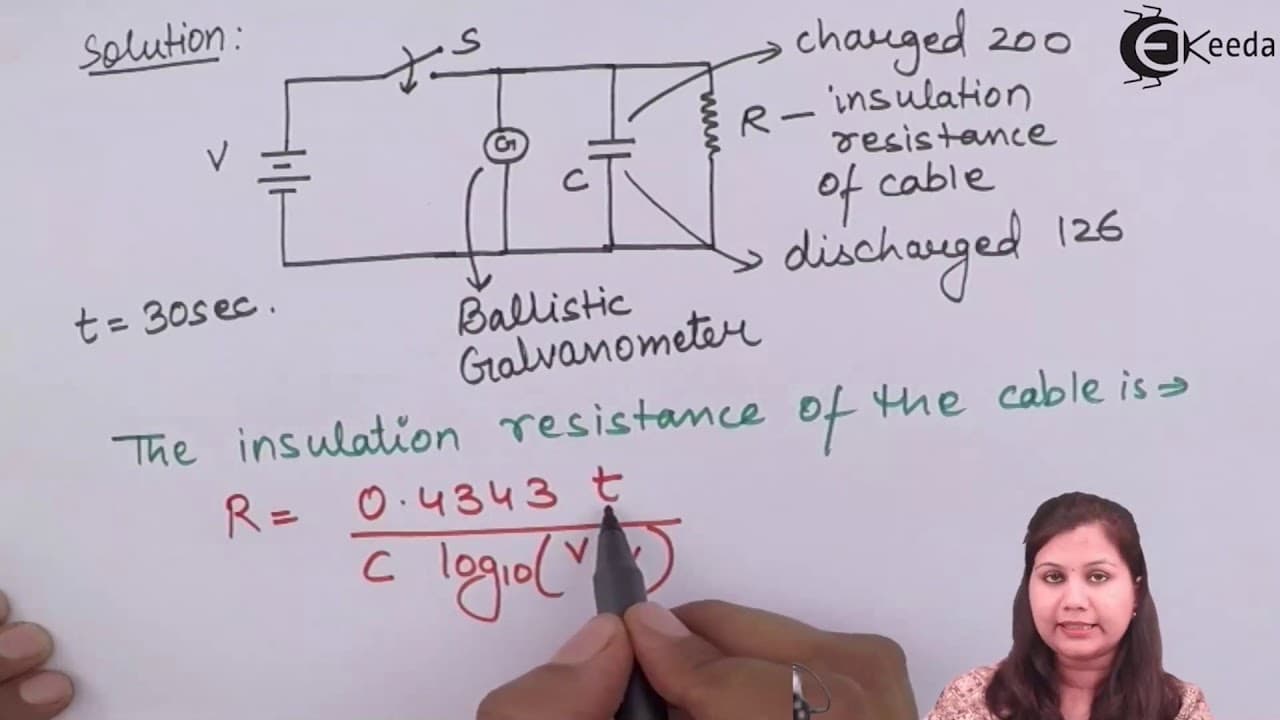
hello friends in this video we are going to solve a problem based on the measurement of high resistance using loss of charge method so let us start with a problem so a question is that a cable is tested by the loss of charge method using a ballistic galvanometer with the following results so uh the loss of charge method it is used for measuring the... Read More
Key Insights
- ✋ The loss of charge method is a useful technique for measuring high resistances or insulation resistance.
- ⚡ The deflection on the galvanometer indicates the voltage across the unknown resistance and capacitor.
- 🌸 Using the formula for the loss of charge method, the insulation resistance of a cable can be calculated.
- ❓ When the insulation resistance is in parallel with another resistance, the equivalent resistance can be determined.
- 🥳 The ratio of the equivalent resistance and the insulation resistance can be calculated to find the value of the insulation resistance.
- 🌸 The given problem demonstrates the step-by-step calculation of the insulation resistance using the loss of charge method.
- 📣 The value of the insulation resistance is found to be 5 mega ohm.
Install to Summarize YouTube Videos and Get Transcripts
Explore YouTube Video Summarizer or Get YouTube Transcript Extractor
Questions & Answers
Q: What is the purpose of the loss of charge method?
The loss of charge method is used to measure the high resistances or insulation resistance of a cable.
Q: How are the measurements indicated in the loss of charge method?
The deflection on the ballistic galvanometer indicates the voltage across the unknown resistance and capacitor.
Q: How do you calculate the insulation resistance of the cable?
The insulation resistance can be calculated using the formula: r = 0.4343 * t / c * log10(capital v / small v).
Q: How can you find the equivalent resistance when the insulation resistance is in parallel with another resistance?
The equivalent resistance (r dash) can be calculated as r * 10 mega ohm / (r + 10 mega ohm).
Summary & Key Takeaways
-
The loss of charge method is used to measure the high resistance or insulation resistance of a cable.
-
The deflection on the galvanometer indicates the voltage across the unknown resistance and capacitor in the circuit.
-
By using the given measurements and the formula for the loss of charge method, the insulation resistance of the cable can be calculated.
Read in Other Languages (beta)
Share This Summary 📚
Summarize YouTube Videos and Get Video Transcripts with 1-Click
Try YouTube Summary with ChatGPT & Claude or YouTube Transcript Generator
Explore More Summaries from Ekeeda 📚






Summarize YouTube Videos and Get Video Transcripts with 1-Click
Try YouTube Summary with ChatGPT & Claude or YouTube Transcript Generator