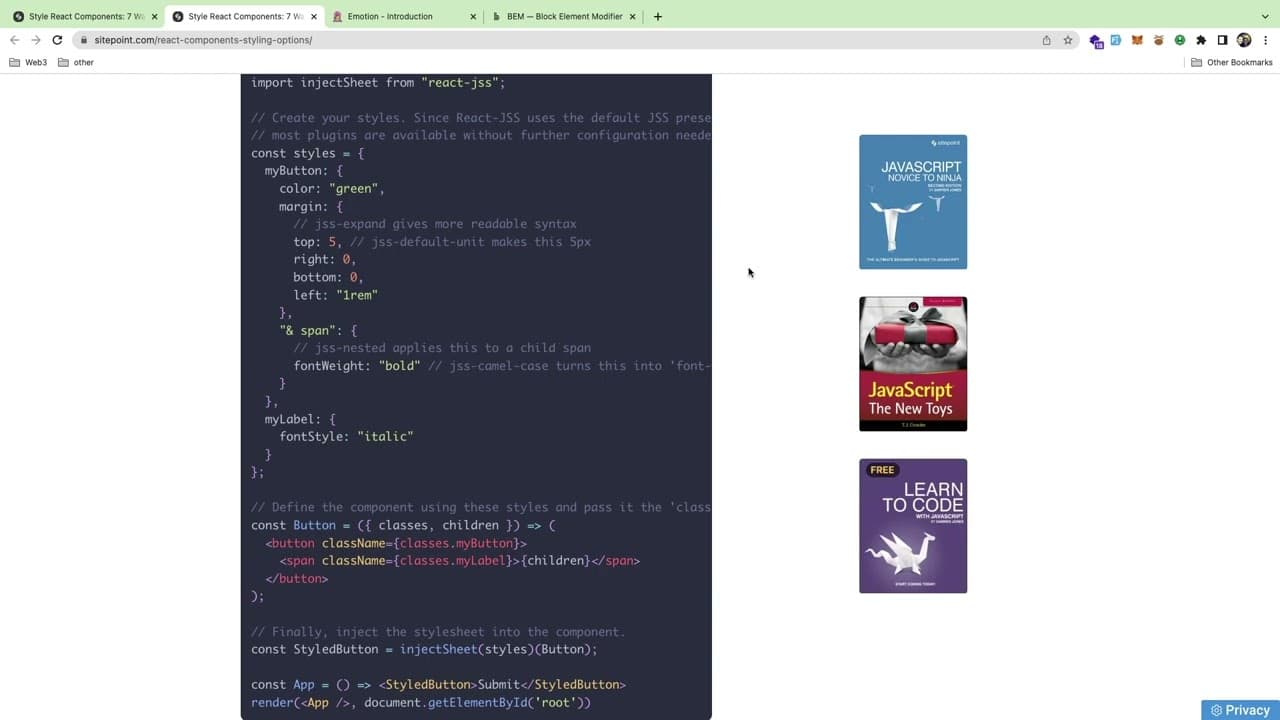
Why are there so many different ways to style a react app?
TL;DR
The discussion explores various methods of styling in React and their complexities.
Transcript
all right how's it going everyone so i want to have a little talk about how we do styling and react i'm not an expert i don't really know all the different ways i've barely even played with most of these i've been using uh sas at work for the past like three plus years so that's kind of the approach i'm used to but i've kind of dabbled with learnin... Read More
Key Insights
- 🥺 Traditional CSS can be a double-edged sword: while it's straightforward, managing large stylesheets can lead to chaos without proper conventions.
- 🍵 BEM and similar methodologies offer structure but may become unnecessary when using CSS-in-JS libraries that handle scoping naturally.
- 👨💻 Inline CSS may offer flexibility but can quickly clutter code, complicating maintenance and readability in larger applications.
- 👻 CSS Modules allow for scoped styles, helping to mitigate naming conflicts in large projects while retaining the benefits of external stylesheets.
- 👔 Styled-components and other CSS-in-JS solutions appeal to developers seeking dynamic styling tied directly to component logic and state.
- 🫠 Tailwind CSS allows for rapid UI development with utility-first classes, but it can result in very large HTML files that can be hard to read on smaller screens.
- 🥺 The multitude of styling options reflects a constant search for efficiency and productivity in frontend development but can also lead to confusion and decision fatigue among developers.
Install to Summarize YouTube Videos and Get Transcripts
Explore YouTube Video Summarizer or Get YouTube Transcript Extractor
Questions & Answers
Q: What are some common styling approaches in React?
Common styling approaches in React include traditional CSS stylesheets, inline styles, CSS Modules, styled-components, Emotion, and utility-first libraries like Tailwind CSS. Each method offers a different way to manage styles, balancing flexibility and complexity, depending on project and team preferences.
Q: Why might inline CSS be considered unmanageable in larger projects?
Inline CSS can become challenging in larger projects as it mixes styles directly into JavaScript components, which complicates maintenance. Developers need to ensure consistency across styles and manage potentially numerous inline style properties, leading to cluttered and harder-to-read code, especially as the project scales.
Q: What are the benefits of using CSS Modules?
CSS Modules provide a way to write modular CSS where class names are scoped locally to their respective components. This prevents name clashes and improves code organization. While they require some configuration, the local scope can lead to better stylesheet management, especially in larger applications.
Q: What concerns are raised about CSS-in-JS libraries like styled-components?
Concerns regarding CSS-in-JS libraries center on code readability and management. Many CSS-in-JS approaches generate non-descriptive class names, making debugging challenging. Additionally, their integration can lead to confusion between style components and regular React components, cluttering the codebase.
Q: How does Tailwind CSS facilitate development?
Tailwind CSS promotes rapid development by allowing developers to apply utility classes directly within their markup. This eliminates the need for pre-defined components and enables quick prototyping. Developers can easily copy examples from the Tailwind documentation and adapt them to their projects without resetting styles.
Q: Why is there a proliferation of styling approaches in React?
The diverse styling approaches arise from evolving project demands and team preferences in the React ecosystem. Many developers seek flexibility, maintainability, and separation of concerns. Additionally, the open-source nature of web development encourages innovation, which can lead to a plethora of solutions for similar problems.
Q: What is the primary concern about using frameworks that may become outdated?
Using frameworks or libraries that might be abandoned raises concerns regarding project longevity and maintenance. If a library becomes outdated, it may lead to technical debt, requiring time-consuming refactors to adopt newer technologies, which can impact progress and efficiency in larger projects.
Summary & Key Takeaways
-
The speaker shares insights on different styling methods used in React, including CSS stylesheets, inline CSS, and CSS-in-JS libraries such as styled-components and Emotion. Each approach has its merits and drawbacks depending on project requirements.
-
CSS, while familiar and foundational, can become unmanageable in larger projects if not organized properly, leading developers to adopt various conventions like BEM or CSS Modules for better management.
-
The evolution of styling approaches in React raises questions about the necessity of multiple frameworks, with the speaker suggesting that many styles may ultimately achieve similar objectives, highlighting the cyclical nature of trends in development.
Read in Other Languages (beta)
Share This Summary 📚
Summarize YouTube Videos and Get Video Transcripts with 1-Click
Try YouTube Summary with ChatGPT & Claude or YouTube Transcript Generator
Explore More Summaries from Web Dev Cody 📚



Summarize YouTube Videos and Get Video Transcripts with 1-Click
Try YouTube Summary with ChatGPT & Claude or YouTube Transcript Generator