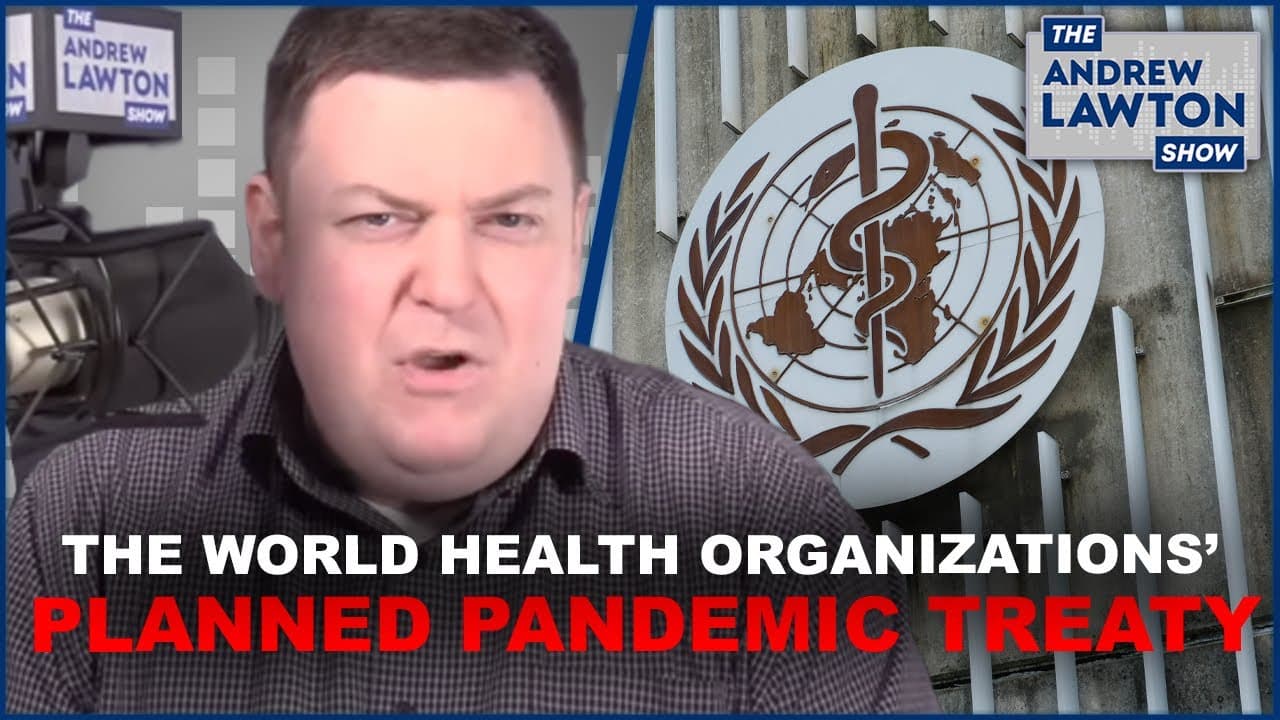
WHO's planned pandemic treaty threatens sovereignty and free speech
TL;DR
The potential pandemic treaty raises significant concerns about governmental autonomy and censorship.
Transcript
e welcome to Canada's most irreverent talk show this is the Andrew logen show brought to you by True North hello and welcome to you all Canada's most Reverend talk show here on True North the Andrew loton show on this Thursday January 11th this is our last program for a week in the lovely Dominion of Canada next week as you may have heard we are ta... Read More
Key Insights
- 🌍 The WHO's proposed pandemic treaty could diminish national sovereignty by compelling countries to adhere strictly to international health recommendations.
- 😀 The high demand and cost of accommodations during international events like the World Economic Forum illustrate economic disparities and challenges faced by attendees.
- 🧑⚕️ Reliance on WHO guidance may encourage governments to sidestep accountability for health policies, shifting responsibility to an international body.
- 😑 Provisions around misinformation in the treaty could establish legal frameworks for censoring dissenting opinions, weakening free expression.
- 🍝 Trudeau's non-committal tone regarding inquiries into COVID responses suggests a political reluctance to confront past governmental decisions.
- 🧑⚕️ The pandemic has enabled a precedent for governments to justify extensive control under health emergencies, risking future liberties.
- 🥺 Normalizing emergency powers could lead to systemic changes in governance, impacting citizen rights and freedoms.
Install to Summarize YouTube Videos and Get Transcripts
Explore YouTube Video Summarizer or Get YouTube Transcript Extractor
Questions & Answers
Q: What is the main purpose of the World Health Organization's proposed pandemic treaty?
The proposed pandemic treaty aims to establish a global framework for countries to follow during public health emergencies. This includes delegating authority to the WHO to declare emergencies and recommend specific health measures, which countries would then be expected to adopt, raising fears of diminished national sovereignty.
Q: How does the host describe the accommodation challenges faced for the World Economic Forum?
The host humorously recounts the difficulties in booking accommodations in Davos during the World Economic Forum, illustrating how exorbitant prices effectively pushed them to choose lodging in Austria instead of Switzerland due to exorbitant Airbnb rates and a scarcity of affordable options.
Q: What concerns do experts have regarding governmental compliance with the WHO's recommendations?
Experts are worried that countries might use the WHO's non-binding recommendations as excuses to impose strict health measures. This could lead to governments shifting responsibility for difficult public health decisions away from themselves, relying instead on WHO guidance to justify their actions.
Q: Why is the concept of disinformation significant regarding the WHO treaty?
The treaty's proposal to commit countries to censor disinformation raises alarm because it could undermine free speech and allow governments to suppress dissenting views under the guise of protecting public health. This trend may lead to increased restrictions on expression and open discourse about health policies.
Q: How did the host critique the response from Canadian Prime Minister Justin Trudeau regarding public health inquiries?
The host criticized Trudeau's vague and non-committal responses to questions about initiating a public health inquiry into the government's COVID-19 response. The host implies that Trudeau's reluctance may stem from not wanting to admit there was a lack of scientific justification for pandemic measures.
Q: What historical context does the host provide regarding governmental accountability during health crises?
The discussion highlights that in the recent pandemic, governments have often hidden behind public health bureaucrats to avoid accountability for controversial decisions. This pattern raises concerns about whether similar structures will be reinforced in the future, potentially limiting transparency and citizen engagement in health policy.
Q: How does the WHO's proposed treaty relate to the concept of the "biomedical state"?
The treaty is seen as a step towards normalizing the powers exercised during the COVID-19 pandemic, potentially leading to a "biomedical state" where public health emergencies become the norm, allowing authorities greater control over citizens’ lives and decisions, diminishing individual freedoms.
Q: How do experts view the normalization of emergency powers?
Experts argue that if the proposed treaty is adopted, it would lead to an acceptance of expanded governmental powers under the umbrella of public health, which might be invoked repeatedly, leading to a culture of emergency governance and reduced respect for civil liberties.
Summary & Key Takeaways
-
The Andrew Lawton Show discusses the upcoming World Health Organization (WHO) pandemic treaty, emphasizing its implications for national sovereignty and public health policies.
-
The host shares his personal experience with accommodation challenges for the World Economic Forum, illustrating the high costs and demand related to such global events.
-
Experts express concerns that countries may use WHO recommendations as an excuse for enacting controversial health measures without accountability, diminishing individual rights and freedoms.
Read in Other Languages (beta)
Share This Summary 📚
Summarize YouTube Videos and Get Video Transcripts with 1-Click
Try YouTube Summary with ChatGPT & Claude or YouTube Transcript Generator
Explore More Summaries from True North 📚
Summarize YouTube Videos and Get Video Transcripts with 1-Click
Try YouTube Summary with ChatGPT & Claude or YouTube Transcript Generator