DeepMind Made a Math Test For Neural Networks
TL;DR
DeepMind's study explores AI's mathematical reasoning abilities by benchmarking their performance on a dataset of difficult math questions.
Transcript
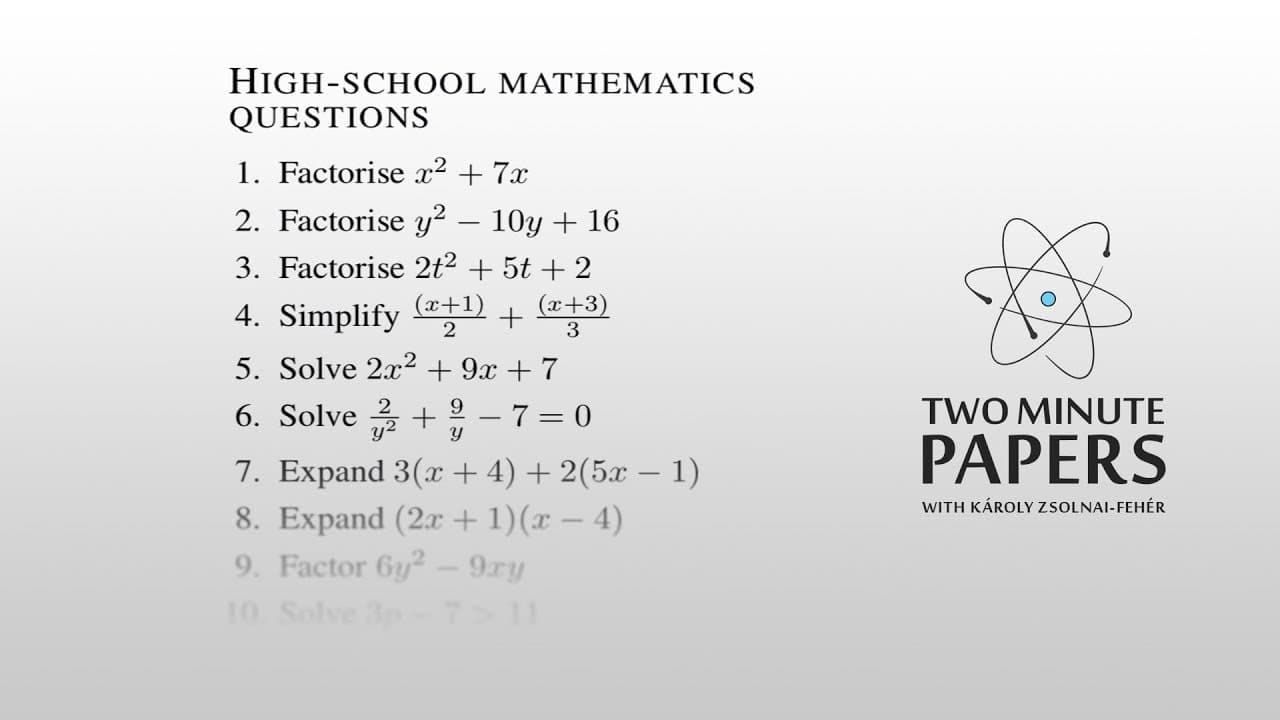
Dear Fellow Scholars, this is Two Minute Papers with Károly Zsolnai-Fehér. This paper from DeepMind is about taking a bunch of learning algorithms and torturing them with millions of classic math questions to find out if they can solve them. Sounds great, right? I wonder what kind of math questions would an AI find easy to solve? What percentage of... Read More
Key Insights
- ❓ Recurrent neural networks are commonly used to solve math problems involving sequences of data.
- ⁉️ The dataset created by DeepMind offers control over question difficulty by using modular question design.
- 👋 The Transformer network model produced the best results, answering 50% and 76% of questions in extrapolation and interpolation, respectively.
- 🎭 Generalizing knowledge is essential for AI models to perform well in extrapolation tasks.
- 😀 The AI faced similar difficulties as humans, highlighting the challenges in certain math areas like primality and factorization.
- 🥶 DeepMind released 2 million questions from the dataset for free to support future research in mathematical reasoning in AI.
- 👨🔬 DeepMind's research contributes valuable insights into benchmarking AI's abilities to solve complex math problems.
Install to Summarize YouTube Videos and Get Transcripts
Explore YouTube Video Summarizer or Get YouTube Transcript Extractor
Questions & Answers
Q: What is the main goal of DeepMind's research on mathematical reasoning in AI?
DeepMind aims to create a benchmark dataset that tests an AI's mathematical reasoning abilities, particularly in understanding concepts, evaluating expressions, and solving complex math problems.
Q: How did DeepMind design the dataset to make it difficult for the AI to solve?
DeepMind designed the dataset to require generalized knowledge rather than relying on memorization. Changing a single number in a question should make it challenging for an AI without a deep understanding of the underlying tasks.
Q: What advantage does modular question design offer in testing math reasoning abilities?
Modular question design allows for the generation of a large number of questions by combining different subtasks. This flexibility enables easy control of difficulty levels, as more modules typically lead to more challenging questions.
Q: Which math tasks were difficult for the AI in the study?
The AI faced difficulties in accurately rounding decimals and integers, performing comparisons, and solving tasks related to primality and factorization. Basic algebra, however, was relatively easy for the AI.
Summary & Key Takeaways
-
DeepMind conducted a study to evaluate AI's mathematical reasoning abilities using a dataset of challenging math questions.
-
The dataset is designed to test an AI's understanding of functions, variables, arithmetic operators, and the ability to evaluate expressions.
-
The research found that a neural network model called the Transformer network performed the best, answering 50% of questions in extrapolation and 76% in interpolation.
Read in Other Languages (beta)
Share This Summary 📚
Summarize YouTube Videos and Get Video Transcripts with 1-Click
Try YouTube Summary with ChatGPT & Claude or YouTube Transcript Generator
Explore More Summaries from Two Minute Papers 📚






Summarize YouTube Videos and Get Video Transcripts with 1-Click
Try YouTube Summary with ChatGPT & Claude or YouTube Transcript Generator