How Does the Mass Framework in UE5 Enable Agent Simulation?
TL;DR
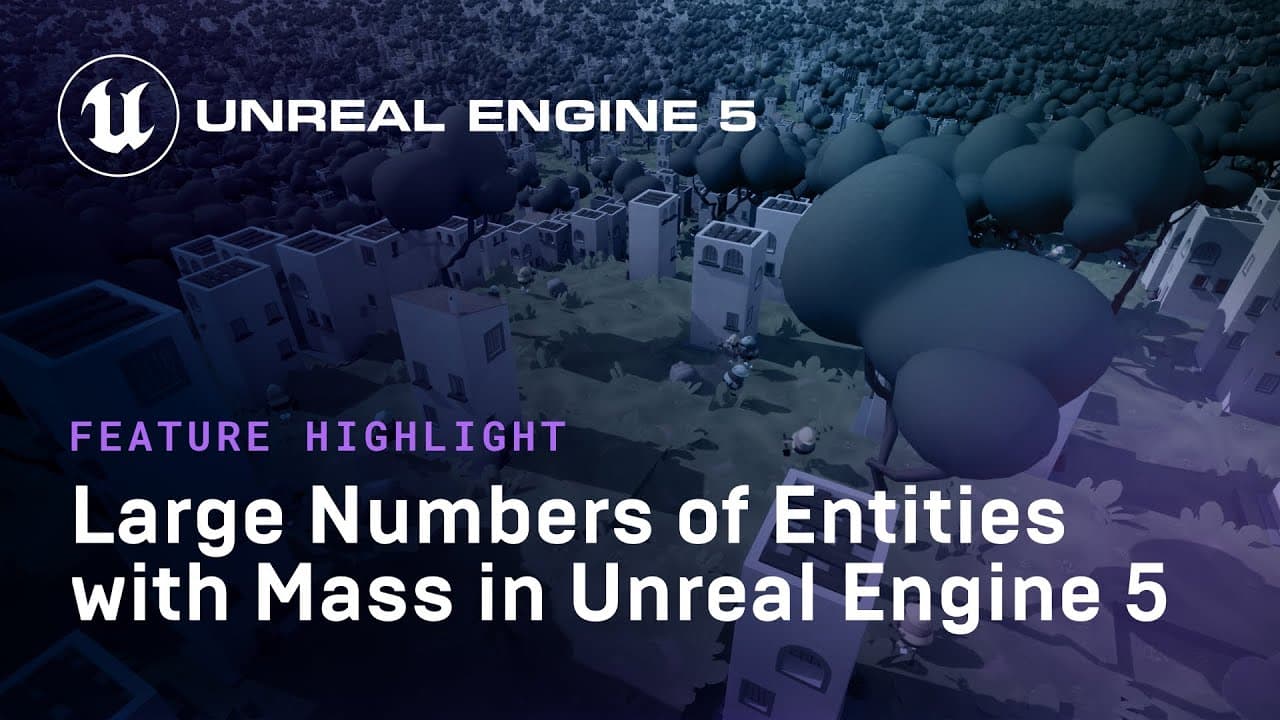
The Mass Framework in Unreal Engine 5 allows for the scalable simulation of large numbers of agents by using data-oriented design to process tightly packed data efficiently. This framework, initially developed for The Matrix Awakens demo, enables real-time AI simulation and other gameplay functionalities, primarily through C++ and with some upcoming Editor features for easier usability.
Transcript
MARIO PALERMO: Hello, and welcome to Unreal Engine 5. We're going to be talking about a new system implemented in the engine that provides the foundations for having huge numbers of agents simulated in real time. It is a framework that was initially designed for The Matrix Awakens demo and used for AI simulation in that context. But in fact, it can... Read More
Key Insights
- The Mass Framework in Unreal Engine 5 allows for the simulation of large numbers of agents in real-time, initially designed for The Matrix Awakens demo.
- Mass leverages data-oriented design to efficiently process tightly packed data, enhancing scalability and performance.
- The framework is currently C++-centric but includes some Editor features, with plans for further integration in future Unreal Engine 5 versions.
- Entities in Mass are defined by traits, with fragments storing data and processors handling functionality, optimizing cache usage.
- The Mass system includes built-in processors for movement and navigation, allowing developers to focus on custom logic and behaviors.
- Advanced features like LOD and variable tick rates help manage performance, enabling simulations with up to 100,000 entities.
- Integration with Unreal Engine's existing systems, such as state trees and subsystems, allows for complex interactions and behaviors.
- Visualization in Mass can utilize static mesh instances or actors, supporting high and low detail representations for scalability.
Install to Summarize YouTube Videos and Get Transcripts
Explore YouTube Video Summarizer or Get YouTube Transcript Extractor
Questions & Answers
Q: What is the primary advantage of the Mass Framework in Unreal Engine 5?
The primary advantage of the Mass Framework in Unreal Engine 5 is its ability to simulate large numbers of agents in real-time, leveraging data-oriented design to efficiently process tightly packed data. This approach optimizes cache usage, enhancing scalability and performance, making it suitable for complex AI simulations and gameplay scenarios.
Q: How does the Mass Framework optimize performance?
The Mass Framework optimizes performance by using data-oriented design, which processes tightly packed data to minimize cache misses. Entities are defined by traits, with data stored in fragments and functionality handled by processors. This design ensures efficient memory access and manipulation, allowing for scalable simulations of large numbers of agents.
Q: What development approach does the Mass Framework primarily support?
The Mass Framework primarily supports a C++ development approach, as most of its functionality requires writing C++ code. However, some Editor features are available, and further integration with Unreal Engine 5's Editor is planned for future versions, making it more accessible for developers who prefer visual scripting.
Q: How does the Mass Framework handle entity movement and navigation?
The Mass Framework handles entity movement and navigation using built-in processors like AppliedMovement, SmoothOrientation, SteerToMoveTarget, and Avoidance. These processors update movement-related fragments, allowing developers to focus on custom logic while leveraging existing systems for efficient and realistic movement and navigation in simulations.
Q: What advanced features enhance the scalability of the Mass Framework?
Advanced features like Level of Detail (LOD) and variable tick rates enhance the scalability of the Mass Framework. These features allow for different levels of simulation detail and processing rates based on distance and importance, optimizing performance and enabling simulations with up to 100,000 entities while maintaining acceptable frame rates.
Q: How does the Mass Framework integrate with other Unreal Engine systems?
The Mass Framework integrates with other Unreal Engine systems through subsystems, state trees, and the MassAgent component. Subsystems manage shared data and logic, state trees provide a structured way to handle entity states, and the MassAgent component allows entities to interact with the gameplay framework, facilitating complex interactions and behaviors.
Q: What visualization options are available in the Mass Framework?
The Mass Framework offers visualization options using static mesh instances or actors. Static mesh instances are suitable for large-scale simulations where detail is less critical, while actors provide high-detail representations for closer camera views. This flexibility supports both high and low detail visualizations, enhancing scalability and performance in various scenarios.
Q: What potential does the Mass Framework hold for future Unreal Engine versions?
The Mass Framework holds significant potential for future Unreal Engine versions, with plans for further integration into the Editor and expansion of its features. As the system evolves, it is expected to offer even greater scalability and flexibility, enabling developers to create more complex and dynamic simulations with large numbers of agents, enhancing game and simulation experiences.
Summary & Key Takeaways
-
The Mass Framework in Unreal Engine 5 enables scalable simulation of large numbers of agents, using data-oriented design for efficient processing. Initially created for The Matrix Awakens, it allows for real-time AI simulation and other gameplay purposes, with a focus on C++ development.
-
Entities in Mass are defined by traits, with data stored in fragments and functionality handled by processors. This design optimizes cache usage, enhancing performance. Built-in processors for movement and navigation simplify development, allowing for custom logic implementation.
-
Advanced features like LOD and variable tick rates manage performance, supporting large-scale simulations. Integration with state trees and subsystems facilitates complex interactions. Visualization options include static mesh instances and actors, supporting both high and low detail representations.
Read in Other Languages (beta)
Share This Summary 📚
Summarize YouTube Videos and Get Video Transcripts with 1-Click
Try YouTube Summary with ChatGPT & Claude or YouTube Transcript Generator
Explore More Summaries from Unreal Engine 📚




Summarize YouTube Videos and Get Video Transcripts with 1-Click
Try YouTube Summary with ChatGPT & Claude or YouTube Transcript Generator