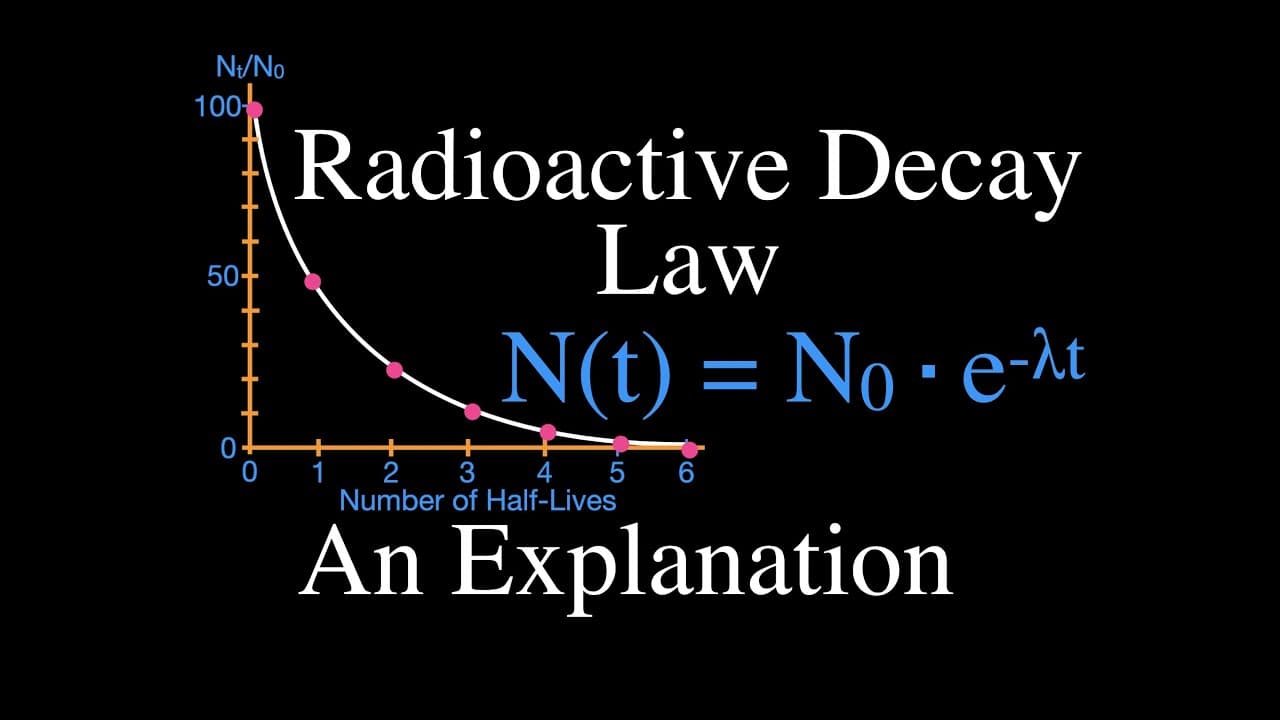
Radioactivity (11 of 16) Radioactive Decay Law, An Explanation
TL;DR
Radioactive decay law explains exponential decrease in parent nuclei over time.
Transcript
okay in today's video as you can see from the title we are going to be talking about radioactive decay law radioactive decay before you do that please don't forget in the bottom right hand corner click on that red button subscribe to my channel get all my excellent physics chemistry and math videos I have a little bit of a cold so hopefully I won't... Read More
Key Insights
- 👮 Radioactive decay law explains how parent nuclei decrease exponentially over time.
- 😒 The radioactive decay equation uses initial nuclei, decay constant, and time for calculations.
- 💆 Equations for activity and mass calculations stem from the same radioactive decay principle.
- 💆 Decay curves for number, activity, and mass exhibit similar exponential decrease patterns.
- ☠️ Half-life plays a crucial role in determining the rate of radioactive decay.
- ☢️ The radioactive decay equation can be applied to different scenarios involving radioactive materials.
- ☢️ Understanding decay constants is essential for accurate radioactive decay calculations.
Install to Summarize YouTube Videos and Get Transcripts
Explore YouTube Video Summarizer or Get YouTube Transcript Extractor
Questions & Answers
Q: What does the radioactive decay law explain?
The radioactive decay law explains how the number of parent nuclei in a radioactive sample decreases exponentially over time, following a half-life pattern.
Q: How is the radioactive decay equation used in calculations?
The radioactive decay equation involves initial and remaining radioactive nuclei, decay constant, and time to calculate various parameters like half-life, initial and final numbers of nuclei.
Q: How can the radioactive decay equation be applied to activity calculations?
The same equation used for radioactive nuclei can also be applied to calculate activity, which represents the number of radioactive decays per second.
Q: What do the graphs of decay curves for number, activity, and mass show?
The graphs for number, activity, and mass decay curves exhibit the same exponential decrease pattern, reflecting the relationship between the count of radioactive nuclei, activity, and mass.
Summary & Key Takeaways
-
Radioactive decay law states that the number of parent nuclei in a sample decreases exponentially over time, following a half-life pattern.
-
The equation used for radioactive decay involves initial and remaining radioactive nuclei, decay constant, and time.
-
Different equations based on the same principle can be used for activity and mass calculations.
Read in Other Languages (beta)
Share This Summary 📚
Summarize YouTube Videos and Get Video Transcripts with 1-Click
Try YouTube Summary with ChatGPT & Claude or YouTube Transcript Generator
Explore More Summaries from Step by Step Science 📚
Summarize YouTube Videos and Get Video Transcripts with 1-Click
Try YouTube Summary with ChatGPT & Claude or YouTube Transcript Generator