What Is IP Addressing and How Is It Organized?
TL;DR
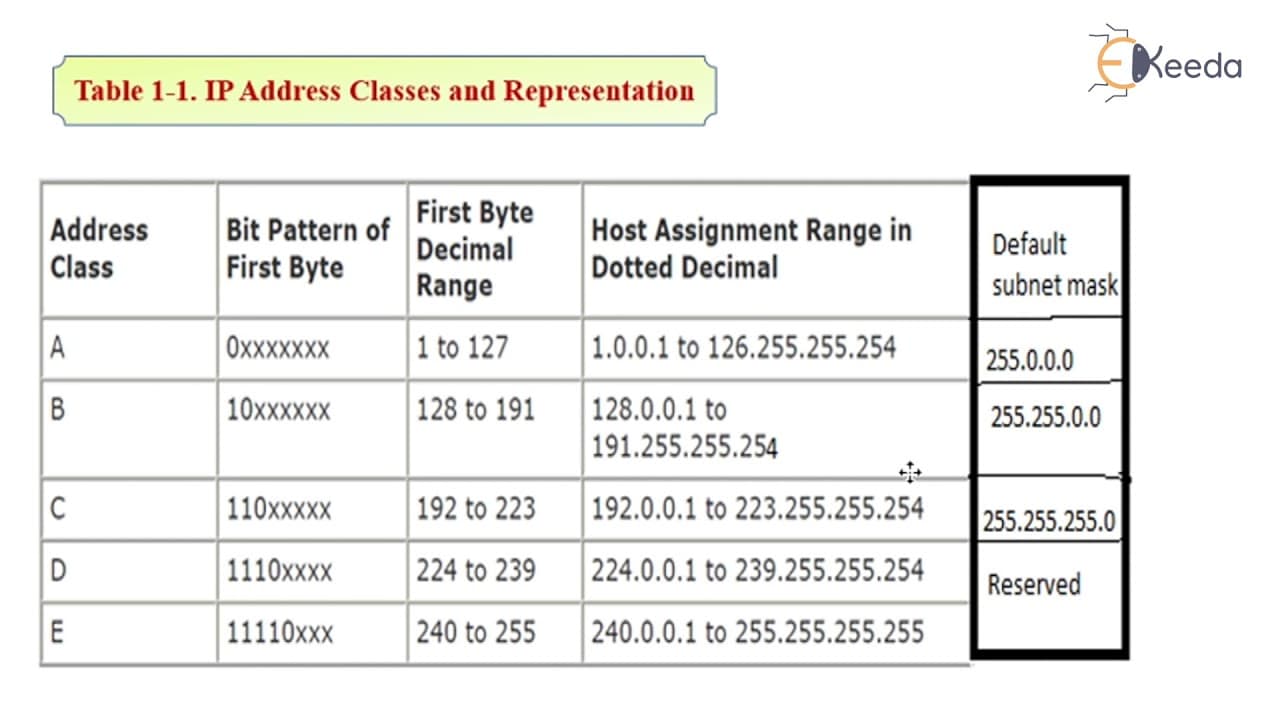
An IP address is a numerical label used to identify devices on a network, consisting of a network address and a host address. IP addresses are categorized into five classes (A, B, C, D, and E) based on their range and subnet masks, with Class A ranging from 1 to 127, Class B from 128 to 191, and Class C from 192 to 223.
Transcript
dear students we will be studying about the concept of IP address IP address is a numerical label assigned to each device connected on a computer network that uses Internet Protocol for communication the IP address can be split into network address it specifies a specific network and the post number it specifies a particular machine on that network... Read More
Key Insights
- 🏷️ IP addresses are numerical labels for devices on a network using Internet Protocol.
- 👻 They are split into network and host addresses.
- 🔙 There are five classes of IP addresses: A, B, C, D, and E.
- 🧡 Class A IP addresses have a range from 1 to 127 for the first byte.
- 🧡 Class B IP addresses have a range from 128 to 191 for the first byte.
- 🧡 Class C IP addresses have a range from 192 to 223 for the first byte.
- 🏛️ Class D IP addresses are used for multicast addressing.
Install to Summarize YouTube Videos and Get Transcripts
Explore YouTube Video Summarizer or Get YouTube Transcript Extractor
Questions & Answers
Q: What is an IP address?
An IP address is a numerical label assigned to devices on a computer network that uses Internet Protocol for communication. It consists of a network address and a host address.
Q: How are IP addresses divided into classes?
IP addresses are divided into five classes: A, B, C, D, and E. The class is determined by the range of the first byte of the IP address.
Q: What is the range for Class A IP addresses?
Class A IP addresses have a range from 1 to 127 for the first byte. The default subnet mask for Class A is 255.0.0.0.
Q: What is the range for Class B IP addresses?
Class B IP addresses range from 128 to 191 for the first byte. The default subnet mask for Class B is 255.255.0.0.
Summary & Key Takeaways
-
An IP address is a numerical label assigned to devices on a network using Internet Protocol.
-
IP addresses are split into network and host addresses, with different classes and ranges.
-
The five classes of IP addresses are A, B, C, D, and E, each with its own range and subnet mask.
Read in Other Languages (beta)
Share This Summary 📚
Summarize YouTube Videos and Get Video Transcripts with 1-Click
Try YouTube Summary with ChatGPT & Claude or YouTube Transcript Generator
Explore More Summaries from Ekeeda 📚






Summarize YouTube Videos and Get Video Transcripts with 1-Click
Try YouTube Summary with ChatGPT & Claude or YouTube Transcript Generator