r-selected and K-selected population growth strategies | High school biology | Khan Academy
TL;DR
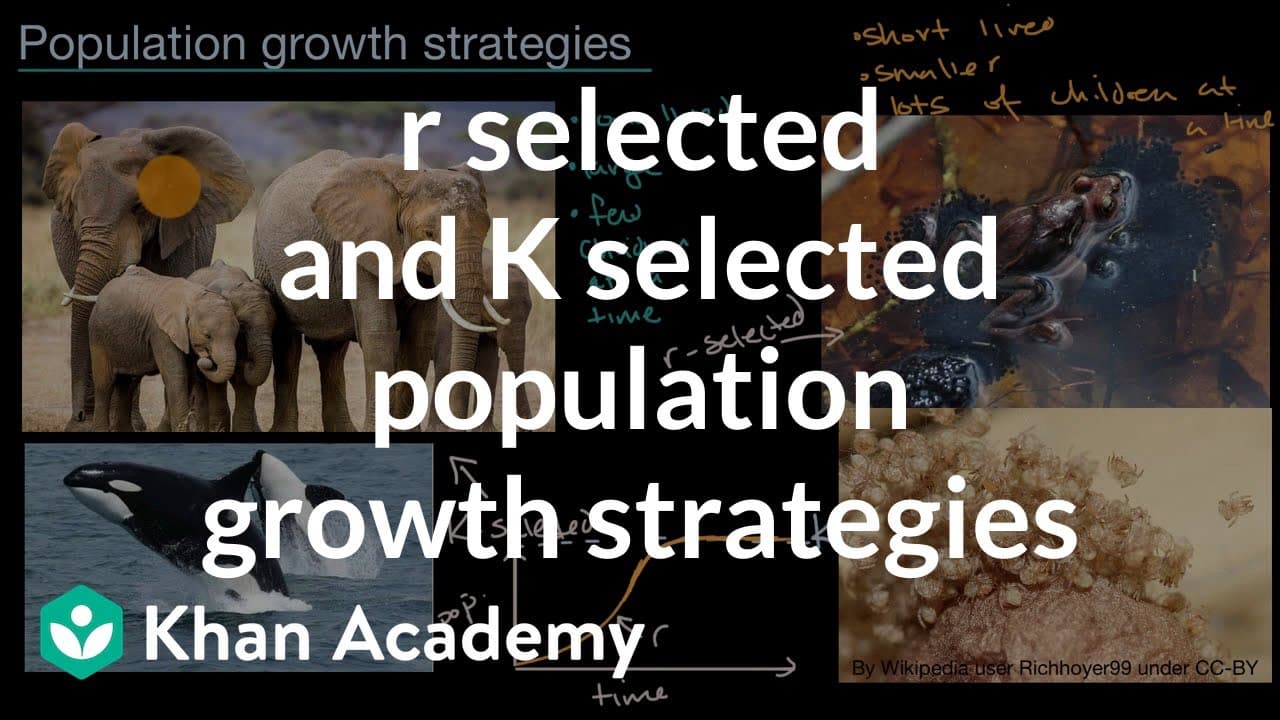
This video categorizes species into two groups, K-selected (large, long-lived animals with fewer offspring) and R-selected (short-lived, smaller animals with more offspring), based on their population growth strategies.
Transcript
- [Narrator] What we're going to do in this video is talk about different population growth strategies for different species. And think about if we can come up with a broad categorization or if there's a broad categorization already out there for us. So, we see that there are species like elephants that are long lived, in the wild. An African eleph... Read More
Key Insights
- 🚚 Large, long-lived animals with few offspring are categorized as K-selected species, while short-lived, smaller animals with many offspring are categorized as R-selected species.
- 🧑🏭 Population growth in K-selected species is limited by resource availability and environmental carrying capacity, while R-selected species are primarily influenced by environmental factors like temperature and moisture.
- ☠️ The population growth rate of a species is denoted by the letter R and is determined by its biotic potential, which encompasses factors like reproduction rate and successful maturation.
- 😉 Nature does not strictly adhere to categorizations, and certain species may exhibit characteristics of both K-selected and R-selected strategies.
- 😉 Invasive species tend to be more R-selected, growing autonomously without much competition, which can negatively impact K-selected species that rely on resource availability.
Install to Summarize YouTube Videos and Get Transcripts
Explore YouTube Video Summarizer or Get YouTube Transcript Extractor
Questions & Answers
Q: What are the characteristics of K-selected species in terms of population growth?
K-selected species, like elephants and gorillas, have longer lifespans, fewer children at a time, and invest more time and effort into nurturing and caring for their young. They are more limited by the availability of resources and the carrying capacity of their environment.
Q: How do R-selected species differ from K-selected species?
R-selected species, including frogs, insects, and bacteria, have shorter lifespans, many children at a time, and limited parental care or dependency. They are more influenced by environmental factors such as temperature, moisture, and predator-prey dynamics in their reproduction.
Q: What determines the population growth rate of a species?
The population growth rate, denoted by the letter R, is determined by a species' biotic potential or its ability to reproduce in a given environment. Factors like maturity rate, survival rate, and reproductive success impact the biotic potential and consequently the growth rate.
Q: Are K-selected or R-selected species more successful?
Success is not determined by whether a species is K-selected or R-selected. Both strategies have been effective in ensuring the survival and continuation of species. The coexistence of various species with different growth strategies demonstrates their individual success.
Summary & Key Takeaways
-
Large, long-lived animals like elephants, killer whales, and gorillas have few children at a time and take longer to give birth, focusing on nurturing and caring for their young.
-
Short-lived, smaller animals like frogs, insects, and bacteria have many offspring at a time and have shorter lifespans, with less emphasis on individual nurturing or dependency.
Read in Other Languages (beta)
Share This Summary 📚
Summarize YouTube Videos and Get Video Transcripts with 1-Click
Try YouTube Summary with ChatGPT & Claude or YouTube Transcript Generator
Explore More Summaries from Khan Academy 📚



Summarize YouTube Videos and Get Video Transcripts with 1-Click
Try YouTube Summary with ChatGPT & Claude or YouTube Transcript Generator