The de Broglie Equation and Why There Is No Wave-Particle Duality
TL;DR
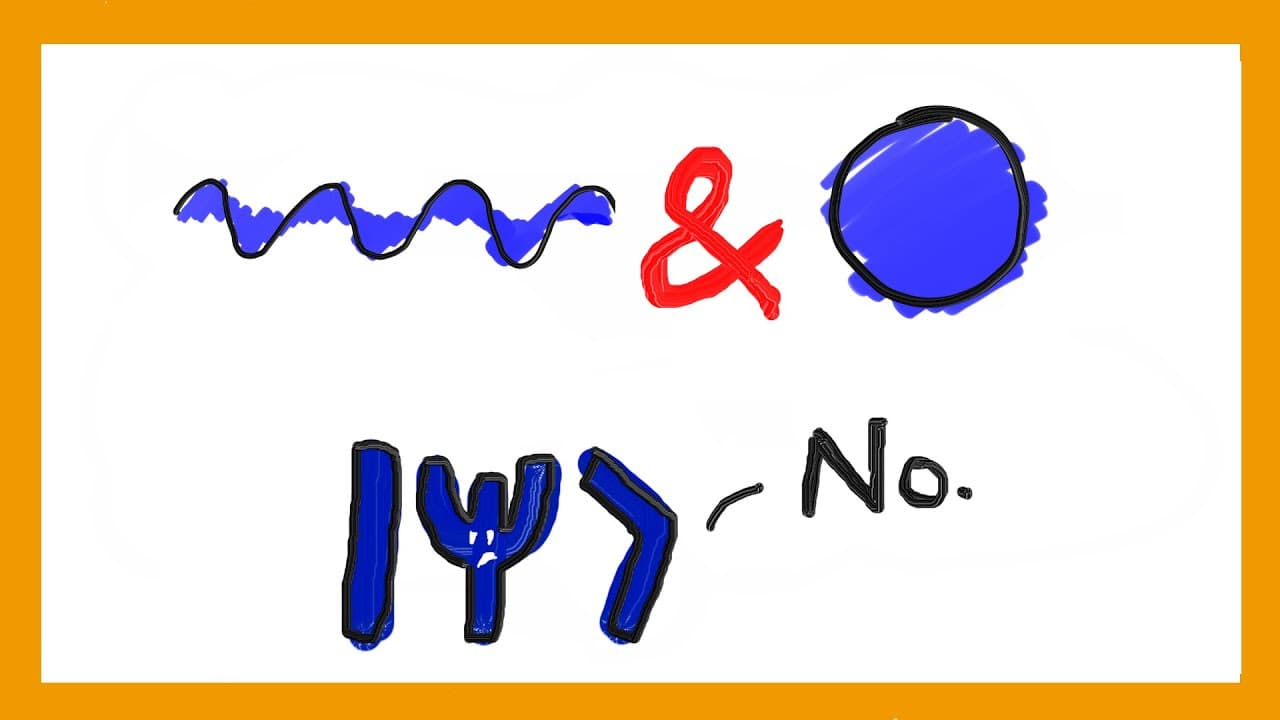
The De Broglie hypothesis states that matter is both a wave and a particle, and the wavefunction of a particle can be converted from the position basis to the momentum basis. This video discusses the precise interpretation of the hypothesis and provides an alternative explanation for wave-particle duality using quantum mechanics.
Transcript
This video is about the de Broglie hypothesis which supposedly says matter is a wave as well as a particle and this equation that tells us how to find the ‘wavelength’ of a particle. The issue is, there is a very precise way to interpret the hypothesis that leads to interesting questions about quantum mechanics, but instead it’s often stated in an ... Read More
Key Insights
- 👋 The De Broglie hypothesis states that matter exhibits both wave-like and particle-like properties.
- 🥺 Shifting a momentum eigenstate in position does not change momentum but may introduce a phase, leading to the derivation of the De Broglie hypothesis.
- 👋 Wave-particle duality can be explained using quantum mechanics by considering a particle's wavefunction as a superposition of multiple paths.
- 🇩🇰 The interpretation of the De Broglie hypothesis removes confusion and provides a more comprehensive understanding of particle behavior.
- 👻 Understanding the precise interpretation allows for a deeper exploration of quantum mechanics.
- 🦾 The double-slit experiment can be explained using quantum mechanics and the interference of wavefunctions.
- 👋 Nils Bohr's argument for wave-particle duality is additional research worth exploring.
Install to Summarize YouTube Videos and Get Transcripts
Explore YouTube Video Summarizer or Get YouTube Transcript Extractor
Questions & Answers
Q: What is the De Broglie hypothesis?
The De Broglie hypothesis states that matter exhibits both wave-like and particle-like properties, and the wavefunction of a particle describes its position, speed, and momentum.
Q: How can a momentum eigenstate have a wave-like behavior?
When a momentum eigenstate is shifted in position, it does not change momentum but may acquire a phase. This phase is dependent on the amount of shifting and momentum, highlighting the wave-like behavior of particles.
Q: How can wave-particle duality be explained using quantum mechanics?
In the double-slit experiment, particles' wavefunctions are in a superposition of going through both slits. When the waves from these paths interfere, the resulting pattern shows alternating regions of constructive and destructive interference, explaining the observed wave-like properties of particles.
Q: Why is it important to understand the precise interpretation of the De Broglie hypothesis?
Understanding the precise interpretation allows for a comprehensive understanding of quantum mechanics and removes the confusion surrounding wave-particle duality. It also provides a more nuanced perspective on particle behavior.
Summary & Key Takeaways
-
The De Broglie hypothesis states that the wavefunction of a particle contains all information about the particle's position, speed, and momentum.
-
Position wavefunctions describe the particle's position, while momentum eigenstates describe the particle's speed.
-
Shifting a momentum eigenstate in position does not change momentum but may introduce a phase, leading to the derivation of the De Broglie hypothesis.
-
Wave-particle duality can be explained using quantum mechanics, where a particle's wavefunction can be a superposition of going through multiple paths.
Read in Other Languages (beta)
Share This Summary 📚
Summarize YouTube Videos and Get Video Transcripts with 1-Click
Try YouTube Summary with ChatGPT & Claude or YouTube Transcript Generator
Explore More Summaries from Looking Glass Universe 📚




Summarize YouTube Videos and Get Video Transcripts with 1-Click
Try YouTube Summary with ChatGPT & Claude or YouTube Transcript Generator