Leetcode 1743. Restore the Array From Adjacent Pairs
TL;DR
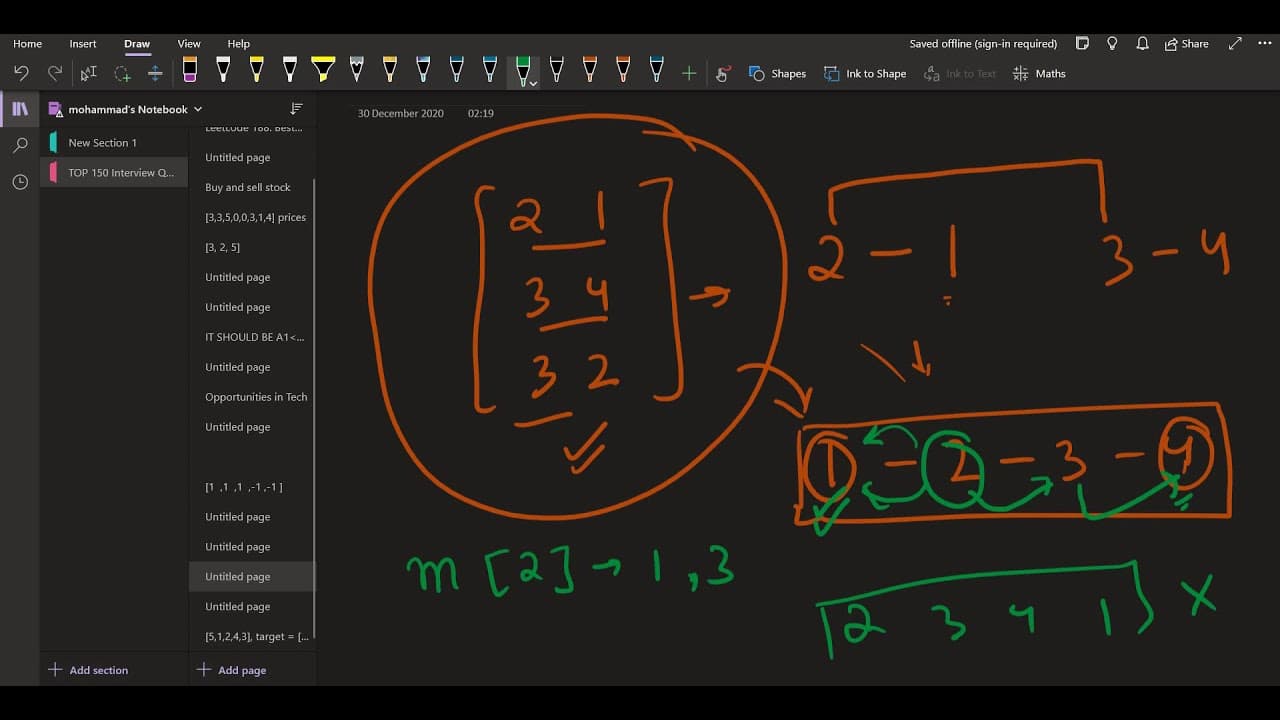
The content explains how to reconstruct an integer array using adjacent pairs provided as input.
Transcript
hey there everyone welcome back to lead coding so it is 8 am in the morning and i am solving the contest number 226 it is the second problem of the contest i'm gonna upload this soon after the contest ends so do hit the subscribe button to get more such content in future as well and press the bell icon because i am frequently uploading videos all r... Read More
Key Insights
- 📁 Adjacent pairs provide essential clues for reconstructing a unique integer array, leveraging their direct relationships.
- 🦻 Implementing a graph structure aids in visualizing and efficiently resolving the adjacency problem presented in coding contests.
- ❓ Utilizing terminal nodes to initiate traversal is a strategic choice to ensure correct and linear data reconstruction without revisits.
- 👨🔬 The depth-first search methodology is powerful for traversing connected elements, supporting efficient data capture in desired order.
- 👾 Time and space complexities are manageable due to the constraints of unique elements and their limited connections.
- 💭 The solution demonstrates clear coding practices and thought processes applicable in competitive programming contexts.
- 👾 Encouraging engagement through comments on time and space complexity showcases a community-oriented approach to problem-solving.
Install to Summarize YouTube Videos and Get Transcripts
Explore YouTube Video Summarizer or Get YouTube Transcript Extractor
Questions & Answers
Q: What is the main problem discussed in the video?
The video discusses a coding problem where the objective is to reconstruct an integer array from its given adjacent pairs. Each pair indicates two elements that were next to each other in the original array. The solution involves effectively utilizing data structures and traversal methods to achieve this.
Q: How do the adjacent pairs establish the original array's structure?
Each adjacent pair hints at a direct connection between two elements in the array. By treating these pairs as edges in a graph, we can visualize the relationship between numbers and subsequently identify the sequential order of the elements. The adjacency guarantees a chain-like structure facilitates reconstruction.
Q: Why must the reconstruction start from terminal elements in the graph?
Starting the reconstruction from terminal elements — those that only connect to one other element — ensures a linear traversal without loops. This guarantees that the depth-first search (DFS) yields the correct sequence rather than backtracking or revisiting elements, minimizing the risk of generating the wrong output.
Q: How is the graph constructed from adjacent pairs?
The graph is built using a map or unordered map, where each element acts as a key, and its corresponding value is a vector that contains all adjacent elements. By iterating over each pair and establishing connections, the complete structure of the underlying array relationships is formed.
Q: What is the role of depth-first search (DFS) in this problem?
DFS is employed to traverse the graph, beginning from a determined terminal node. It explores neighboring nodes recursively, marking each visited node to avoid repeats. This search method effectively reconstructs the array by capturing elements in sequence, following the established adjacency links.
Q: What complexities are associated with this algorithm?
The space complexity is O(n) due to the graph's storage requirements, as each node must retain its connections. The time complexity is also O(n) due to the depth-first search traversing each element only once. The overall efficiency is sustained by the limited edge connections reflecting unique elements.
Q: Can the solution be optimized further?
While the solution is already quite efficient, optimizations could involve using more space-efficient structures, such as sets or lists, and modifying the DFS approach to be iterative rather than recursive, which often helps manage stack depth and improves performance under certain conditions.
Q: What are some potential modifications to enhance the method?
Potential modifications include implementing bidirectional search for quicker verification of array integrity or employing additional data structures to streamline the adjacency relationships. Furthermore, improving error handling within the DFS could enhance robustness against unexpected input structures or errors during traversals.
Summary & Key Takeaways
-
The content outlines a coding contest problem where the goal is to reconstruct an integer array from given adjacent pairs of elements.
-
The speaker describes creating a graph structure to visualize adjacent relationships, making it easier to identify the original order of the elements.
-
A depth-first search (DFS) approach is utilized to traverse the graph. The search begins at terminal elements to ensure that the reconstruction follows a single directional flow.
Read in Other Languages (beta)
Share This Summary 📚
Summarize YouTube Videos and Get Video Transcripts with 1-Click
Try YouTube Summary with ChatGPT & Claude or YouTube Transcript Generator
Explore More Summaries from Fraz 📚


Summarize YouTube Videos and Get Video Transcripts with 1-Click
Try YouTube Summary with ChatGPT & Claude or YouTube Transcript Generator