What Are Support Vector Machines and How Do They Work?
TL;DR
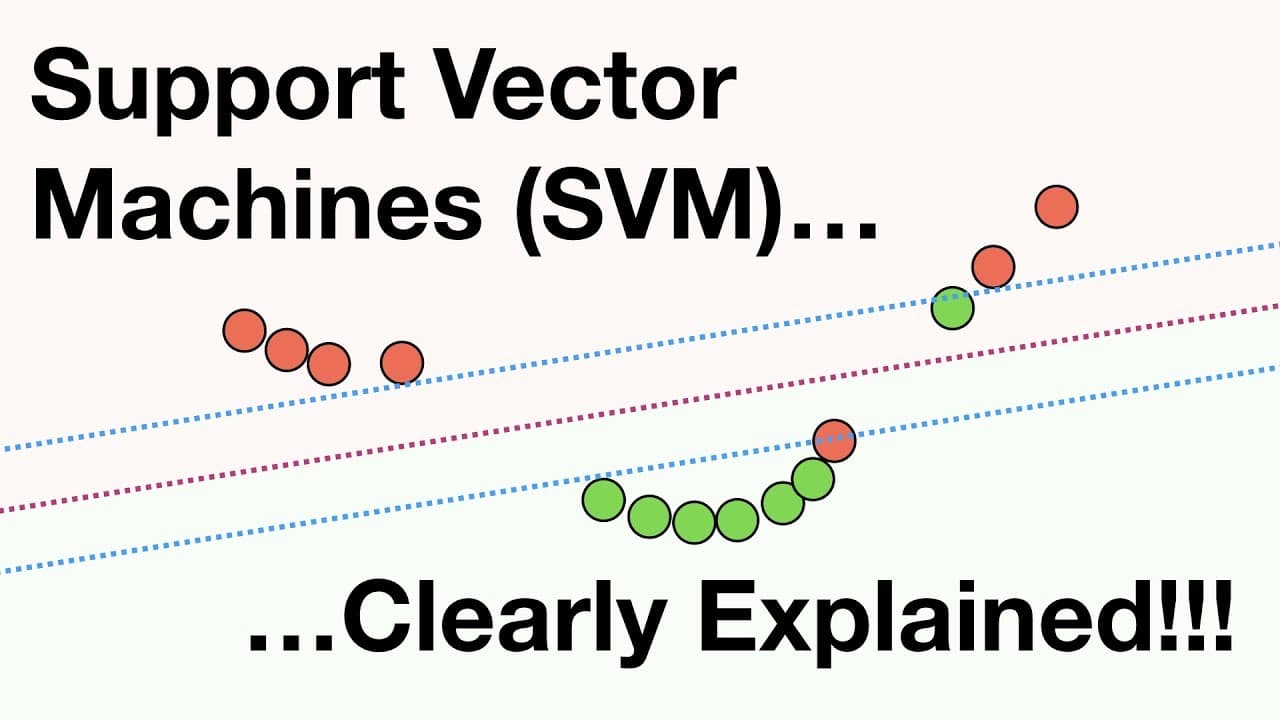
Support Vector Machines (SVM) classify data by maximizing the margin between different categories in high-dimensional space. They utilize soft margins to handle outliers and overlapping data, allowing for better classification. Kernels, such as polynomial and radial basis functions, facilitate movement into higher dimensions while maintaining computational efficiency through the kernel trick.
Transcript
support vector machines have a lot of terminology associated with them brace yourself hello I'm Josh stormer and welcome to stat quest today we're going to talk about support vector machines and they're gonna be clearly explained note this stack quest assumes that you are already familiar with the trade-off that plagues all of machine learning the ... Read More
Key Insights
- ❓ Support Vector Machines utilize margins to establish effective thresholds for classification.
- 👻 Soft margin classification in SVM allows for outliers and overlapping data handling.
- ❓ Kernels like polynomial and radial basis function increase dimensions for in-depth relationships.
- ❓ The kernel trick in SVM reduces computational complexity by avoiding actual transformation.
- ✋ SVM categorize data effectively by finding suitable support vector classifiers in higher dimensions.
- ✋ Support Vector Machines excel in non-linear classification scenarios by moving data to higher dimensions.
- 👾 Kernels play a vital role in SVM by calculating relationships in transformed higher-dimensional spaces.
Install to Summarize YouTube Videos and Get Transcripts
Explore YouTube Video Summarizer or Get YouTube Transcript Extractor
Questions & Answers
Q: How do support vector machines handle outliers in training data?
Support Vector Machines handle outliers by allowing misclassifications, creating thresholds less sensitive to outliers, maintaining a balance in the bias-variance tradeoff.
Q: What role do kernels play in support vector machines?
Kernels like polynomial and radial basis function in SVM help to transform data into higher dimensions, calculating relationships for accurate classification without actual transformation.
Q: Why is the kernel trick significant in support vector machines?
The kernel trick in SVM reduces computation, enabling efficient calculation of relationships in higher dimensions, crucial for complex data classification like the radial basis function in infinite dimensions.
Q: How do support vector machines classify data in higher dimensions?
SVM in higher dimensions find support vector classifiers effectively separate data utilizing margins determined by kernels, facilitating accurate classification of observations.
Summary & Key Takeaways
-
Support Vector Machines (SVM) use margins to establish thresholds for classification.
-
SVM handle outliers and overlapping data through soft margin classification.
-
Kernels like polynomial and radial basis function increase dimensions for efficient classification.
Read in Other Languages (beta)
Share This Summary 📚
Summarize YouTube Videos and Get Video Transcripts with 1-Click
Try YouTube Summary with ChatGPT & Claude or YouTube Transcript Generator
Explore More Summaries from StatQuest with Josh Starmer 📚



Summarize YouTube Videos and Get Video Transcripts with 1-Click
Try YouTube Summary with ChatGPT & Claude or YouTube Transcript Generator