What Is Quantile Normalization and How Does It Work?
TL;DR
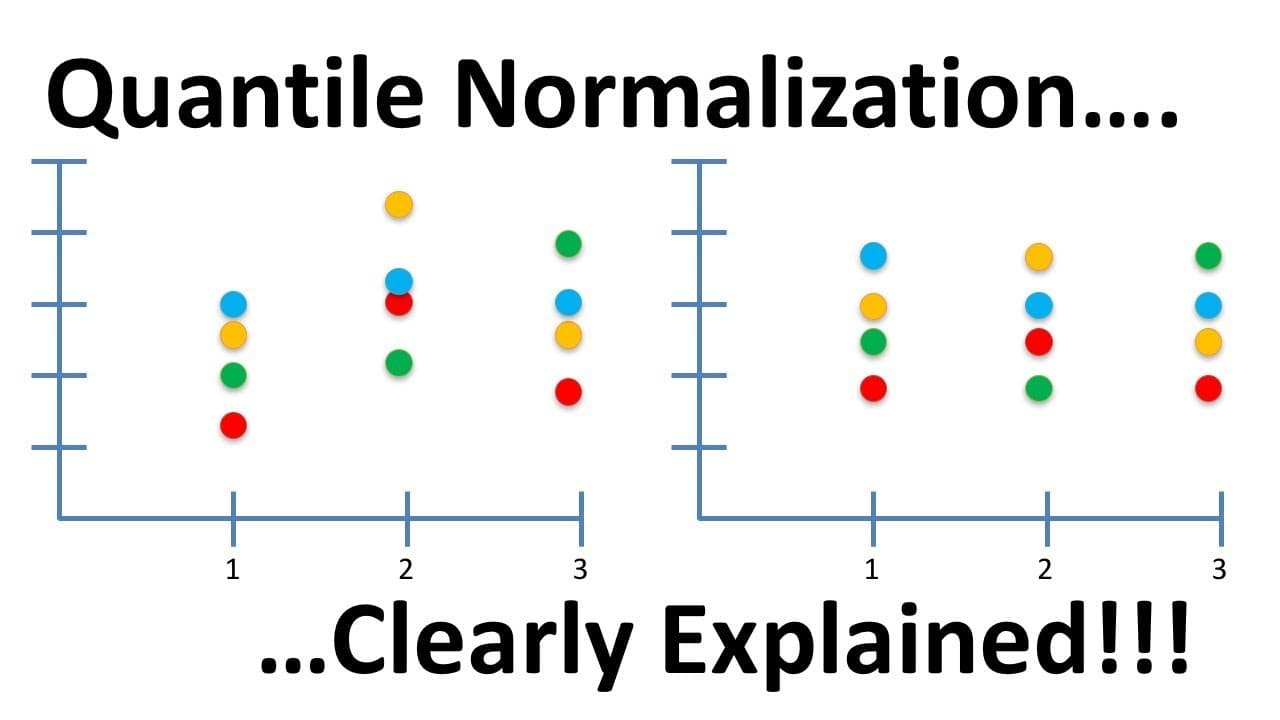
Quantile normalization is a technique used to adjust data values in microarray experiments, ensuring comparability across samples. By focusing on the mean values of highly expressed genes, it equalizes the data while preserving original gene orders, thus simplifying data analysis and allowing researchers to detect biological differences more effectively.
Transcript
burn burn burn burn burn burn stat quest hello I'm Josh stormer and welcome to stat quest stat quest is brought to you by the friendly folks in the genetics department at the University of North Carolina at Chapel Hill today we're going to be talking about quantile normalization and it's going to be clearly explained imagine we have some data from ... Read More
Key Insights
- 😑 Quantile normalization is essential in microarray experiments to standardize gene expression data across samples.
- 😑 The method focuses on highly expressed genes in each sample to calculate mean values for adjustment.
- 🏣 By preserving the original gene order, quantile normalization ensures that relative gene rankings are maintained post-adjustment.
- 👻 The technique simplifies data analysis by removing technical artifacts and allowing researchers to focus on biological differences.
- 😫 Quantile normalization can be applied to various data sets beyond microarray experiments with technical variability.
- 😑 Standardizing data values with quantile normalization facilitates accurate comparisons and reduces variability in gene expression analysis.
- ❓ The method offers a straightforward yet effective approach to normalize data and enhance the reliability of results.
Install to Summarize YouTube Videos and Get Transcripts
Explore YouTube Video Summarizer or Get YouTube Transcript Extractor
Questions & Answers
Q: What is quantile normalization and why is it necessary in microarray experiments?
Quantile normalization is a technique used to adjust data values in microarray experiments to account for technical variations between samples. It ensures that gene expression data is comparable across different experiments by equalizing the data distribution.
Q: How does quantile normalization maintain the order of genes while standardizing the data values?
Quantile normalization preserves the original order of genes by adjusting their expression values based on the distribution of values in each sample. This method ensures that the relative rankings of genes within each sample are maintained even after normalization.
Q: What are the benefits of using quantile normalization in data analysis?
Quantile normalization simplifies data analysis by standardizing values across samples, making it easier to compare gene expression levels. It removes technical artifacts from the data, allowing researchers to focus on biological differences rather than experimental variability.
Q: Can quantile normalization be applied to other types of data beyond microarray experiments?
Yes, while quantile normalization is commonly used in microarray data analysis, it can also be applied to other types of data sets with similar technical variations between samples. The principles of quantile normalization can be adapted to various data analysis scenarios.
Summary & Key Takeaways
-
Quantile normalization is a method to adjust data values in microarray experiments to account for technical differences between samples.
-
By focusing on highly expressed genes in each sample and calculating mean values, quantile normalization ensures that data is comparable and standardized.
-
The process preserves original gene orders while equalizing values across samples, simplifying data analysis.
Read in Other Languages (beta)
Share This Summary 📚
Summarize YouTube Videos and Get Video Transcripts with 1-Click
Try YouTube Summary with ChatGPT & Claude or YouTube Transcript Generator
Explore More Summaries from StatQuest with Josh Starmer 📚



Summarize YouTube Videos and Get Video Transcripts with 1-Click
Try YouTube Summary with ChatGPT & Claude or YouTube Transcript Generator