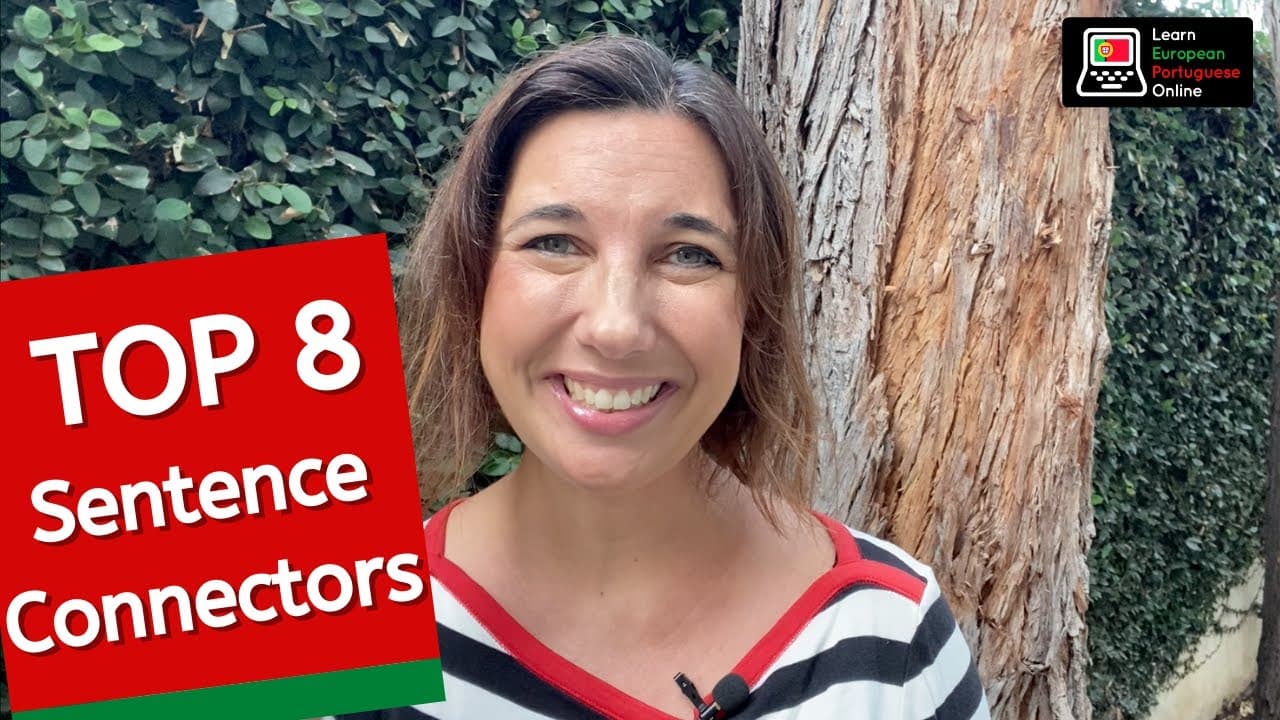
Most Important TRANSITIONAL WORDS in European Portuguese.
TL;DR
Learn key transitional words to enhance Portuguese fluency.
Transcript
Olá a todos! Cá estamos para mais um episódio! Today I'm going to talk about my top eight basic sentence connectors, also known as transitional words. These are special words that help you connect thoughts into more complex sentences. They will make you sound more natural and help you express yourself better in European Portuguese. Thank you so ... Read More
Key Insights
- Transitional words are essential for constructing complex sentences in European Portuguese, enhancing fluency and natural expression.
- The video celebrates reaching 2,000 subscribers and encourages viewers to subscribe and receive notifications for new content.
- Transitional words are categorized to express time, importance, cause-effect, comparison, contrast, examples, and additional information.
- Key transitional words include 'mas' for contrast, 'e' for adding information, and 'também' for agreeing in negative contexts.
- 'Porque' is the most common word for 'because,' though pronunciation can be tricky for learners.
- 'Ou' is used for presenting alternatives, and 'então' can mean 'then' or 'so,' depending on context.
- 'Depois' helps describe an order of events, while 'enquanto' is used for simultaneous actions.
- The video encourages practice by reading Portuguese news or watching interviews to see these words in use.
Install to Summarize YouTube Videos and Get Transcripts
Explore YouTube Video Summarizer or Get YouTube Transcript Extractor
Questions & Answers
Q: What is the main focus of the video?
The main focus of the video is to introduce and explain the use of eight key transitional words in European Portuguese. These words are essential for constructing more complex sentences and improving fluency in the language. The video provides examples and context for each word to aid learning.
Q: How does the video categorize transitional words?
The video categorizes transitional words into several groups based on their function. These categories include expressing time, importance, cause-effect, comparison, contrast, providing examples, and adding information. Each category helps learners understand how to use transitional words effectively in different contexts.
Q: What are some examples of the transitional words discussed?
Some examples of transitional words discussed in the video include 'mas' for contrast, 'e' for adding information, 'também' for agreeing in negative contexts, 'porque' for cause, 'ou' for alternatives, 'então' for time or cause-effect, 'depois' for sequence, and 'enquanto' for simultaneous actions.
Q: Why is 'porque' considered tricky for learners?
The word 'porque' is considered tricky for learners primarily due to its pronunciation. While it is the most common word used to express 'because,' learners often struggle with pronouncing it correctly. The video emphasizes the importance of practice to master the pronunciation and use of this word in sentences.
Q: How does the video suggest practicing these transitional words?
The video suggests practicing these transitional words by engaging with Portuguese media, such as reading news articles or watching interviews on Portuguese TV. This exposure helps learners see the words in context and understand their practical applications, enhancing their ability to use them naturally in conversation.
Q: What additional resources does the video promote?
The video promotes several additional resources, including a new online store on Amazon where viewers can purchase related products. It also encourages viewers to become patrons on Patreon for access to exclusive videos and audios. Furthermore, it highlights the importance of following their social media channels for creative posts and updates.
Q: How does the video engage with its audience?
The video engages with its audience by thanking them for reaching 2,000 subscribers and encouraging them to subscribe and hit the notification bell for updates. It also invites viewers to leave comments and likes, fostering a sense of community and interaction. The instructor expresses appreciation for viewer support and encourages feedback.
Q: What is the significance of the word 'também' in negative contexts?
In negative contexts, 'também' is used to express agreement with a negative statement, similar to 'me neither' or 'neither do I' in English. This usage is important for learners to understand as it differs from the typical use of 'também' for adding information, highlighting the nuances in Portuguese language expressions.
Summary & Key Takeaways
-
This video introduces eight essential transitional words in European Portuguese, crucial for forming complex sentences and improving language fluency. The instructor also thanks viewers for reaching 2,000 subscribers and encourages further engagement.
-
Transitional words are divided into categories such as expressing time, cause-effect, and comparison. Key words include 'mas,' 'e,' 'também,' 'porque,' 'ou,' 'então,' 'depois,' and 'enquanto.' Each serves a unique function in sentence construction.
-
Viewers are encouraged to practice using these transitional words by consuming Portuguese media. The video also promotes additional resources, including a new Amazon store and Patreon page for exclusive content.
Read in Other Languages (beta)
Share This Summary 📚
Summarize YouTube Videos and Get Video Transcripts with 1-Click
Try YouTube Summary with ChatGPT & Claude or YouTube Transcript Generator
Explore More Summaries from Learn European Portuguese Online 📚


Summarize YouTube Videos and Get Video Transcripts with 1-Click
Try YouTube Summary with ChatGPT & Claude or YouTube Transcript Generator