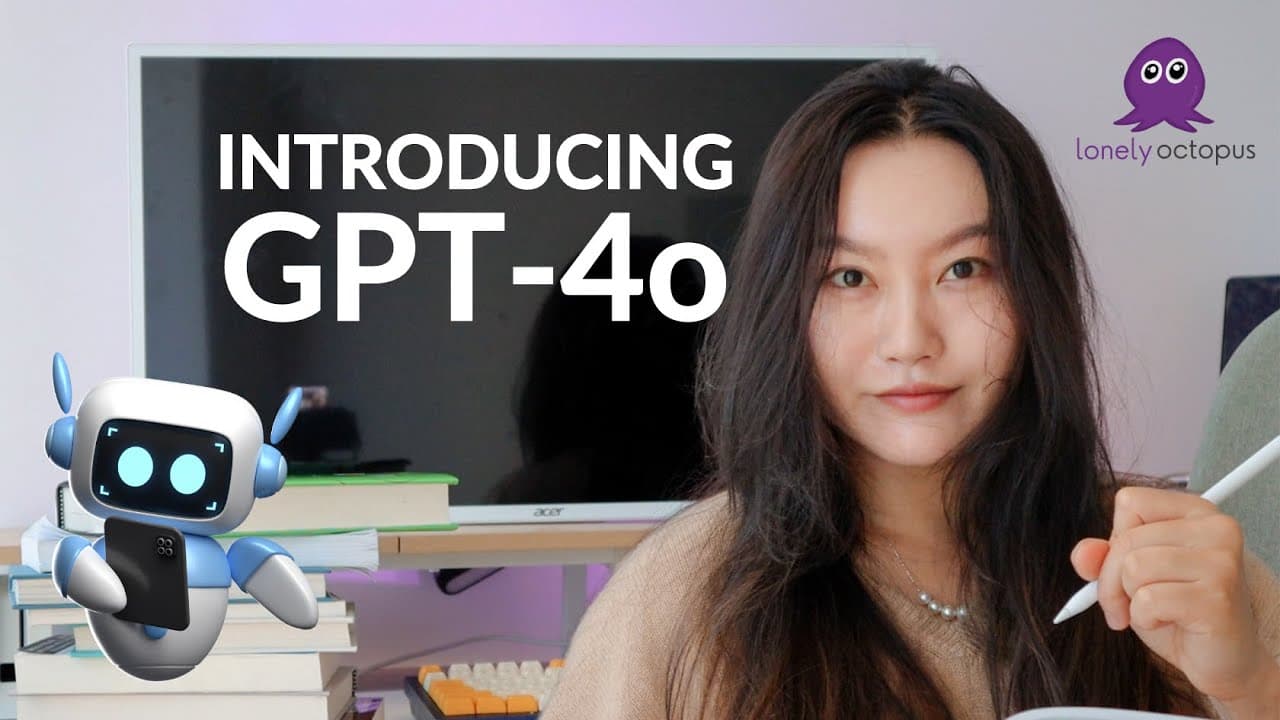
🐙 Lunch & Learn: ChatGPT-4o
TL;DR
OpenAI and Google announce major AI updates, showcasing new models and capabilities.
Transcript
e e okay friends I am sorry I don't know why I couldn't get that particular live stream to work but at least we got this one to work okay let's just jump straight into it there's way too much stuff going on let me wipe this in case you haven't heard it's not just um open a that had a bunch of updates also Google had a bunch of updates uh in their G... Read More
Key Insights
- OpenAI released GPT-40, emphasizing improved user interaction with enhanced audio and vision capabilities, available to free users.
- Google's Gemini model offers multimodal capabilities and a long context window, integrated into various Google services.
- The introduction of real-time conversational AI by OpenAI demonstrates potential applications in customer service and personal assistance.
- Google's Gemini 1.5 Pro and Flash models aim to improve efficiency and scalability, focusing on multimodal reasoning.
- Both companies are exploring AI agents, with Google showcasing Project Astra for everyday life assistance.
- Google's generative video model, Vi, creates high-quality videos from text, image, and video prompts, indicating a leap in video AI.
- OpenAI's advancements in AI-generated images show subtle improvements, while Google integrates AI into search and workspace tools.
- The AI landscape is rapidly evolving, with significant implications for accessibility, education, and personal interaction.
Install to Summarize YouTube Videos and Get Transcripts
Explore YouTube Video Summarizer or Get YouTube Transcript Extractor
Questions & Answers
Q: What is the significance of OpenAI's GPT-40 release?
OpenAI's GPT-40 release is significant because it brings advanced AI capabilities to free users, democratizing access to cutting-edge technology. The model features improved audio and vision capabilities, enabling real-time conversational interaction. This advancement positions OpenAI as a leader in customer service and personal assistance applications, potentially transforming how users interact with AI.
Q: How does Google's Gemini model differ from OpenAI's offerings?
Google's Gemini model differs from OpenAI's offerings by focusing on multimodal capabilities and integration across Google's ecosystem. Gemini models are designed for efficiency and scalability, featuring long context windows and multimodal reasoning. Unlike OpenAI, Google emphasizes integrating AI into existing products like search and workspace, offering a cohesive user experience across its services.
Q: What potential applications do OpenAI's real-time conversational AI have?
OpenAI's real-time conversational AI has potential applications in customer service, personal assistance, and accessibility. By providing natural, human-like interactions, the AI can handle customer inquiries, offer personalized assistance, and improve accessibility for individuals with disabilities. This technology could also enhance educational tools and create AI companions for users seeking emotional support.
Q: How is Google's generative video model, Vi, expected to impact content creation?
Google's generative video model, Vi, is expected to significantly impact content creation by allowing users to generate high-quality videos from text, image, and video prompts. This capability democratizes video production, enabling creators to produce content without extensive resources. Vi's ability to capture detailed instructions in various styles could revolutionize industries like marketing, entertainment, and education.
Q: What are the implications of AI advancements for accessibility and education?
AI advancements have profound implications for accessibility and education. Enhanced AI capabilities can improve accessibility tools, offering real-time translation and interaction for individuals with disabilities. In education, AI can provide personalized learning experiences, assist with problem-solving, and offer interactive content. These developments promise to make education more inclusive and adaptive to individual needs.
Q: How do OpenAI and Google approach AI safety and responsibility?
Both OpenAI and Google emphasize AI safety and responsibility, incorporating industry-standard practices like red teaming to test and improve model robustness. They focus on addressing risks while maximizing AI's benefits for society. However, details on specific safety measures are often sparse, highlighting the need for transparency and continued dialogue on ethical AI development.
Q: What challenges do companies face in the rapidly evolving AI landscape?
In the rapidly evolving AI landscape, companies face challenges like maintaining technological leadership, ensuring ethical AI use, and addressing societal impacts. Balancing innovation with responsibility is crucial, as is navigating competitive pressures from other tech giants. Companies must also consider the implications of AI on employment and the economy, ensuring that advancements benefit society as a whole.
Q: What opportunities exist for startups in the AI sector?
Opportunities for startups in the AI sector include developing niche applications that address specific needs, such as AI-driven accessibility tools or security solutions. Startups can also focus on integrating AI into existing industries, like healthcare or education, to enhance services and improve outcomes. Additionally, startups have the potential to innovate in AI ethics and governance, contributing to responsible AI development.
Summary & Key Takeaways
-
OpenAI's GPT-40 model is now available to free users, featuring enhanced audio and vision capabilities for improved interaction. The model aims to revolutionize customer service and personal assistance by offering real-time conversational AI. OpenAI's approach contrasts with Google's Gemini model, which integrates multimodal capabilities across its ecosystem.
-
Google's Gemini AI models, including the 1.5 Pro and Flash, focus on efficiency, scalability, and multimodal reasoning. The Gemini models are integrated into Google services like search and workspace, offering features like long context windows and real-time video generation. Google's Project Astra aims to create a universal AI agent for everyday use.
-
The AI landscape is witnessing rapid advancements from major players like OpenAI and Google. These developments have significant implications for sectors like customer service, education, and personal interaction. Both companies are exploring the potential of AI agents, with Google emphasizing integration across its product ecosystem.
Read in Other Languages (beta)
Share This Summary 📚
Summarize YouTube Videos and Get Video Transcripts with 1-Click
Try YouTube Summary with ChatGPT & Claude or YouTube Transcript Generator
Explore More Summaries from Tina Huang 📚





Summarize YouTube Videos and Get Video Transcripts with 1-Click
Try YouTube Summary with ChatGPT & Claude or YouTube Transcript Generator