How to Balance Chemical Equations Step by Step
TL;DR
To balance chemical equations, keep track of the number of atoms on both sides and use coefficients to adjust them without changing subscripts. Start by balancing elements that appear alone, and proceed systematically to address more complex compounds, often requiring multiple steps to achieve balance.
Transcript
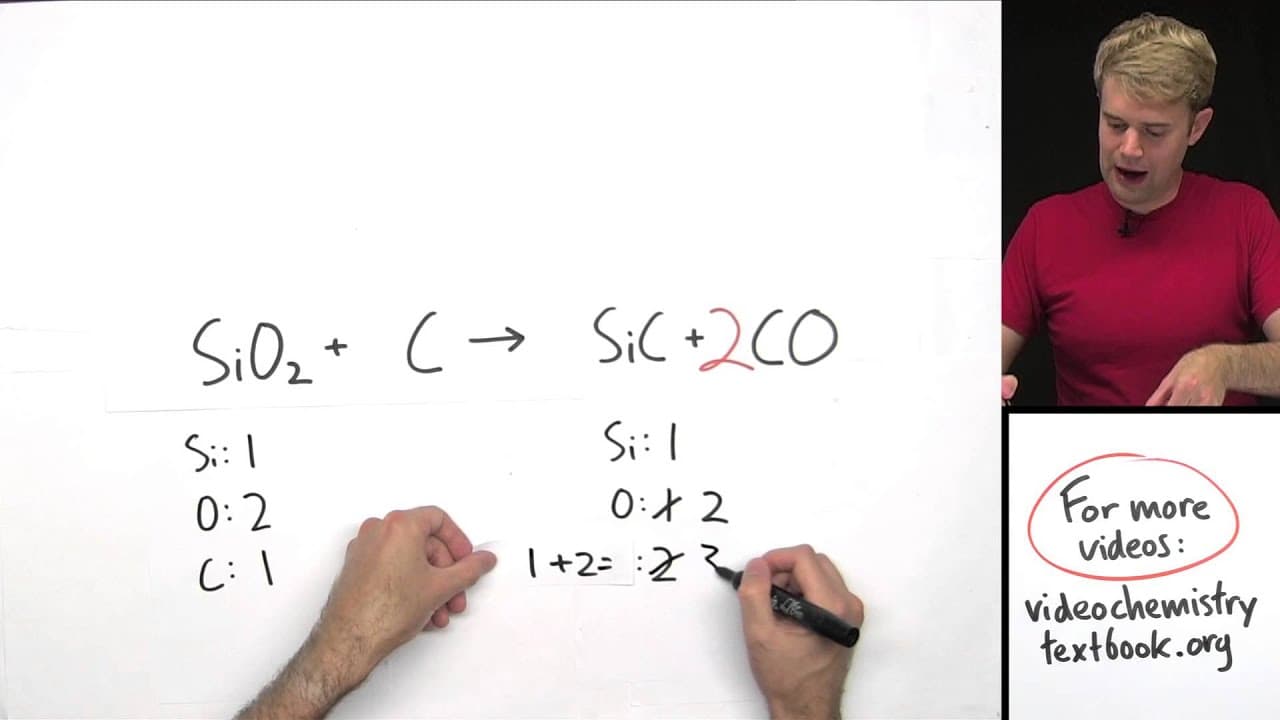
let's do some practice problems for balancing chemical equations we'll start off with some examples that are pretty basic and straightforward and then the problems will get more challenging as we move on here's our first equation we got xenon and fluorine we want to keep track of how many atoms of these elements we have on both sides of the equatio... Read More
Key Insights
- 🙃 Balancing chemical equations involves keeping track of the number of atoms of each element on both sides.
- #️⃣ Coefficients are used to adjust the numbers of elements or compounds in an equation.
- 💳 Subscripts cannot be changed in a chemical equation; only coefficients can be added.
- ❓ Balancing equations often requires multiple steps and careful consideration of the elements involved.
- ⚖️ It is important to balance elements or compounds that are on their own before those found in multiple compounds.
- ✖️ Parentheses in equations indicate that everything inside is multiplied by the coefficient outside.
- ❓ Complex equations may require adjusting multiple elements or compounds in different steps.
Install to Summarize YouTube Videos and Get Transcripts
Explore YouTube Video Summarizer or Get YouTube Transcript Extractor
Questions & Answers
Q: Why can't you change the subscripts in a chemical equation to balance it?
Changing the subscripts would alter the identity of the compound, which is not allowed in chemical equations. The purpose of balancing equations is to maintain the same elements and compounds, only adjusting the number of atoms.
Q: How do you know which elements or compounds to adjust first when balancing an equation?
It is best to start by balancing elements or compounds that are on their own without being part of another compound or element. Then, move on to balancing those that are found in multiple compounds.
Q: Can you give an example of a chemical equation that requires multiple steps to balance?
One example is the equation with aluminum, hydrogen, nitrogen, oxygen, and copper. This equation requires adjusting the hydrogen and oxygen first before balancing the copper and nitrogen.
Q: Is there a specific order in which you have to balance the elements or compounds in an equation?
There is no set order, but it is generally easier to balance elements or compounds that are only present on one side of the equation before moving on to those found in multiple places.
Summary & Key Takeaways
-
Balancing chemical equations involves keeping track of the number of atoms on both sides of the equation and using coefficients to adjust the numbers.
-
You cannot change the subscripts of elements or compounds, but you can add coefficients in front of them.
-
Balancing equations often requires multiple steps and careful consideration of elements and their respective atoms.
Read in Other Languages (beta)
Share This Summary 📚
Summarize YouTube Videos and Get Video Transcripts with 1-Click
Try YouTube Summary with ChatGPT & Claude or YouTube Transcript Generator
Explore More Summaries from Tyler DeWitt 📚


Summarize YouTube Videos and Get Video Transcripts with 1-Click
Try YouTube Summary with ChatGPT & Claude or YouTube Transcript Generator